









The 300-Member Tipping Point: When Manual Membership Management Stops Working
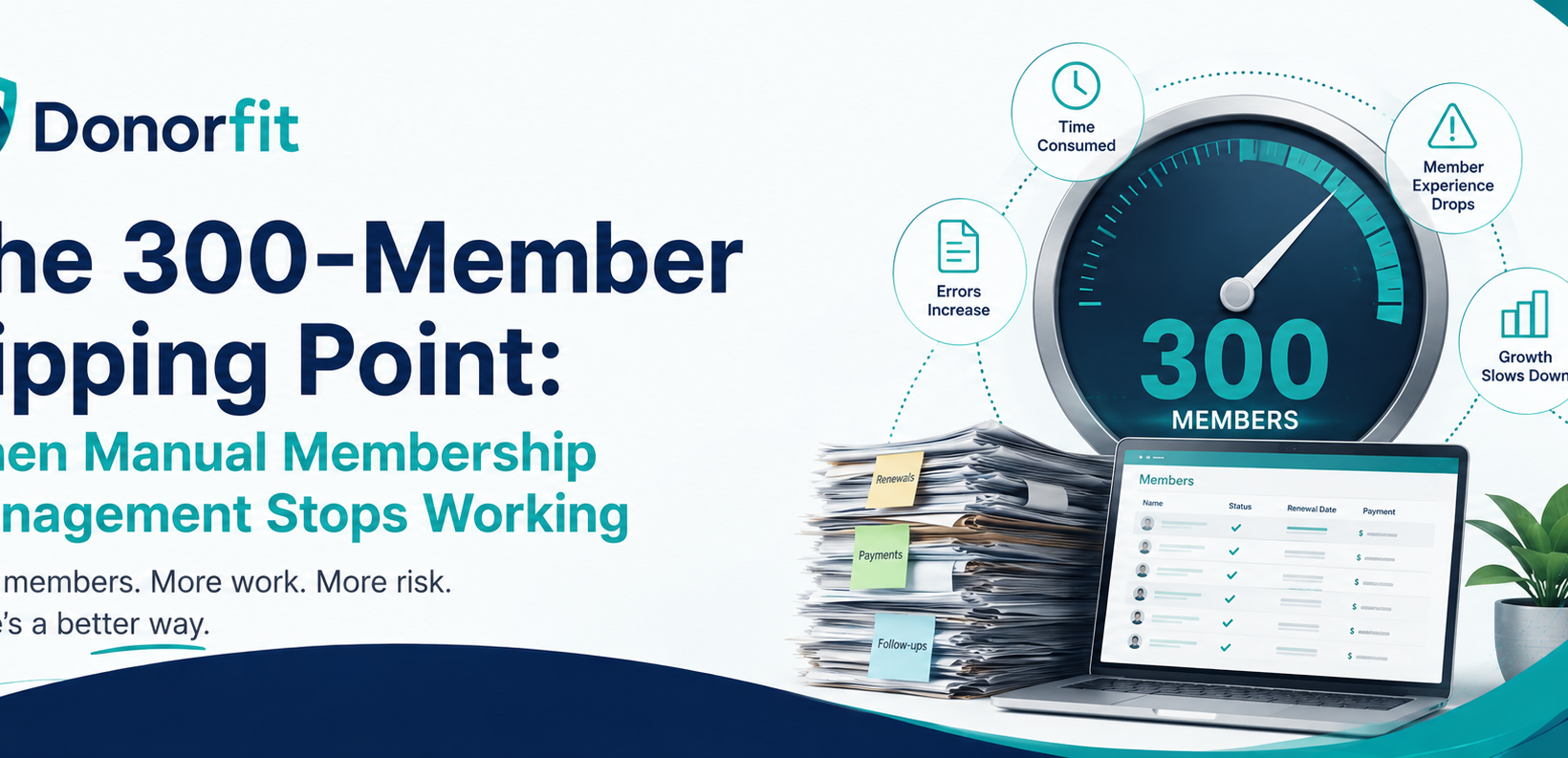
Manual membership management is running your dues, renewals, and member records by hand, usually in spreadsheets and a shared inbox rather than a purpose-built system. It works well when you’re small. The tipping point is the moment when the volume of members quietly outgrows the method, and the cracks start costing you renewals before anyone notices they’re there.
Manual tracking doesn’t fail loudly. It fails silently, and usually somewhere in the low hundreds of members, when the number of things that can quietly go wrong outruns the number a person can hold in their head. This piece is about what actually breaks, why you can’t see it happening, and how to tell you’ve crossed the line.
At 50 members, the spreadsheet is fine
Let’s be fair to the spreadsheet. For a small organisation, it’s a reasonable tool. Fifty members fit on one screen. You know most of them by name. When someone renews, you update a cell, and you’d notice if a row looked wrong because you know what right looks like. The whole state of the membership lives in one place and, more importantly, in one person’s memory.
Nothing about that is a problem worth solving. Plenty of associations run for years this way and should. Advice to “get software” at that size is usually a vendor talking, not a real need. The trouble starts later, and it starts so gradually that most teams pass the point without a signal.
What breaks, and why you don’t see it
The failure of manual management isn’t dramatic. There’s no crash. What happens is that small errors accumulate faster than you catch them, and each uncaught error is a member who doesn’t get reached.
The research on this is sobering. Decades of spreadsheet-error research led by Raymond Panko at the University of Hawaii found that a careful individual review catches only about half the errors in a spreadsheet, and that even simple, carefully built ones frequently contain errors in the first place. About half of the mistakes survive the check. In a member database, an uncaught error isn’t a wrong total in a cell. It’s a renewal notice that goes to an old address, a status column that still says “active” for someone who lapsed, a duplicate record so the same member gets two emails and no one gets the call they needed.
Then there’s what happens when the data lives in more than one place, which it always eventually does. Membership in the spreadsheet, payments in the accounting tool, event signups somewhere else, email in a separate platform. The industry body ASAE has pointed out that association data commonly sits scattered across CRMs, marketing tools, event systems and more, leaving organisations with fragmented, incomplete pictures of their own members. When those sources disagree, a person becomes the reconciliation layer. Finance says a member paid; the membership sheet still shows them unpaid; someone has to stop and work out which record is right before a single renewal reminder can go out. Every one of those stalls is time, and every unresolved one is a member falling through.
The reason this is dangerous rather than merely annoying is that it’s invisible. A renewal that never fired doesn’t announce itself. The member simply doesn’t come back, and it reads as ordinary churn. You don’t get an error message when your process quietly stops working. You get a slightly lower renewal rate and no idea why.
So, is it 300 members?
Honestly, no one can hand you a number. There is no benchmark that says manual management fails at exactly 300 members, and anyone who quotes you a precise figure is guessing. We use “around 300” because that’s roughly where we’ve watched it happen, not because it’s a law.
The real trigger isn’t headcount at all. It’s complexity. Two hundred members with a single flat membership type and annual dues can stay manual longer than eighty members with tiered pricing, corporate sub-accounts, mid-year joiners, and event registrations tied to status. What pushes you over is the number of moving parts, and member count is just the roughest proxy for it.
So rather than watch the headcount, watch for these signs. Any two or three of them together usually means you’ve already crossed the line:
- You’ve sent a renewal reminder and then found the person had already paid, or had lapsed months ago.
- More than one “version” of the member list exists, and staff argue about which is current.
- Onboarding or renewal touches depend on someone remembering to send them.
- You can’t answer “how many members are at risk right now?” without an afternoon of work.
- The same member exists twice, spelt two ways.
- A benefit or renewal notice didn’t go out, and nobody knew until the member complained.
If those feel familiar, the question isn’t whether you’ve hit the tipping point. It’s how many renewals it’s quietly cost you already.
Manual at 50 vs manual at 300
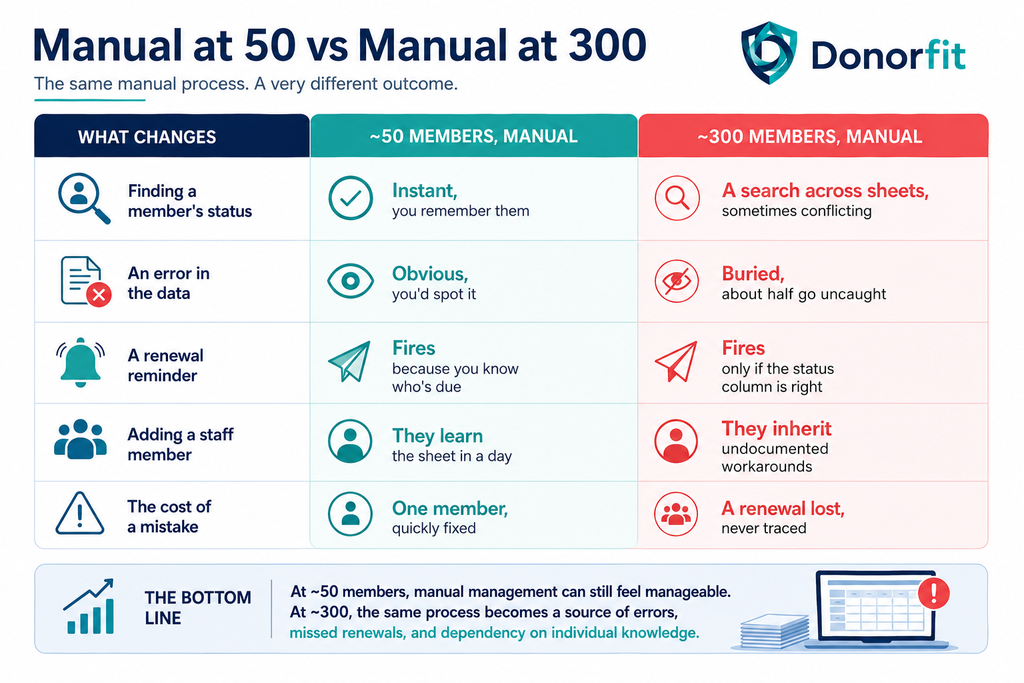
The columns use the same method. Only the scale changed. That’s the whole point of a tipping point: nothing about the tool got worse; the load simply passed what the tool can carry.
What replaces it
The replacement for manual management isn’t a fancier spreadsheet. It’s a single source of truth for member data, where a status change updates everywhere at once, renewals and onboarding fire automatically off accurate records, and “who’s at risk right now” is a screen rather than an afternoon. The category names vary (association management software, membership CRM, a donor and membership platform), but the job is the same: stop making a person the place where all the systems reconcile.
Two honest cautions before you switch. First, clean the data before you move it, because importing duplicates and stale records just moves the mess into a nicer container. Second, don’t over-buy. You don’t need every workflow on day one; you need reliable member records, payments, and renewals working first, then more as the team grows into it.
Related reading:
Frequently asked questions
When should an association stop using spreadsheets for membership? When the number of moving parts outgrows what a person can reliably track, which tends to happen somewhere in the low hundreds of members but depends far more on complexity than headcount. If renewal reminders are misfiring, member records conflict across tools, or nobody can quickly say who’s at risk, you’ve likely passed the point.
Is there a member count where manual dues management breaks? There’s no exact benchmark, and any specific number is a guess. Complexity matters more than count: tiered pricing, corporate sub-accounts, and event-linked status can break a manual system at eighty members, while a simple flat membership can stay manual past two hundred.
Why is manual membership management risky as you grow? Because its failures are invisible. Uncaught data errors, which decades of research show survive even careful spreadsheet review about half the time, turn into renewal notices that never fire and members who lapse without anyone noticing. You don’t get an error message; you get quiet, untraceable churn.
What replaces manual membership management? A single system that holds member data as one source of truth, updates status everywhere at once, and triggers renewals and onboarding automatically. It removes the need for staff to reconcile conflicting records by hand.
How do we switch without losing our data? Clean first: merge duplicates, fix outdated contacts, and standardise records before importing. Then start with the core (members, payments, renewals) rather than configuring every workflow at once, and expand as the team settles in.
If you’re recognising your own team in the signs above, the fix isn’t more discipline with the spreadsheet. It’s a member record you can actually trust, one that fires renewals and onboarding on its own and tells you who’s at risk without an afternoon of digging. That’s the problem a purpose-built donor and membership platform is built to solve, and it’s where Donorfit fits.