





Orphan Sponsorship Matching: Does Letting Sponsors Choose a Child Increase Sign-Ups?
Orphan sponsorship matching is the process of pairing a sponsor with a specific child in your programme, often by letting the sponsor filter by country, age and gender, so the gift becomes a named, ongoing relationship rather than a contribution to a general fund. It’s the difference between “donate to orphans” and “walk beside Amina, who is seven, lives in Somalia and has just started school.”
Most fundraisers feel in their bones that the second ask works better. The research agrees, though more quietly than the industry folklore suggests. This guide sets out what the evidence actually says, why matching still matters, how it works in practice, and how to offer choice without leaving any child waiting on the sidelines.
Key takeaways
- People tend to give more to one identified child than to a statistical group, but across 41 studies the effect is small (Lee and Feeley, 2016), and a 2024 replication of a classic study failed.
- In a field experiment, offering donors a choice over where their gift went did not raise the share of people who gave, but it did raise the size of gifts (Eckel, Herberich and Meer, 2017).
- The stronger case for matching is commitment: a sponsor who chooses a child is choosing a relationship, and relationships are what keep sponsorship going for years.
- Matching by country, age and gender needs safeguards so less-chosen children aren’t left waiting, and so child data stays minimal and protected.
What is targeted orphan matching?
Targeted orphan matching lets a prospective sponsor narrow your list of children waiting for support by a few chosen criteria, then select one child and begin a sponsorship tied to that child. The most common filters are country, age range and gender. The sponsor sees a short, dignified profile: first name, age, country, a photograph where consent allows, and something about the child as a person, such as a favourite subject or what they want to be.
Once matched, the sponsor’s recurring gift is attributed to that child’s care, and progress updates flow back to the sponsor about that child. That last part is where matching earns its keep, as we’ll see.
Does letting sponsors choose a child increase sign-ups?
Honestly: the evidence that choice alone increases sign-ups is thinner than most fundraising advice implies. Here is what the research shows, without the gloss.
| Study | What it tested | What it found | What it means for you |
| Small, Loewenstein and Slovic, 2007, Organizational Behavior and Human Decision Processes | Appeals featuring one named child versus statistics about many | People gave more to the named child; adding statistics reduced giving | Lead with a person, not a number |
| Kogut and Ritov, 2005, Journal of Behavioral Decision Making | One identified child versus a group of eight | The “identified” boost appeared mainly for a single child, not a group | One child at a time, not a gallery |
| Lee and Feeley, 2016, Social Influence (meta-analysis, 41 studies) | Whether the identifiable-victim effect holds across research | Real but small overall (r = .05); stronger with a child, a photo, and poverty rather than illness | Expect a nudge, not a transformation |
| Majumder, Tai, Ziano and Feldman, 2024, Judgment and Decision Making | Large replication of Kogut and Ritov’s Study 2 | Did not replicate: a single identified child drew no more than an unidentified one | Treat the effect as fragile |
| Eckel, Herberich and Meer, 2017, Journal of Behavioral and Experimental Economics | Field experiment giving donors a choice over where gifts went | No change in how many people gave; gifts were larger | Choice may lift commitment more than conversion |
Read across that table, and a pattern appears. Specificity is a gentle tailwind, not a gust. And the one field experiment on choice suggests its value shows up less in whether people say yes and more in how much of themselves they put in once they have.
We looked for published data on sign-up rates for chosen versus assigned orphan sponsorships specifically and did not find any from a named, dated primary source. If your organisation has run its own test, your numbers will tell you more than any of the studies above.
Why matching still matters: choice as commitment
If choice doesn’t reliably win more first yeses, why offer it? Because sponsorship isn’t a single gift. It’s a long walk, and people walk further on a path they chose themselves.
Think about what happens in a sponsor’s mind at the moment of choosing. They have looked at a handful of children, paused on one, and decided: this one. That small act turns a donation into a promise. The sponsor isn’t supporting “orphan care in East Africa” any more. They’re supporting Amina, and Amina will start Year 2 next September whether or not they’re there to hear about it.
That shift has three practical consequences.
Progress reports land differently. An update about “children in our programme” is information. An update about the child you chose is news. Our guide to structured child-progress reporting covers why consistent updates are the backbone of sponsor retention, and matching is what gives those updates someone to be about.
Lapsing becomes a decision, not a drift. Cancelling a general direct debit is housekeeping. Stepping away from a named child is a choice a sponsor has to make on purpose, and many won’t.
The relationship has a natural story. Enrolment, first school year, exams, a new skill, the move to independence. A matched sponsorship has chapters. A general fund has a balance.
None of this is measured in the studies above, and we won’t pretend it is. It’s the operational logic of sponsorship, and most programmes that run it will recognise it.
How orphan sponsorship matching works in practice
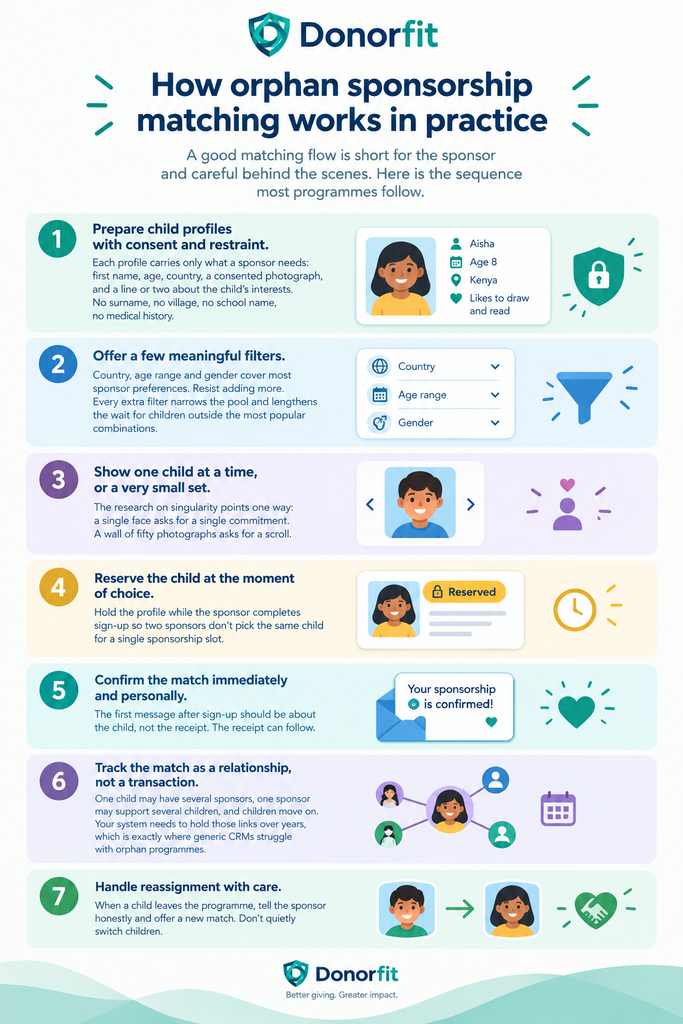
A good matching flow is short for the sponsor and careful behind the scenes. Here is the sequence most programmes follow.
1. Prepare child profiles with consent and restraint. Each profile carries only what a sponsor needs: first name, age, country, a consented photograph, and a line or two about the child’s interests. No surname, no village, no school name, no medical history.
2. Offer a few meaningful filters. Country, age range and gender cover most sponsor preferences. Resist adding more. Every extra filter narrows the pool and lengthens the wait for children outside the most popular combinations.
3. Show one child at a time, or a very small set. The research on singularity points one way: a single face asks for a single commitment. A wall of fifty photographs asks for a scroll.
4. Reserve the child at the moment of choice. Hold the profile while the sponsor completes sign-up so two sponsors don’t pick the same child for a single sponsorship slot.
5. Confirm the match immediately and personally. The first message after sign-up should be about the child, not the receipt. The receipt can follow.
6. Track the match as a relationship, not a transaction. One child may have several sponsors, one sponsor may support several children, and children move on. Your system needs to hold those links over years, which is exactly where generic CRMs struggle with orphan programmes.
7. Handle reassignment with care. When a child leaves the programme, tell the sponsor honestly and offer a new match. Don’t quietly switch children.
Who gets chosen, and who waits
Every filter is also a sorting machine. Matching by preference means some children will be chosen quickly and others will wait. Sponsors often lean towards younger children, and preferences for particular countries or genders shift with the news cycle and the season. We haven’t found published data on these patterns for orphan programmes specifically, so check your own records rather than assuming.
Whatever the patterns, a few safeguards keep choice from becoming unfairness.
- Fund care from a pooled budget, not only from matched gifts, so no child’s support depends on being picked.
- Show “children waiting longest” as a gentle default view, or give sponsors a “match me with a child who needs a sponsor most” option.
- Watch the age at which children leave the waiting list. If older children consistently wait longer, rebalance what you show.
- Never rank children by appeal. Profiles should be equally dignified, equally complete and equally visible.
Safeguarding and data protection come first
A child’s profile is personal data about a minor, and in the DACH region that puts it squarely under the DSGVO (GDPR). Matching makes that data visible to strangers by design, so the bar for what you show is high.
Keep profiles to the minimum a sponsor needs to choose. Never publish surnames, exact locations, school names or anything that could help someone find a child. Record consent for each photograph and its uses, and remove images when consent changes. Restrict who on your own team can see the full child record, not just the public profile. And write about every child with dignity: interests, hopes and milestones, never pity.
If ease of matching and child protection ever pull in different directions, protection wins. Every time.
This section is general information, not legal advice. Your data protection officer should review your matching profiles before they go live.
Common matching mistakes
| Mistake | Why it hurts | Better approach |
| Too many filters | Narrows the pool; some children wait far longer | Country, age range, gender, and stop there |
| A gallery of dozens of children | Dilutes the single-child focus that makes matching work | One child or a very small set at a time |
| Over-detailed profiles | Safeguarding and DSGVO risk | First name, age, country, consented photo, interests |
| Pity-led descriptions | Undermines the child’s dignity and sponsor trust | Describe the child as a person with a future |
| Silent reassignment | Breaks the promise the sponsor made | Tell the sponsor and offer a new match |
| Funding care only through matched gifts | Children who aren’t chosen go without | Pooled funding with matching on top |
The bottom line
The research won’t let us say that choosing a child doubles sign-ups. What it does suggest, gently and consistently, is that people give more of themselves to one person than to a statistic, and more to a choice they made than to one made for them. Orphan sponsorship matching is how you turn that into a relationship that lasts. Build it with restraint, protect every child behind every profile, and make sure the children nobody picked today are still cared for tomorrow. Then the sponsor who chose Amina will still be walking beside her when she finishes school.
Frequently asked questions
What is orphan sponsorship matching?
Orphan sponsorship matching pairs a sponsor with a specific child in a sponsorship programme, usually by letting the sponsor filter children by country, age and gender and then choose one. The sponsor’s recurring gift supports that child, and progress updates are about that child.
Does letting sponsors choose a child increase sign-ups?
The evidence is modest. Research on the identifiable-victim effect finds people give somewhat more to one identified child than to a statistical group. Still, a 2016 meta-analysis found the effect small overall, and a 2024 replication of a classic study failed. A 2017 field experiment found that offering choice didn’t change how many people gave, but it did increase gift size.
Which filters should a child sponsorship platform offer?
Country, age range and gender cover most sponsor preferences. Adding more filters narrows the pool and can leave children outside popular combinations waiting longer.
What information is safe to show on a child sponsorship profile?
Keep it minimal: first name, age, country, a photograph with recorded consent, and something about the child’s interests. Avoid surnames, exact locations, school names and medical information. This is general information, not legal advice.
How do we make sure children who aren’t chosen still get support?
Fund care from a pooled budget so no child’s support depends on being picked, offer a “match me with a child who needs it most” option, and monitor how long different children wait.
What happens if a sponsored child leaves the programme?
Tell the sponsor honestly, share what you can about the child’s next step, and offer a new match. Don’t switch children without telling them.
Sources
- Small, D. A., Loewenstein, G. and Slovic, P. (2007). Sympathy and callousness: The impact of deliberative thought on donations to identifiable and statistical victims. Organizational Behavior and Human Decision Processes, 102(2), 143–153. Summary: Stanford GSB Insights.
- Kogut, T. and Ritov, I. (2005). The “identified victim” effect: An identified group, or just a single individual? Journal of Behavioral Decision Making, 18(3), 157–167. Author PDF.
- Lee, S. and Feeley, T. H. (2016). The identifiable victim effect: A meta-analytic review. Social Influence, 11(3), 199–215. Abstract.
- Majumder, R., Tai, Y. L., Ziano, I. and Feldman, G. (2024). Revisiting the impact of singularity on the Identified Victim Effect. Judgment and Decision Making, 19. Cambridge Core.
- Eckel, C. C., Herberich, D. H. and Meer, J. (2017). A field experiment on directed giving at a public university. Journal of Behavioral and Experimental Economics, 66, 66–71. RePEc.
If you’d like sponsors to choose the child they’ll walk beside, Donorfit’s sponsorship module lets them filter waiting children by country, age and gender, with minimal, consent-based profiles and sponsor-to-child records built for the long relationship that follows. See how matching works.