







How Structured Child-Progress Reporting Doubles Sponsor Lifetime Value
Sponsor lifetime value is the total a sponsor contributes across the whole time they stay with your program. The size of the first gift does not set it. It is set by how many years the relationship lasts. That single fact is why child-progress reporting, which looks like an operational chore, is really one of the strongest levers you have on revenue.
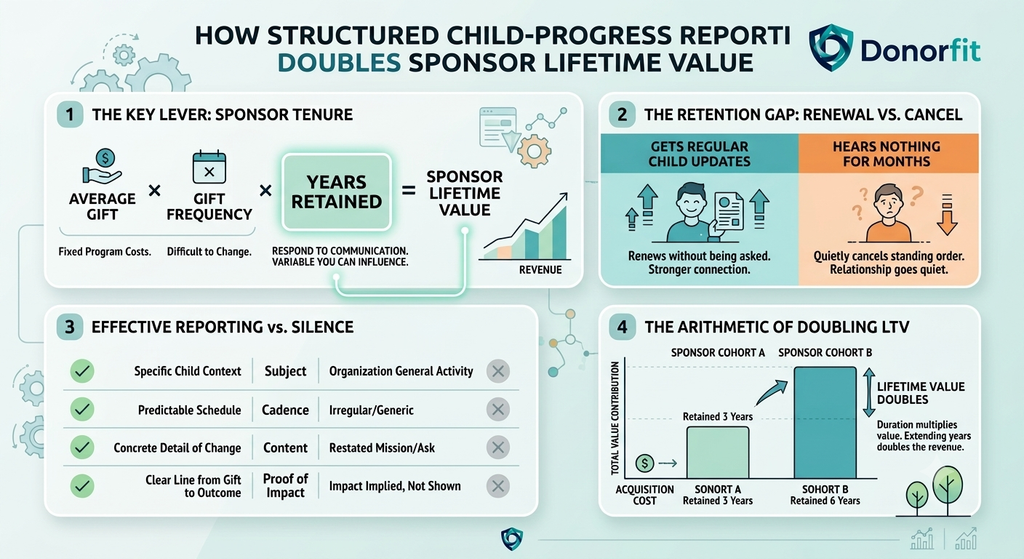
Most sponsorship teams already sense this. The sponsor who keeps getting real updates about the child they support tends to renew without being asked. The sponsor who hears nothing for eight months tends to cancel the standing order quietly. What the data adds is a way to size that instinct and act on it.
What “sponsor lifetime value” actually measures
The simplest working definition is the one most fundraising teams use day to day:
Sponsor lifetime value = average gift × gift frequency × number of years retained.
The 2026 Virtuous Nonprofit Benchmark Report takes a more detailed approach, using a five-year, cohort-based model that also considers how donor giving can increase over time. But even the simple version makes one thing clear: retention is the variable you have the most control over.
You may not be able to convince a sponsor to increase their monthly contribution, and the frequency of their gift is usually tied to the structure of your programme. But you can influence how long they stay.
And that is where communication matters. Consistent, meaningful updates that show sponsors the progress their support is making can strengthen the relationship and give them more reasons to continue.
Duration is the variable you can actually influence
Retention research from outside the sector makes the stakes concrete. Frederick Reichheld’s work at Bain & Company, first set out in the 1990 Harvard Business Review article “Zero Defections,” found that a five-percentage-point lift in customer retention was associated with a 25 to 95 per cent increase in value, because retained relationships compound. That figure is cross-industry, and sponsorship is not retail, so treat it as a direction rather than a promise. But the mechanism it describes carries over cleanly: a sponsor kept for a sixth year is far more valuable than a sponsor replaced in year five, because you have already paid to acquire them and they give at a steadier rate.
The sector’s own numbers show how wide the retention gap runs. The Fundraising Effectiveness Project has put overall donor retention near 43 per cent, first-time-donor retention around 19 per cent, and repeat-donor retention close to 69 per cent. Neon One’s 2026 reporting puts recurring donors higher still, near 79 per cent retention with an average relationship measured in years, not months. Sponsors sit at the committed end of that range by design. The risk is not that they never commit. The risk is that they slide back toward the low-retention band because the relationship goes quiet.
Why silence, not price, ends most sponsorships
When sponsors leave, the reason they give is rarely money. Across donor-retention research, the dominant drivers of attrition are the same: silence after the gift, communication that shows no evidence the gift changed anything, and a cadence that feels generic. A sponsor who cannot see what their support did has no reason to treat next month’s payment as different from any other line on the bank statement.
A practitioner account from a national child-sponsorship organisation, published on the DonorVoice Agitator blog, makes the same point from the inside. The team found retention tracked two things above almost all others: whether a sponsor survived the first year, and how they paid. Their retention programme leaned heavily on regular communication from the sponsored child and the field office. In other words, the proof of impact was the retention strategy. It was not a nice-to-have layered on top of one.
What structured progress reporting changes
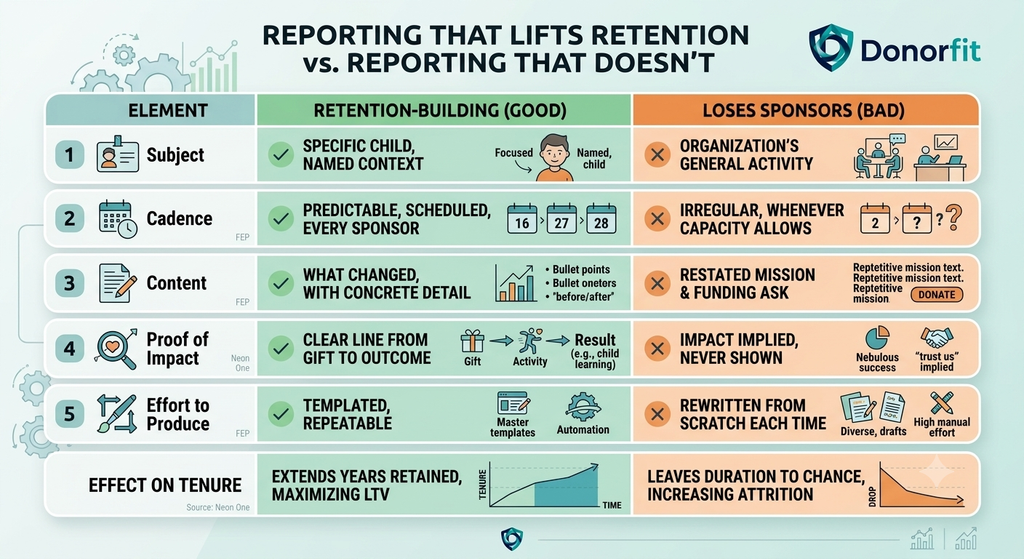
“Structured” is the operative word. A structured child-progress report is not a longer newsletter. It is a repeatable record tied to a specific child that a sponsor receives on a predictable rhythm, covering the few things a sponsor genuinely wants to know: how the child is doing, what changed since last time, and where their support went. The structure matters because it removes the two failure modes that kill reporting programmes. It stops updates from depending on whoever has time that month, and it stops them from drifting into generic appeals.
When that rhythm holds, three things move in your favour. Sponsors stop wondering whether the program still exists. First-year survival, the make-or-break window the practitioners above flagged, improves because the relationship gets established before doubt sets in. And the sponsor who has watched a child progress across two or three reporting cycles has built up something a lapsed-payment prompt cannot easily undo.
Reporting that lifts retention vs. reporting that doesn’t
The honest math behind “doubling”
Here is where the headline claim needs to be exact rather than impressive. No published study shows that progress reporting on its own doubles sponsor lifetime value, and we are not going to pretend one does. The doubling is arithmetic, and it is worth understanding precisely because it is arithmetic.
Lifetime value equals gift times frequency times years. Hold the gift and the frequency steady, which is realistic, and lifetime value moves in direct proportion to how long the sponsor stays. A sponsor retained for six years is worth twice one retained for three. So the real question is not “does reporting double LTV,” but “does consistent reporting move a meaningful share of sponsors from the short-tenure band toward the long-tenure band.” The retention research says sustained, proof-carrying communication is exactly what separates those bands. Reporting is how you buy the extra years, and the extra years are what double the value.
That framing keeps the claim usable. It tells you what to measure: not “did the report perform,” but “did average sponsor tenure lengthen across the cohort that received structured reports.” That is a number your own system can show you.
Frequently asked questions
Does more frequent reporting always mean higher retention? Not on its own. Frequency without substance reads as noise and can speed up attrition. What lifts retention is predictable reporting that carries real evidence of the child’s progress. A steady quarterly report that shows change will outperform a monthly one that repeats the mission.
How do we measure whether reporting is working? Track average sponsor tenure and first-year retention for the cohort receiving structured reports, and compare it to earlier cohorts. Lifetime value follows tenure, so tenure is the leading indicator worth watching.
Isn’t lifetime value mostly about gift size? For sponsorship, no. Gift size and frequency are usually fixed by the program structure. Duration is the input that responds to how you communicate, which is why retention work returns more than upgrade appeals for most sponsorship programs.
What makes a report “structured” rather than just regular? Structure means it is tied to a specific child, follows a repeatable template, and lands on a set schedule for every sponsor. That repeatability is what stops reporting from collapsing the first busy month.
For a practical breakdown of what to include, see what to put in a sponsor update — and what to leave out. And if you run a child-sponsorship or orphan-care program on a general-purpose CRM, the orphan-program gap covers why that reporting rhythm is so hard to sustain on the wrong tool.
Donorfit keeps each child’s progress record, sponsor communications, and giving history in one place, so a structured reporting rhythm is something your team can actually keep. If sustaining consistent sponsor updates is where your program strains, that’s the problem it’s built to solve.