




Full, Partial, or Shared: Why Water Giving Needs More Than One Way to Give
Water project funding options are the different ways a supporter can pay toward clean-water work, whether funding a whole project, a share of one, its infrastructure, its ongoing maintenance, or an emergency response, as a one-time gift or a recurring commitment. Most water fundraising offers one: a single donation box and a suggested amount. That single box quietly decides who can take part and, more importantly, what parts of the work get paid for. And in water, the part that most often goes unpaid is the part that matters most for whether the water keeps flowing.
This is a piece about matching the way people give to the way water work actually costs money, and why a single funding model leaves both donors and projects short.
The gap a single donation box hides
The hardest problem in water charity is not building the well. It is keeping it working, and a one-off donation is built to fund the first thing, not the second. This is the uncomfortable fact the sector has lived with for years. A water point is not a finished object the day it is installed. It is a piece of infrastructure that needs upkeep, spare parts, and local capacity, and without funding for those, a surprising share of them simply stop working.
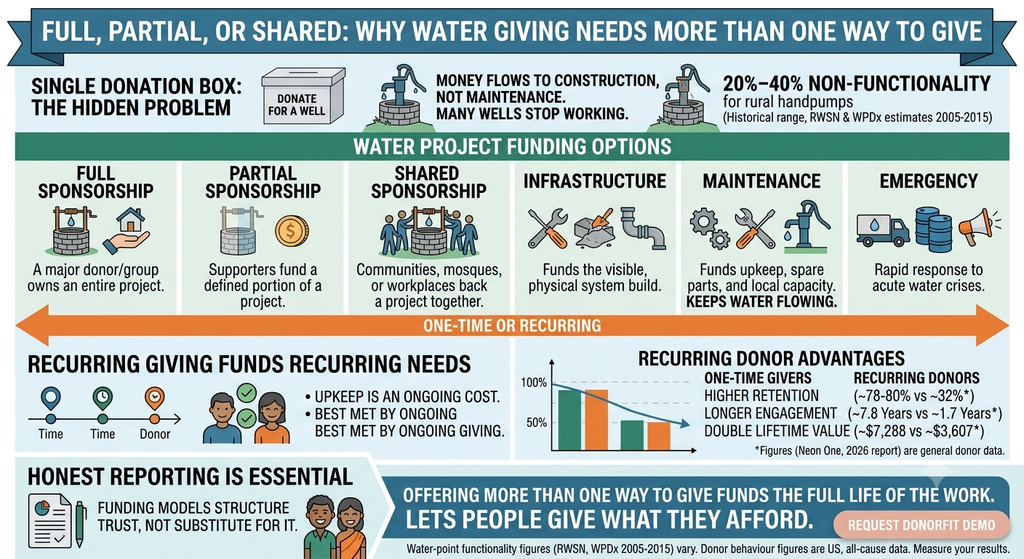
The figures are sobering, and worth stating with their dates because they are not new. A frequently cited estimate from the Rural Water Supply Network (RWSN) in 2010 suggested that only about two in three handpumps in sub-Saharan Africa were working at any given time, leaving roughly one in three non-functional. An earlier RWSN collation in 2007 found around 36 percent non-functionality across 21 countries, and analysis around 2005 put the sub-Saharan figure near 40 percent. More recent monitoring through the Water Point Data Exchange in 2015, covering more than 126,000 water points across 37 countries, found about 20 percent non-functional and a further 10 percent working but with problems. Functionality has been measured many ways and varies widely by region and programme, so treat these as evidence of a real, persistent gap rather than a single current number.
The pattern behind all of them is the same. The money flows to construction, because construction is what feels like impact, and far less flows to the unglamorous business of maintenance. A funding model that only knows how to accept a donation “for a well” is, without meaning to, funding the very imbalance that leaves wells broken.
What each funding model is actually for
Different funding options exist because water work has different kinds of cost, and each model lets a supporter fund the kind that matches what they can give and what they care about. They are not six flavours of the same thing. Each answers a distinct need.
| Funding model | What it funds | Why it matters |
| Full sponsorship | An entire project, start to finish | Lets a major donor or group own a complete outcome |
| Partial sponsorship | A defined portion of a project | Lowers the entry point so a modest gift still funds something real |
| Shared sponsorship | A project funded jointly by several givers | Lets a community, mosque, or workplace back one project together |
| Infrastructure | The build itself: the physical system | Funds the visible, one-time capital cost |
| Maintenance | Upkeep, repairs, spare parts, local capacity | Funds the part that keeps water flowing after the cameras leave |
| Emergency | Rapid response to an acute water crisis | Lets supporters act fast when need spikes |
Read down that “why it matters” column and the point becomes clear. Partial and shared sponsorship are about who can take part. Infrastructure and maintenance are about what gets paid for across a project’s whole life. Emergency is about when. A charity offering only “donate now” is collapsing all three questions into one, and losing the supporters and the funded needs that do not fit the default.
Lowering the barrier widens the base
Partial and shared sponsorship matter because they let people give at the level they can actually afford while still feeling they funded something whole. A full water project is beyond most individual donors. Faced with a number they cannot meet, many give a token amount or nothing, because the ask implied that only the whole thing counted. Letting a supporter fund a defined share, or join others in backing one project together, changes the proposition. Their contribution is no longer a fraction of someone else’s project. It is their part of a shared one.
This matters especially for community-rooted giving, where a mosque, a family, or a workplace may want to back a single project collectively. Shared sponsorship lets the group act as a group, with each contribution visible as part of the whole, rather than dissolving everyone’s gift into a general fund where the shared achievement disappears.
Recurring giving funds what recurring needs require
Maintenance is an ongoing cost, so ongoing giving best meets it, and it’s also where the strongest and most durable donor relationships live. There is a neat alignment here that the sector often misses. The need that goes chronically underfunded, upkeep, is recurring by nature. The form of giving that sustains both funding and donor loyalty, the monthly commitment, is recurring too. Matching them is close to obvious once stated.
The general giving data makes the donor side of the case plain. Neon One’s 2026 Recurring Donor Report found recurring donors retained at around 78 to 80 per cent, against roughly 32 per cent for one-time donors in 2025, with recurring donors worth roughly double over their lifetime and staying engaged far longer. Those are United States, all-cause figures rather than water-specific ones, so take them as direction rather than a local promise. But the direction is strong, and it points the same way the maintenance problem does: recurring support funds something that needs funding every month, and it keeps the donor who funds it.
The honest caveat
Offering more ways to give helps only if each one maps to real work and is reported on honestly; the models are a structure for trust, not a substitute for it. It would be easy to present funding flexibility as a growth lever and leave it there. The truer framing is that these options let a charity tell the truth about its costs. Maintenance sponsorship is only meaningful if maintenance actually happens and the supporter hears about it. A shared project only builds community if the group can see the shared result. The funding model opens the possibility of a more honest, better-matched relationship. The programme still has to keep its side of it.
There is no verified figure showing that offering flexible water funding lifts revenue or retention by a fixed amount, and we will not invent one. What the evidence supports is a direction worth acting on and measuring against your own results: fund the whole life of the work, let people in at the level they can afford, and make the recurring need easy to meet recurringly.
Frequently asked questions
What are the main ways to fund a water project? Commonly: full sponsorship of a whole project, partial sponsorship of a defined share, shared sponsorship where several givers back one project together, infrastructure funding for the build, maintenance funding for ongoing upkeep, and emergency funding for acute crises, each available as a one-time or recurring gift.
Why offer partial or shared water sponsorship instead of a single donation? Because a full project is beyond most individual donors. Partial and shared options let a modest gift fund something real and whole, and let groups back a project collectively, which tends to widen participation rather than limiting it to those who can fund an entire project.
Why does maintenance funding matter so much in water projects? Because water points fail without upkeep. Estimates over the years have put non-functionality of rural handpumps in sub-Saharan Africa anywhere from about 20 to 40 percent depending on the study and period (RWSN and Water Point Data Exchange figures from roughly 2005 to 2015). Funding maintenance, not just construction, is what keeps water flowing.
Is recurring giving better than one-time giving for water charities? For ongoing costs like maintenance, recurring giving fits the need better, and recurring donors generally retain far longer and are worth more over time (Neon One, 2026 Recurring Donor Report, reporting 2025 figures). Both have their place; the point is to offer both rather than defaulting to one.
Does offering more funding options complicate administration? It can, if the options live in separate tools or spreadsheets. The aim is to offer the models to donors while keeping them as one manageable system internally, so flexibility for the supporter does not become overhead for the team.
The part worth keeping
A single donation box tells supporters a single story: give once, for a well, and trust that it works out. The honest story is longer. Some people can fund a whole project and some a small share; some want to build and some want to keep things running; the need is sometimes a patient one and sometimes an emergency; and the water only keeps flowing if someone funds the quiet years after the opening day. Offering more than one way to give is how a charity lets supporters meet that fuller story where they actually stand.
If your organisation runs water and sanitation programmes across the DACH region, Donorfit supports full, partial, shared, infrastructure, maintenance, and emergency sponsorship, as one-time or recurring contributions, held together as a single system rather than a stack of separate forms. It exists so the way people can give finally matches the way water work actually costs.
This article is general information for fundraising teams. Water-point functionality figures are drawn from named sources spanning roughly 2005 to 2015 and vary by region and study; donor-behaviour figures are general, all-cause, US-based data applied to water giving by inference. Confirm current figures and measure your own programme’s results.