







Donation Receipt Rules in Germany, Austria, and Switzerland: What Every Charity Needs to Know Before January

A donation receipt is the document a donor uses to claim their gift against tax, and in the DACH region the rules for issuing one differ so sharply between Germany, Austria, and Switzerland that a charity working across borders is really running three separate processes at once. Getting them right is a legal obligation. Getting them out on time is where most small teams quietly lose their January.
This article is general information, not tax or legal advice. Rules change, and individual cases vary, so confirm the current position with your Finanzamt, Steuerberater, or cantonal authority.
Why the receipt matters more than it looks
For the donor, the receipt is the difference between a gift that reduces their tax bill and one that does not. For the charity, it is a trust moment. A donor who gives all year faithfully and then waits weeks for a receipt they need for their return learns something about how the organisation is run, and it is rarely what you want them to learn.
The work itself is deceptively heavy. Pulling a full year of gifts for each donor, matching them to the right person, producing a compliant document, and sending hundreds of them in a narrow window is the kind of task that swallows a small team right when the new year should be about planning the next campaign.
Germany: the €300 line that decides everything
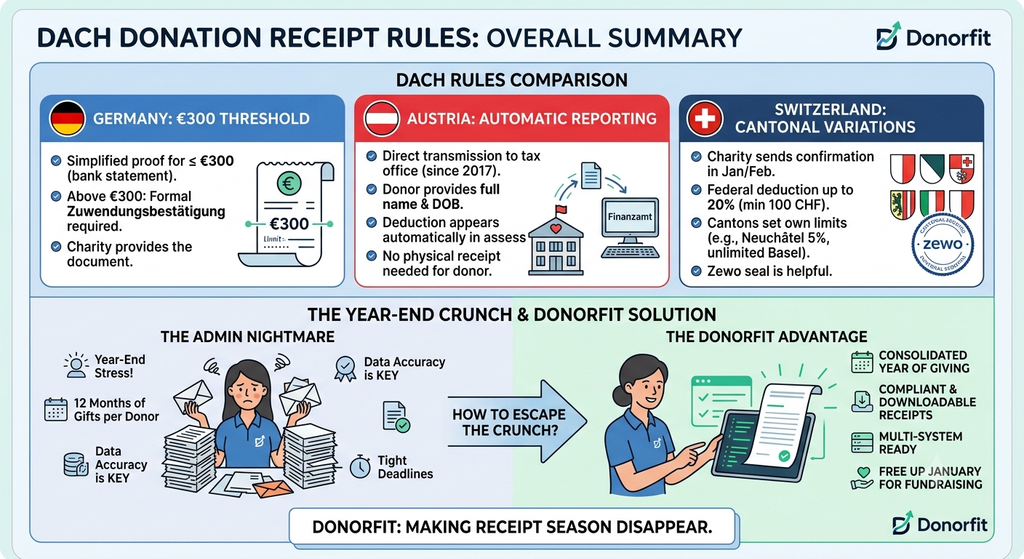
German rules turn on a single threshold. For donations up to and including 300 euros, a donor can use a simplified proof, the vereinfachter Zuwendungsnachweis, which in practice means a bank statement showing the transfer. No formal receipt is required at that level.
Once a single donation goes above 300 euros, the charity must issue a formal Zuwendungsbestätigung under § 50 Abs. 4 EStDV, following the officially prescribed form. This is where the administrative weight lands, because recurring donors who give monthly often cross that annual line without either side thinking about it, and the organisation is then on the hook for a proper receipt.
Austria: the receipt the donor never sees
Austria took the opposite path. Since 1 January 2017, recognised organisations have been required to transmit donation data directly to the tax office themselves. The donor hands over two things: their full name and their date of birth, and the spelling has to match their official registration exactly or the record will not reconcile.
After that, the donor does nothing. They keep no receipt, because the deduction appears automatically in their assessment. For individuals, donations are deductible as Sonderausgaben up to 10 per cent of annual income. The burden here is not paper, it is data accuracy: one mistyped name or wrong birth date and a donor’s gift silently fails to register, and they find out only when their refund is smaller than expected.
Switzerland: twenty-six answers to one question
Switzerland has no single national rule, because tax is partly a cantonal matter. At federal level, a donor can deduct up to 20 per cent of net income, with a minimum of 100 Swiss francs a year. Most cantons follow that 20 per cent line, but not all: Jura caps the deduction at 10 per cent, Neuchâtel at 5 per cent, while Basel-Landschaft allows an unlimited deduction. A few cantons set a higher entry point, such as Thurgau’s 200-franc minimum.
Swiss donors expect their confirmation in January or February, sent by the organisation. Only gifts to tax-exempt charities qualify, and the Zewo seal is the reliable marker, because an organisation carrying it is recognised as tax-exempt across every canton.
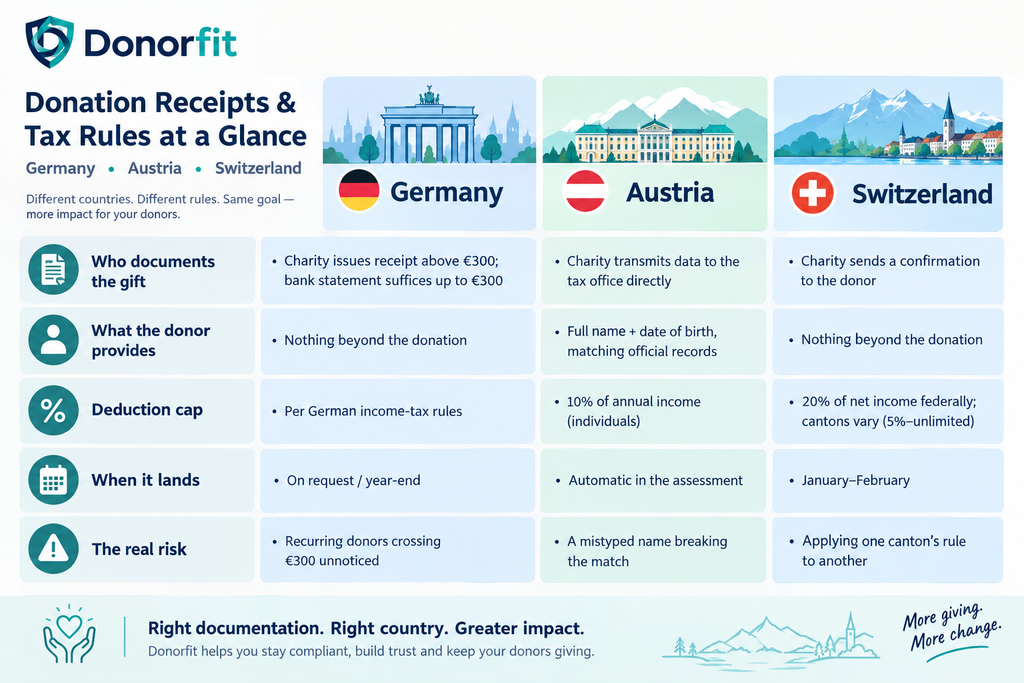
The three systems side by side
Where the year-end crunch actually comes from
Notice what the three systems share. Each one asks the charity to assemble a complete, accurate, per-donor picture of a full year of giving, and to do it in a tight window at the turn of the year. Whether the output is a German receipt, an Austrian data file, or a Swiss confirmation, the underlying job is the same: one donor, twelve months of gifts, one clean record, no errors.
That is manageable when you have fifty donors. At five hundred, across three countries with three rule sets, it becomes the reason a fundraising lead spends January on administration instead of donors. The task does not get more interesting as it scales. It just gets longer.
FAQ
What is a Zuwendungsbestätigung? It is the formal German donation receipt a charity must issue for gifts above 300 euros, following the officially prescribed form, so the donor can claim the deduction.
Do Austrian donors need to keep donation receipts? No. Since 2017 recognised organisations report donations directly to the tax office using the donor’s name and date of birth, and the deduction appears automatically, so there is no receipt for the donor to retain.
How much of a donation is tax-deductible in Switzerland? Federally, up to 20 percent of net income with a 100-franc annual minimum. Cantons set their own limits, from 5 percent in Neuchâtel to unlimited in Basel-Landschaft, so the answer depends on where the donor lives.
Why is the €300 threshold a problem for recurring donors? A monthly donor can pass 300 euros in total across the year without anyone deciding to, which moves the gift from simplified-proof territory into formal-receipt territory and puts the obligation back on the charity.
Donorfit consolidates a member’s full year of giving into one compliant, downloadable receipt, and keeps the record ready for whichever of the three systems applies. If receipt season is where your team loses January, that is the part we built to disappear.