







Zuwendungsbestätigung: What a Donation Receipt Actually Requires in Germany, Austria, and Switzerland
A Zuwendungsbestätigung is the official confirmation a German donor may need to claim a qualifying donation against income tax. The term is familiar across the German-speaking world, but the legal machinery behind it changes at the border.
Ask a treasurer in Vienna or Zürich for a Zuwendungsbestätigung and they will understand what you mean. But the document that supports a deduction in Germany is not interchangeable with the reporting process in Austria or the proof a Swiss canton may accept.
For charities working across the DACH region, that distinction matters. A process designed around one country’s requirements may leave gaps in another.
This guide explains what donation receipts mean in Germany, Austria, and Switzerland, what each country’s process generally requires, and where organised donation records can reduce administrative work.
This is general information, not tax or legal advice. Requirements depend on the organisation, the donor, and the nature of the gift. Confirm your specific obligations with a qualified adviser in the relevant country.
The word, and why it matters
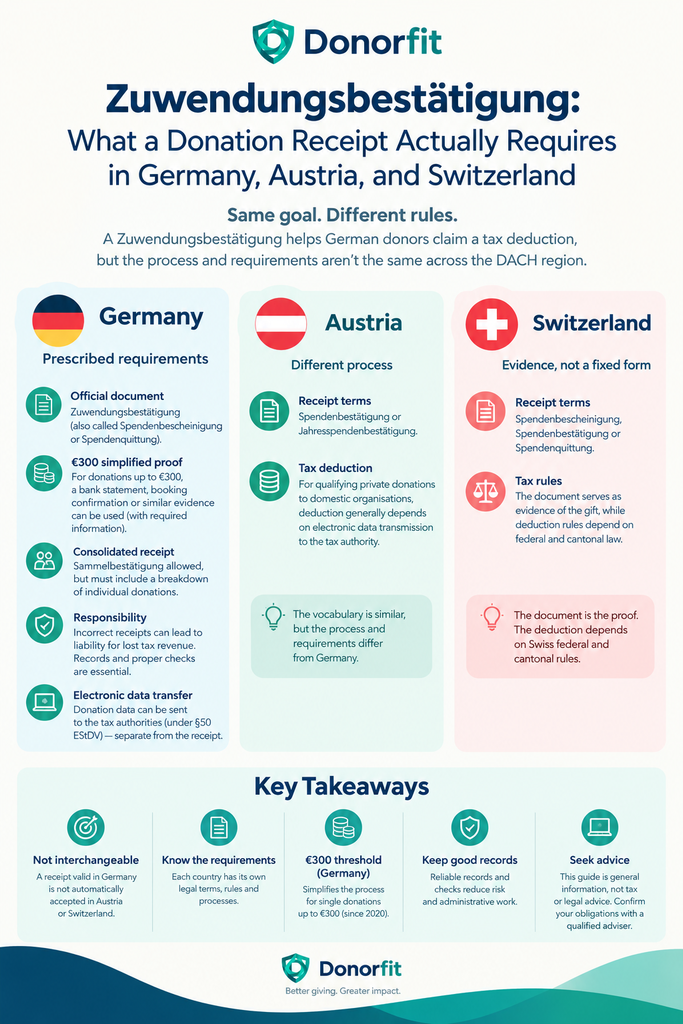
Germany has one precise legal term and several familiar everyday alternatives. The legally recognised document is the Zuwendungsbestätigung. People also say Spendenbescheinigung or Spendenquittung. In this context, they generally mean written confirmation of a qualifying donation to a tax-privileged recipient.
Austria and Switzerland use similar everyday vocabulary, but the process differs.
In Austria, a donor may receive a Spendenbestätigung or Jahresspendenbestätigung, but for qualifying private donations to domestic organisations covered by the reporting rules, the deduction generally depends on electronic data transmission to the tax authority.
In Switzerland, a charity may issue a Spendenbescheinigung, Spendenbestätigung, or Spendenquittung. The document serves as evidence of the gift, while the applicable deduction rules depend on federal and cantonal law.
The vocabulary travels easily. The requirements do not.
Germany: the receipt has prescribed requirements
For German donors, a qualifying donation must meet the applicable tax requirements, including those governing the evidence needed to claim a deduction.
Under §10b EStG and §50 EStDV, the official Zuwendungsbestätigung follows prescribed requirements. For donations requiring a formal confirmation, organisations must use the applicable official pattern and observe its required wording and information.
This is more than a design choice. A charity cannot assume that a document becomes a valid tax receipt simply because it includes a donor’s name, donation amount, and logo.
The €300 threshold can simplify the process
For a single monetary donation of up to and including €300, German rules permit a vereinfachter Zuwendungsnachweis, or simplified proof, subject to the statutory conditions.
For a qualifying payment, the donor can generally use a bank statement, booking confirmation, or comparable payment evidence together with the required information about the recipient’s tax-privileged status and purpose.
The €300 threshold has applied since 1 January 2020. It was increased from €200 by the Jahressteuergesetz 2020 and is set out in §50(4) EStDV.
The distinction is between an individual gift and the donor’s annual total. Three separate qualifying gifts of €250 each are each below the threshold. A single gift of €350 is above it.
That does not mean every donation below €300 is automatically deductible. The recipient and donation must still meet the applicable requirements.
What a consolidated receipt actually means
German charities can issue a Sammelbestätigung, a consolidated confirmation covering multiple donations.
It is tempting to think of this as an annual summary with a total at the bottom. But a legally valid consolidated confirmation must meet the relevant formal requirements, including the required breakdown of the individual donations in an accompanying schedule.
That distinction matters for membership and fundraising teams. A downloadable payment history may be convenient, but it does not automatically qualify as a valid Sammelbestätigung.
The record and the legal document serve related purposes. They are not necessarily the same thing.
The responsibility behind the receipt
Issuing a donation confirmation is not merely a clerical task. Under §10b(4) EStG, a person who intentionally or with gross negligence issues an incorrect confirmation, or causes donations to be used for purposes other than those stated, may face liability for lost tax revenue.
The practical implication is straightforward: the organisation needs reliable records and a process for checking what it certifies.
Germany also provides for electronic transmission of donation-receipt data to the tax authorities under §50 EStDV, subject to the applicable conditions. That is a separate process from simply giving a donor a downloadable statement.
Austria: the deduction depends on electronic reporting
For qualifying private donations to domestic organisations covered by Austria’s reporting rules, the tax deduction generally relies on electronic data transmission rather than a paper receipt.
Since 1 January 2017, covered organisations have been required to report qualifying donations directly to the tax authority. The process operates through FinanzOnline.
The donor must provide their first name, surname, and date of birth correctly if they want the donation to be included in the automatic reporting process. The organisation uses those details to establish the required encrypted identifier.
The name is checked against official register information, which makes accurate spelling important. If the details do not match, the donation may not be correctly attributed to the donor.
What donors and charities need to know
The ordinary process has several key requirements:
- The recipient must be eligible under the applicable Austrian donation-benefit rules.
- The donor must provide the required identifying details for the ordinary reporting process.
- The organisation reports the relevant donation data through FinanzOnline.
- The reporting deadline is the end of February following the donation year.
Donors can prohibit further transmission. If they do, the donation generally cannot be claimed through the ordinary automatic reporting route for domestic organisations.
For a charity, the operational lesson is that accurate donor records matter, but so does the reporting process itself. A beautifully formatted annual confirmation cannot replace a required electronic submission.
Switzerland: donation proof with cantonal variation
Switzerland requires a different approach because federal and cantonal tax rules both matter.
At the federal level, Article 33a of the Bundesgesetz über die direkte Bundessteuer (DBG) governs qualifying donations to tax-exempt charitable recipients.
But the important point for charities is not one particular national threshold. The practical rules can differ depending on the canton, including the conditions for deductibility and the evidence a donor may need.
That makes Switzerland different from Germany, where the federal framework provides a more uniform set of requirements for donation confirmations.
For organisations fundraising across Switzerland, a national process can therefore be useful, but it should not be treated as a substitute for checking the rules that apply to individual donors.
What the receipt does
Unlike Germany’s prescribed federal donation-receipt template, Switzerland does not use one universal federal official form for all charitable donation confirmations.
A charity-issued Spendenbescheinigung can provide evidence of the donation. Whether a bank statement or another form of proof is sufficient, and what supporting documentation is required, depends on the applicable rules and circumstances.
The recipient’s tax-exempt status also matters. A charity should not assume that every payment it receives qualifies as a deductible donation. Payments involving a counter-benefit, including some membership fees, require separate consideration.
The ZEWO seal is a quality label. It should not be presented as a legal prerequisite for tax deductibility.
The practical lesson is simple: Swiss charities should treat donor documentation as an evidence process, while checking the applicable federal and cantonal requirements rather than assuming that one national receipt procedure covers every situation.
Related Reading:
| The Lapse Window: Why the 30 Days After Expiry Decide Your Renewal Rate | https://donorfit.com/en/the-lapse-window-why-the-30-days-after-expiry-decide-your-renewal-rate/ |
| Building a Renewal Reminder Sequence: What to Send at 90, 60 & 30 Days | https://donorfit.com/en/building-a-membership-renewal-reminder-sequence-what-to-send-at-90-60-30-days/ |
| The First 30 Days: A New Member Onboarding Playbook That Lifts First-Year Renewals | https://donorfit.com/en/the-first-30-days-a-new-member-onboarding-playbook-that-lifts-first-year-renewals/ |
| The 300-Member Tipping Point: When Manual Membership Management Stops Working | https://donorfit.com/en/the-300-member-tipping-point-when-manual-membership-management-stops-working/ |
Donation receipt requirements in Germany, Austria, and Switzerland compared
| Question | Germany | Austria | Switzerland |
| Core process | Formal donation confirmation or qualifying simplified proof | Electronic reporting for covered domestic donations | Charity-issued donation proof, subject to applicable rules |
| Official federal receipt template | Prescribed patterns apply where a formal confirmation is required | No equivalent paper process for ordinary automatic reporting | No universal federal official template |
| Simplified proof | Qualifying individual monetary gifts up to €300 may use simplified proof | Electronic reporting remains the central process | Depends on applicable federal and cantonal rules |
| Consolidated annual record | Sammelbestätigung with required formal details | Annual donation data reported electronically | Annual donation statements may provide useful evidence |
| Main administrative challenge | Correct receipt format and complete donation records | Accurate donor data and electronic reporting | Managing federal rules alongside cantonal differences |
| Key takeaway | The receipt has formal requirements | The data transmission matters | The applicable canton matters |
This table is a high-level orientation, not a substitute for checking current tax requirements.
Where organised records help, and where they do not
It is tempting to reach for a tidy conclusion here: better software solves compliance.
It does not.
Organised donation records can reduce administrative work. They do not change what the law requires.
In Germany, a formal confirmation must still meet the applicable requirements, and a Sammelbestätigung must include the required information. In Austria, the relevant electronic reporting process still has to be completed. In Switzerland, the evidence must still satisfy the applicable federal and cantonal rules.
Good records make the work around those requirements easier.
A treasurer who can retrieve a member’s giving history from one place does not have to reconstruct it from scattered spreadsheets every January. A donor who can download an available annual record may not need to email the office asking for another copy.
That is a meaningful operational benefit. It is not the same as guaranteeing that a tax receipt is valid or that a donation has been reported correctly.
The distinction is important for charities evaluating membership and fundraising tools. Ask what the system actually records, what it can produce, and which legal steps remain the organisation’s responsibility.
Frequently asked questions
Is a Zuwendungsbestätigung mandatory in Germany?
Not for every donation. A qualifying single monetary gift of up to €300 may use the simplified proof under §50(4) EStDV. Donations outside that route may require a formal confirmation on the applicable official pattern. The donor and recipient must still meet the relevant tax conditions.
Does the €300 limit apply to my total giving for the year?
The simplified-proof threshold applies to an individual monetary donation, not simply the annual total. However, the tax treatment of the gifts still depends on the applicable conditions.
Do Austrian donors need a paper donation receipt?
For qualifying private donations to domestic organisations covered by the electronic reporting rules, generally not for the ordinary deduction process. The organisation reports the relevant information to the tax authority, and the donation is normally included automatically in the donor’s assessment.
Are donations tax-deductible in Switzerland?
Qualifying donations to eligible tax-exempt charitable recipients may be deductible, subject to federal and cantonal rules. The applicable requirements and supporting evidence should be checked for the donor’s canton.
Is a consolidated annual receipt the same as a legal Zuwendungsbestätigung?
Not automatically. In Germany, a Sammelbestätigung is a specific type of confirmation with formal requirements. A downloadable payment summary is useful, but it only serves as the formal receipt if it meets those requirements.
Do Germany, Austria, and Switzerland follow the same donation-receipt rules?
No.
Germany uses prescribed confirmation requirements and a simplified-proof route for qualifying small monetary gifts.
Austria relies on electronic reporting for covered domestic donations.
Switzerland combines federal and cantonal rules governing deductibility and proof.
That difference is the most important thing for a cross-border fundraising team to remember.
The part that is easy to forget
Behind every one of these rules is a person in January, working through a list of names and a deadline.
The law decides what evidence is required. The organisation decides how much time its team spends finding the information, checking it, and answering donors who need help.
Getting the compliance right protects the integrity of the process. Getting the administration right gives the team more time to focus on the people behind the donations.
If your team manages memberships and annual receipt records across the DACH region, Donorfit’s Membership module keeps a consolidated receipt history for each member and allows that record to be downloaded on demand. That can make retrieving records more routine and reduce the need to rebuild a member’s history manually.
It supports the administrative side of the work. The organisation remains responsible for meeting the applicable tax and reporting requirements.
This article is general information and does not constitute tax or legal advice. Donation-receipt rules differ by country and, in Switzerland, by canton. Requirements can change and may depend on the recipient, donor, and type of gift. Confirm your organisation’s specific obligations with a qualified tax adviser (Steuerberater / Steuerberaterin) or the relevant tax authority.