










The Lapse Window: Why the 30 Days After Expiry Decide Your Renewal Rate
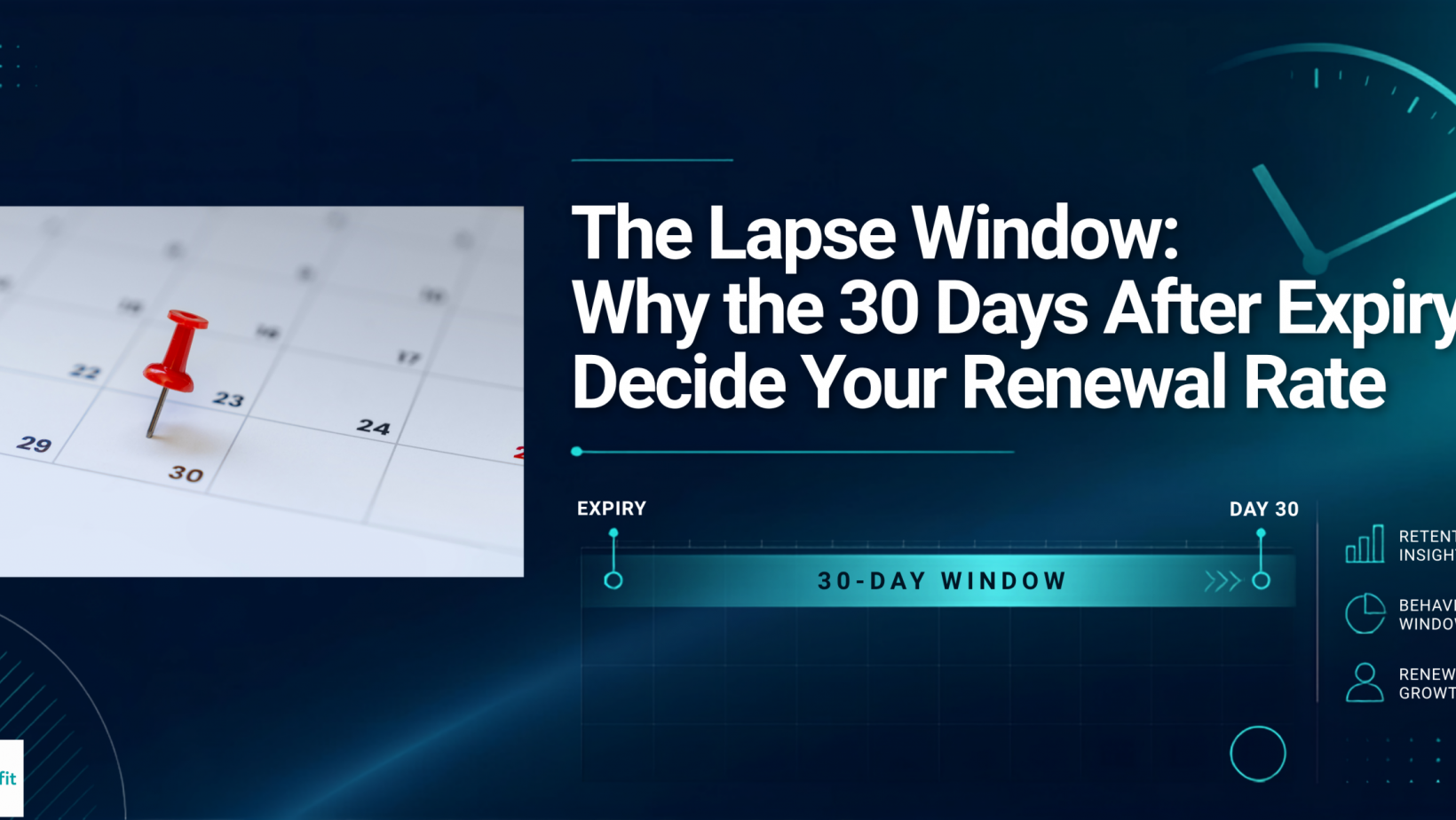
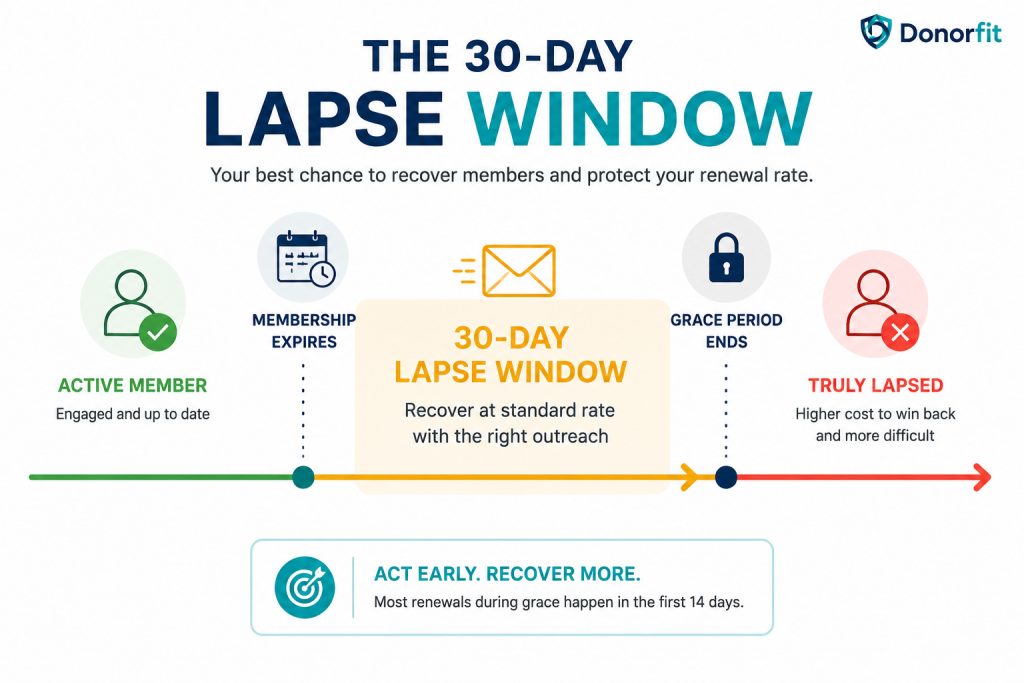
The membership lapse window is the short stretch immediately after a membership expires—commonly the first 30 days—when a member has technically lapsed but can still be recovered at the standard renewal rate, before they slide into true lapse and the harder, costlier work of reinstatement begins. Most organisations treat the expiry date as a deadline. It isn’t. It’s the starting gun for the highest-leverage recovery window you have all year.
If your renewal rate is where you want it, the lapse window is quietly protecting it. If it isn’t, this is almost always where the leak is—not in acquisition, and not even in the year of membership itself, but in the 30 days after the invoice goes unpaid.
Your renewal rate is a scoreboard, not a strategy
By the time a renewal rate lands, the decisions behind it have already been made. According to the 2025 MGI Membership Marketing Benchmarking Report, the median overall renewal rate across associations sits at 84%, with first-year members renewing at roughly 74–75%—figures that have held steady for several years. Those numbers tell you what happened. They don’t tell you what to do next.
That’s because the renewal rate is a lagging indicator. A lapsed member didn’t decide to leave the day the invoice arrived; the drift usually started months earlier, in declining engagement. (We covered that leading-indicator problem in depth in the 90-day renewal window piece.) But there is one point where a lagging metric briefly becomes something you can still influence directly—and that point is the lapse window. Once a membership expires, you have a narrow, active period where a well-timed sequence can still convert a “no” back into a “yes” at full price.
What actually happens in the 30 days after expiry
The window between expiration and true lapse is called the grace period, and how you run it decides how much of your at-risk membership you recover. During this stretch, a lapsed member can typically still renew without penalty, keep continuity on their record, and—if you’ve set it up well—still hear from you.
The operational benchmarks here are fairly consistent. In its June 2026 analysis, association software provider i4a identifies 30–60 days as the grace-period “sweet spot”—long enough to catch genuinely delayed renewers, short enough to preserve urgency. It varies by organisation type: professional associations typically run 30–45 days, trade associations and chambers 45–60 (to accommodate organisational budget approval cycles), and credentialing bodies 30 days or fewer.
Three targets from the same source are worth pinning to the wall:
-
- Grace-period conversion rate: 70–80% of members who enter grace should ultimately renew.
-
- Days to renew during grace: under 14. Most recoverable members act in the first two weeks, which is why the window front-loads and why waiting to “follow up next month” is how recoverable members become lost ones.
-
- Lapse rate after grace: under 10%. If more than one in ten truly walks after grace ends, the problem is usually the sequence, not the members.
Why 30 days? An honest answer
There is no single industry benchmark proving that renewal probability falls off a statistical cliff at exactly day 30—and it’s worth saying so plainly. The 30-day figure is operational consensus, not a measured dropoff. Anyone quoting you a precise “renewals drop X% after 30 days” number is likely extrapolating past what the published data actually supports.
What the evidence does support is a concentration of recovery activity and results inside that first month. The recognised grace-period communication sequences run from day 1 through roughly day 30. The days-to-renew target under 14 means the bulk of successful grace renewals happen early. And separately, Spark Consulting has noted a correlation between a two-to-three-month grace period and a higher probability of clearing 80% retention, while explicitly cautioning that correlation is not causation.
The mechanism behind the window is straightforward, even where the precise numbers aren’t published: after grace ends, many systems reset the member’s status to “new,” reinstatement can carry friction or fees, and every additional week of lapse weakens both the habit and the relationship. The 30-day window isn’t magic. It’s simply the period where recovery is cheapest, easiest, and least awkward—an email sequence rather than a full win-back campaign.
The three states of a membership—and what each costs to recover
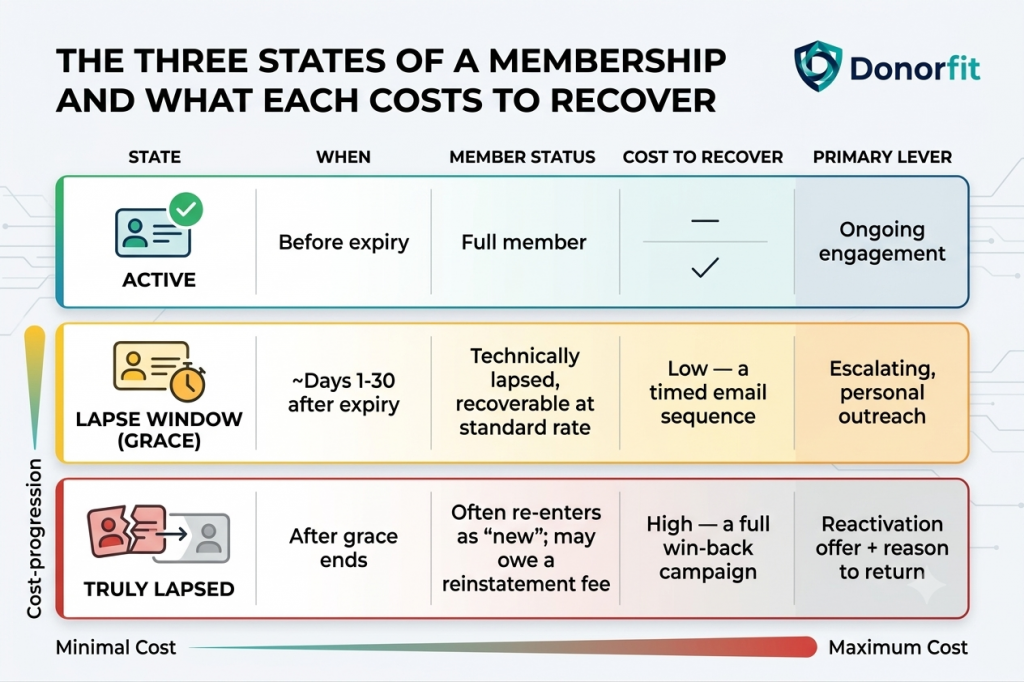
The table makes the economic case on its own: the same member who costs you one email sequence to keep in week two costs you a multi-touch win-back campaign three months later. The lapse window is where retention is still an operations problem. Miss it, and retention becomes a marketing problem.
The recovery sequence that fits the window
A grace-period sequence should escalate urgency while keeping every path to renewal one click away. The five-touch framework i4a recommends maps cleanly onto the 30-day window:
-
- Day 1 — “Your membership has expired.” A friendly, low-friction reminder with a direct renewal link.
-
- Day 7 — “Don’t miss what’s coming.” Name a specific upcoming event, resource, or benefit they’d lose.
-
- Day 14 — “You’re missing out.” Point to the benefits they’ve actually used that are now paused.
-
- Day 21 — “We haven’t heard from you.” A personal-feeling appeal, ideally from a real name or leadership.
-
- Day 28–30 — “Final notice.” A clear deadline and a plain statement of what happens next.
On access, the middle path wins. Cutting members off the instant they expire feels punitive and can damage the relationship; leaving full access indefinitely trains people to ignore renewal dates entirely. Restricted access with visible renewal prompts—members can still log in but see clear reminders of what they’re about to lose—tends to convert better than either extreme. The tone throughout should be a nudge, not a threat: urgency without punishment.
Where this fits in the membership lifecycle
The lapse window sits between renewal and reinstatement—the last stretch where a member is still yours to keep before they become someone you have to win back. It builds directly on the earlier stages of this series:
-
- The 90-Day Renewal Window — why engagement signals predict renewal long before the invoice.
-
- First-Year Member Retention — closing the 10-point gap between first-year and established members.
-
- Winning Back Lapsed Members — what to do once the lapse window has closed.
Frequently asked questions
What is the membership lapse window? The membership lapse window is the period immediately after a membership expires—usually the first 30 days—during which the member has technically lapsed but can still renew at the standard rate before entering true lapse. It’s functionally the same as the grace period, viewed through the lens of recovery.
How long should a membership grace period be? For most organisations, 30–60 days is the recognised sweet spot, per i4a’s June 2026 analysis. Professional associations typically use 30–45 days; trade associations and chambers often extend to 45–60 days to accommodate budget approval cycles; credentialing bodies usually stay at 30 days or fewer.
What percentage of grace-period members should renew? A healthy grace-period conversion target is 70–80%, with fewer than 10% of members truly lapsing after grace ends. If you’re well below that, the issue is typically the timing or content of your recovery sequence rather than the members themselves.
Do members lose access during the grace period? Not necessarily—and the best practice is a middle path. Restricted access with visible renewal reminders tends to convert better than either an immediate cutoff (which feels punitive) or indefinite full access (which removes any urgency to renew).
What’s the difference between the lapse window and reinstatement? The lapse window is for recovery at standard cost, while the grace period is still open. Reinstatement is what happens after grace ends—when the member may re-enter as “new,” may owe a reinstatement fee, and typically requires a full win-back campaign rather than a simple renewal reminder.
Stop Losing Members During the Lapse Window
The first 30 days after a membership expires can make the difference between a simple renewal and an expensive win-back campaign. But managing grace periods, sending timely reminders, and identifying at-risk members manually is difficult—especially as your membership grows.
Donorfit helps membership organisations automate the entire renewal and recovery process.
With Donorfit, you can:
-
- Automatically trigger renewal reminders before and after expiry.
-
- Create personalised grace-period email sequences.
-
- Track member engagement to identify at-risk members earlier.
-
- Monitor renewal and lapse rates with real-time dashboards.
-
- Give members a seamless online renewal experience.
-
- Reduce manual administration while improving retention.
Instead of reacting after members have already left, Donorfit helps you engage them before, during, and after the lapse window—so more memberships are renewed, and fewer need costly win-back campaigns.
Want to improve your membership renewal rate? Discover how Donorfit can help your organisation automate renewals, recover more lapsed members, and build stronger long-term member relationships.