




Why Donor Engagement Stalls — and the Data Blind Spot Behind It
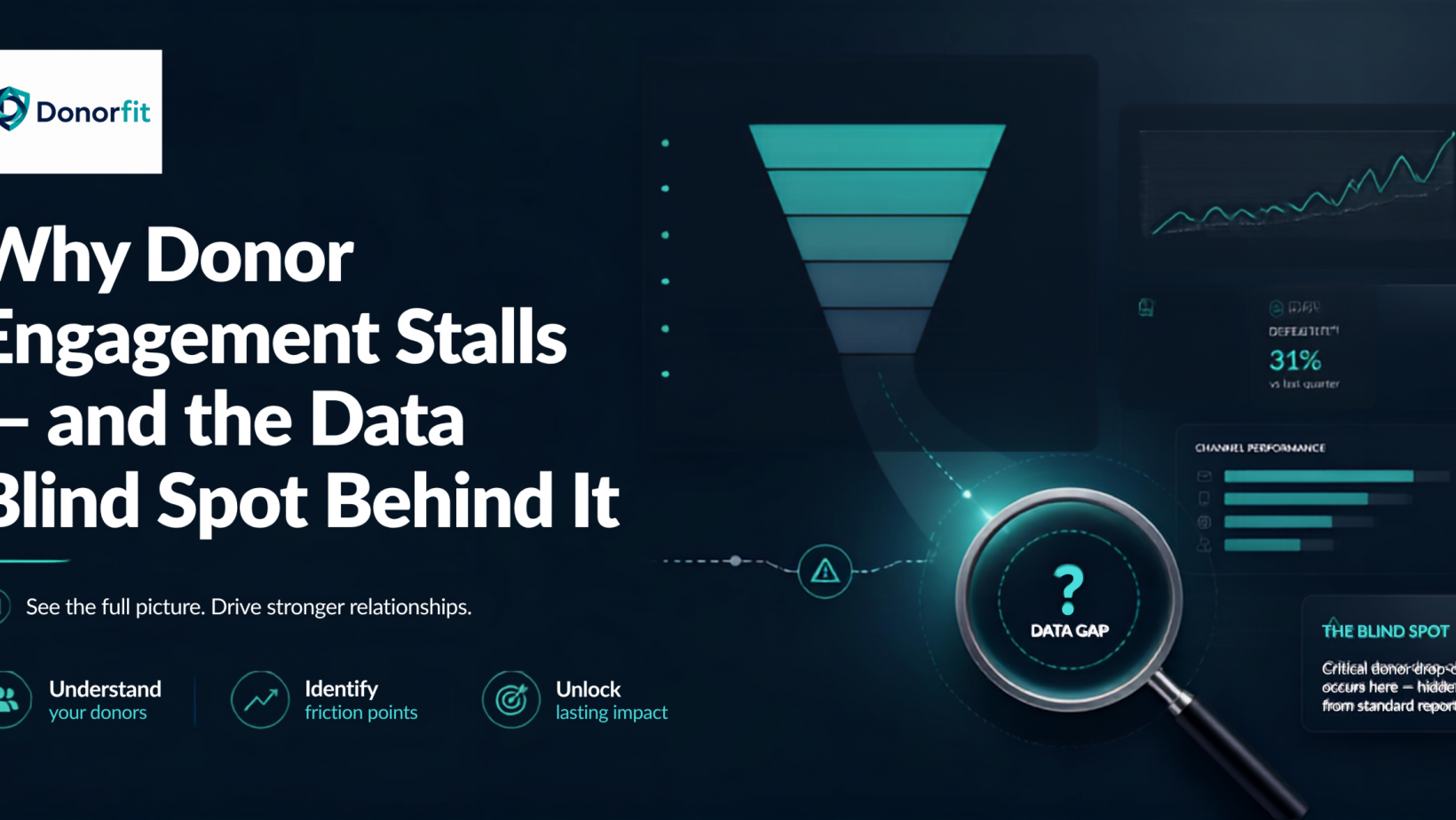
A donor data blind spot is the gap between the engagement that’s actually happening and the engagement your team can actually see—and it’s the reason most donor engagement stalls long before anyone notices. The signals are there: the donor who stopped opening emails, the volunteer who quietly became a lapsed giver, the event attendee who was ready for a bigger ask. But when those signals live in five different tools that don’t talk to each other, they’re invisible until they show up as a number you can’t fix: a retention rate, a missed renewal, a gift that never came back.
You can’t grow engagement you can’t see. This is the pillar problem beneath almost every retention failure—and it’s structural, not a matter of your team trying harder.
Engagement doesn’t stall quietly—you just can’t see it move
By the time disengagement shows up in your results, it has usually been visible in your data for months—if that data had been in one place. Donor engagement is a leading indicator. The declining email opens, the skipped event, the smaller gift: these move first, and the lapse follows. Miss the movement, and you’re left reacting to the outcome instead of preventing it.
The problem is that the most reliable engagement signals are often the most siloed. Event attendance, for instance, is one of the clearest indicators that a donor is invested—yet it commonly lives only in an events tool, disconnected from the donor record (OrangeDot / monday CRM). When your gala list sits in one system and your giving history in another, you can’t see that a major donor showed up in person, or that a lapsed donor came back for the night. The relationship timeline is broken into pieces no one can read end to end.
The blind spot is structural, not a discipline problem
Donor data fragments because organizations add tools one problem at a time, until the same donor exists in half a dozen disconnected places. This isn’t carelessness—it’s the default outcome of growth. And the numbers show how widespread it is:
- 60% of nonprofits still primarily use spreadsheets to manage their data, despite the well-known limits on security, automation, and reporting (Database for Nonprofit Organizations guide, 2026).
- 70% of nonprofits now manage five or more core platforms, up from 62% the year before, and 90% run three or more (Omatic 2026 Nonprofit Technology Ecosystem Trends Report).
- 54% of nonprofits identify incomplete or inaccurate data as a major obstacle to making the most of their donor information (2025 CCS Philanthropy Pulse Report).
Put those together, and the blind spot is almost designed in: more tools, more spreadsheets, and data that no longer agrees with itself. A data silo forms the moment the same person exists in two systems with no reliable way to keep both current, and most organisations have crossed that line without deciding to.
There’s a starker way to frame the waste. One figure that circulates in the sector—cited by Tim Lockie of The Human Stack—holds that roughly 90% of nonprofits collect data but only about 5% use it to make decisions. Treat the exact numbers as directional; the original study is hard to pin down. But the gap it points at is real, and you can see it in any fragmented tech stack: the data is being collected. It’s just not in a form anyone can act on.
What you literally cannot do without a connected view
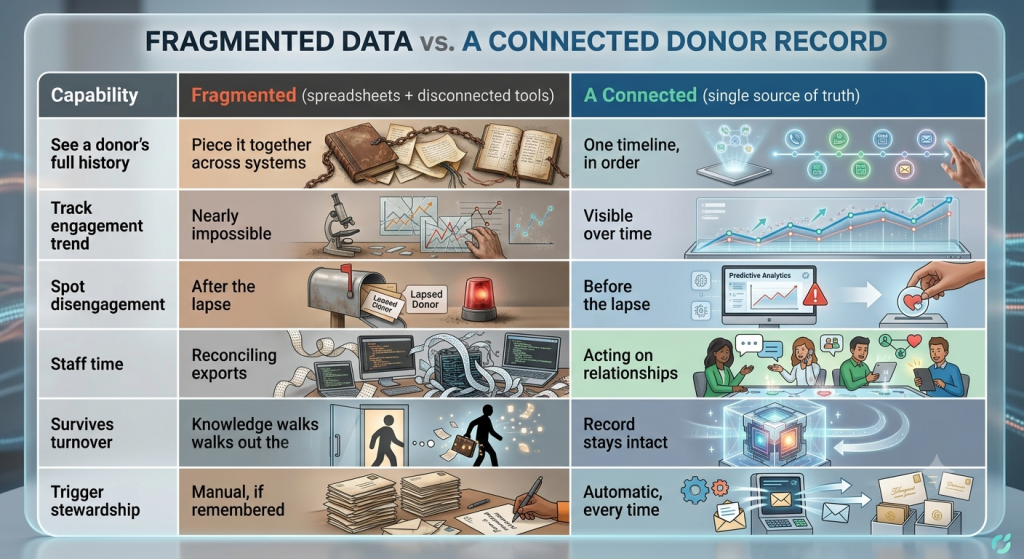
A fragmented donor record doesn’t just slow your team down—it makes entire categories of engagement work impossible. When donor data is scattered, you cannot:
- Track engagement over time. Spreadsheets make it nearly impossible to segment donors or watch engagement trend across a year (Neon One, 2026). Without a trend, you can’t tell rising or falling.
- Spot disengagement early. The signals that predict a lapse are only useful if you can see them before the lapse. Split across tools, they surface too late to act on.
- Act instead of reconcile. When records live in different platforms, staff spend their time merging exports and hunting for information rather than using it to strengthen relationships (Giveffect).
- Survive staff turnover. In a fragmented environment, every departure takes undocumented knowledge with it, and the next person rebuilds the picture from scratch.
Each of these is an engagement problem wearing a data costume. The team wants to steward donors well. The system won’t let them see who needs it.
The blind spot sits upstream of every retention failure
Almost every specific way donors and partners drift away traces back to the same root: a signal that was there but couldn’t be seen in time. It’s worth making the connection explicit, because the symptoms usually get treated in isolation:
- Sponsors don’t ghost because your price was too high—they ghost because the relationship went dark and no one saw the disengagement building. (See Why Sponsors Ghost After Year One.)
- Water donors don’t give twice because the gift vanished into silence between donation and proof, with no system prompting the update. (See The Six-Month Silence.)
- Members slip past the renewal date because no one could see them entering the lapse window while there was still time to act. (See The Lapse Window.)
Fix each symptom, and you’ll help. Fix the blind spot, and you address all of them at once.
The fix is a single source of truth (before it’s a software purchase)
The goal isn’t more software—it’s one connected donor record that every team draws from, so engagement becomes visible enough to act on. A single source of truth means the gift history, the event attendance, the email engagement, the volunteer hours, and the communication log all attach to the same donor, updated in real time, without exporting and reconciling first.
That’s a principle before it’s a product. You can move toward it by auditing where the same donor currently lives, identifying which engagement signals are stranded in standalone tools, and consolidating toward a system where the relationship timeline is readable end to end. The test is simple: can you pull up one donor and see everything they’ve done with you, in order, in under a minute? If not, that’s the blind spot—and it’s what’s quietly capping your engagement.
Fragmented data vs. a connected donor record
Frequently asked questions
What is a donor data blind spot? A donor data blind spot is the gap between the engagement actually happening and what your team can see, caused by donor information being split across spreadsheets and disconnected tools. The signals that predict giving or lapsing exist, but no one can read them in time to act.
Why does donor engagement stall? Engagement usually stalls because it’s invisible, not because donors suddenly lost interest. Disengagement shows up first as small signals—fewer opens, a skipped event, a smaller gift—and when those signals are scattered across systems, they’re missed until they harden into a lost donor.
How many nonprofits still use spreadsheets for donor data? About 60% of nonprofits still primarily rely on spreadsheets for data management, according to a 2026 nonprofit database guide—despite spreadsheets’ limits on tracking engagement over time, segmenting donors, and keeping records consistent.
What’s the difference between collecting donor data and using it? Collecting data means it exists somewhere; using it means it’s connected and visible enough to change a decision. Many organisations collect far more than they can act on, because the data sits in silos rather than in one readable donor record.
What does a “single source of truth” mean for donor data? It means every piece of a donor’s history—gifts, events, emails, volunteering, communications—lives on one record that all teams share and that updates in real time, without exporting or reconciling between tools. It’s what makes engagement visible enough to grow.
How do data silos hurt donor retention? Silos hide the early signals of disengagement and force staff to spend time reconciling records instead of building relationships. Because engagement is a leading indicator of retention, a blind spot on engagement becomes a blind spot on who’s about to lapse—until it’s too late to intervene.
Related reading
- Why Sponsors Ghost After Year One (And It’s Not the Money)
- The Six-Month Silence: Why Water Donors Don’t Give Twice
- The Lapse Window: Why 30 Days After Expiry Decide Your Renewal Rate
Everything above points to one capability: being able to see a donor’s whole relationship in one place, in real time. That’s the core of what DonorFit is built to do—unify donor, gift, event, and engagement data into a single record your whole team can act on, with the security and reliability nonprofit data demands. See how DonorFit closes the donor data blind spot.