





The Six-Month Silence: Why Water Donors Don’t Give Twice
Most water donors don’t stop giving because they lost faith in the cause—they stop because they gave, heard nothing for months, and quietly concluded their gift didn’t matter. A well takes time to build. Somewhere in that gap between the donation and the proof, the relationship goes dark—and by the time the water is flowing, the donor has already moved on. That gap is the six-month silence, and it’s where most repeat gifts are lost.
The six-month silence is the communication gap between a water donor’s gift and any proof it worked—and it’s the single biggest driver of poor water donor retention. This isn’t a giving problem. It’s a communication problem. And unlike the cause itself, it’s entirely within your control.
The second gift is where water fundraising breaks
The hardest gift to earn isn’t the first—it’s the second, and the sector loses most donors right there. Across nonprofits, roughly 70% of new donors never give again (Bloomerang, 2026). Depending on how it’s measured, only about 14% of first-time donors go on to make a second gift (Fundraising Effectiveness Project data, via Keela, 2026); more generous estimates still top out under 30% (Dataro, 2024). Either way, the first-to-second-gift cliff is the single biggest leak in fundraising.
A note on the numbers: these are sector-wide figures, not water-specific ones—there’s no reliable retention benchmark unique to WASH charities, and it would be dishonest to invent one. But water fundraising inherits the general second-gift problem and adds a structural challenge few other causes face: the thing the donor paid for is invisible for a long time.
The stakes compound. One-time donors retain at roughly 19%, while donors who give seven or more times retain at about 87% (Keela, 2026). And acquiring a new donor costs around five times as much as keeping one. Every donor lost to silence is one you’ll pay a premium to replace.
Why the silence happens (and why “build faster” isn’t the answer)
Water projects are genuinely slow, so the fix isn’t speeding up the well—it’s refusing to go quiet while it’s built. This is worth stating plainly, because the instinct is to promise faster results you can’t deliver.
Consider the field’s gold standard. charity: water tells donors upfront that a completion report can take up to 21 months to arrive, because their partners need time to implement projects in remote areas and then travel back—sometimes by motorbike or on foot—to gather GPS coordinates and photos (charity: water). Twenty-one months. If the most celebrated water charity in the world can’t show you a finished well in six months, neither can you.
What they do instead is the entire lesson: they don’t leave the donor in silence during the wait. While work is underway, they share progress from the field through an ongoing update feed, and then, at completion, they deliver personalised proof—photos and GPS coordinates of the exact project the donor funded. Their promise, in effect, is to give water, get proof—every time. The build is slow. The communication never stops.
What donors actually need between the gift and the well
Donors stay when they can see who their money helped—so impact, not urgency, is what fills the silence. DonorVoice’s research (summarised by Bloomerang) found that several of the top reasons donors stay loyal are tied directly to outcomes: believing the organisation is effective, feeling part of an important cause, and—critically—receiving information showing who is being helped.
That maps to a simple stewardship cadence. The first 90 days matter most: send a genuine thank-you within 48 hours, show some form of impact within 30 days, and make a second meaningful touchpoint within 90 days (Keela, 2026). For a water gift, “impact within 30 days” doesn’t mean a finished well—it means context: where the project is, who it will serve, what happens next. You’re not proving completion. You’re proving the gift is alive.
The silent path vs. the proof path
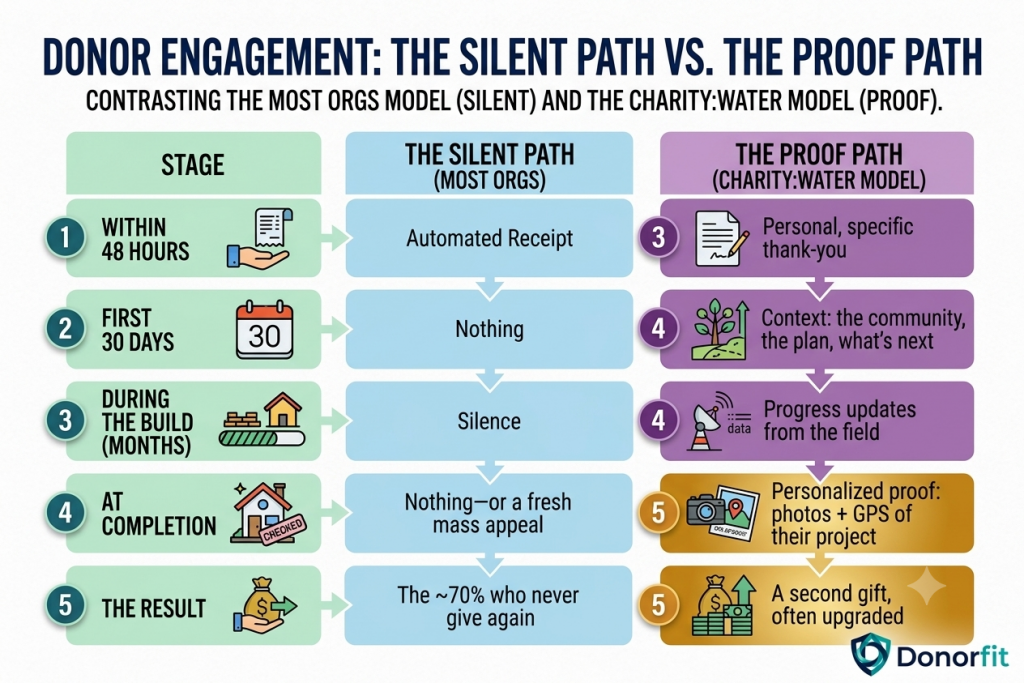
| Stage | The silent path (most orgs) | The proof path (charity: water model) |
| Within 48 hours | Automated receipt | Personal, specific thank-you |
| First 30 days | Nothing | Context: the community, the plan, what’s next |
| During the build (months) | Silence | Progress updates from the field |
| At completion | Nothing—or a fresh mass appeal | Personalized proof: photos + GPS of their project |
| The result | The ~70% who never give again | A second gift, often upgraded |
The difference between these two columns isn’t budget or better wells. It’s whether anyone decided to stay in touch.
What to fix first
You don’t need a charity: water budget to close the six-month silence—you need a sequence that runs whether or not anyone remembers to send it. In order:
- Thank fast and specifically. Within 48 hours, and referencing what they actually funded—not a generic acknowledgment.
- Send a 30-day “your project is underway” update. Location, community, timeline. Proof of life, not proof of completion.
- Break the silence during the build. Even one or two field updates over the months turns a black hole into a story the donor is following.
- Deliver real proof at completion. Photos and specifics tied to their gift. This is the moment that earns the second gift—don’t waste it on a form letter.
- Then, and only then, ask again. A donor who just saw their well is far more receptive than one being cold-solicited out of silence.
Frequently asked questions
Why don’t water donors give a second time? Most don’t give again because the relationship went silent between their gift and any evidence it worked. Nearly 70% of new donors never give a second time sector-wide, and water fundraising makes the problem worse because the funded project stays invisible for months. Silence reads as “your gift didn’t matter,” even when it did.
How long does it actually take to see a completed water project? Longer than most donors expect. charity: water tells donors a completion report can take up to 21 months, because projects are implemented in remote areas and completion data has to be gathered in person. This is exactly why interim communication matters—you usually can’t show a finished well quickly, so you have to show progress instead.
What is the “six-month silence”? It’s the communication gap between when a donor gives to a water project and when they hear anything about it. Because wells take months to build, organizations that only communicate at the point of donation and (maybe) at completion leave a long silent stretch—and most donors drift away inside it.
What should you send a water donor while the project is being built? Proof of life, not proof of completion: a specific thank-you within 48 hours, a 30-day update on where the project is and who it will serve, and periodic field progress during the build. The goal is to keep the gift feeling active and real until the finished-project proof can arrive.
Is there a donor retention benchmark specific to water charities? No reliable one exists. The available benchmarks—around 70% of new donors giving only once, roughly 14% making a second gift—are sector-wide figures from sources like the Fundraising Effectiveness Project, not water-specific data. Track your own retention rather than assuming a borrowed number fits WASH giving.
How does charity: water keep donors giving? By never letting the wait become silence. They thank donors, share field progress while work is underway, and then deliver personalized proof—photos and GPS coordinates of the specific project funded—so the donor sees exactly what their money did. Proof, delivered consistently, is what converts a one-time gift into a lasting relationship.
Related reading
- Why Water Charities Lose Donors Between Well Completions (And How to Close the Gap) https://donorfit.com/en/why-water-charities-lose-donors-between-well-completions-and-how-to-close-the-gap/ How Water Charities Report Impact When One Well Has 40 Different Donors https://donorfit.com/en/how-water-charities-report-impact-when-one-well-has-40-different-donors/
Closing the six-month silence is a systems problem before it’s a writing problem—someone has to know which donor funded what, and trigger the right update at 48 hours, 30 days, and completion without relying on memory. That connective tissue between a gift and its proof is exactly what a purpose-built donor platform is meant to hold. See how DonorFit helps you turn first-time water donors into lasting ones.