







How Water Charities Report Impact When One Well Has 40 Different Donors
Multi-donor project attribution is the process of accurately tracking and reporting how much each donor contributed toward a shared project — such as a single well funded by 40 separate gifts of varying amounts — and communicating that specific contribution back to each donor. It’s a distinct operational challenge from single-donor reporting, and it’s one most water and WASH organisations run into constantly, because very few wells are funded by one donor alone.
Why is this a structurally different problem than general donor communication?
A single-donor project is straightforward to report on: one gift, one project, one update. A multi-donor project isn’t a bigger version of that same problem — it’s a different kind of problem entirely. When 40 donors each gave a different amount toward the same well, the organization has to answer questions a single-donor system was never built to handle: What percentage of this project did each donor actually fund? Does a donor who gave $10 get the same update as one who gave $1,000? What happens when a project is only 60% funded — do early donors get told their well is still incomplete, or does the organisation wait until it’s fully funded to say anything at all?
Where manual systems break down specifically
-
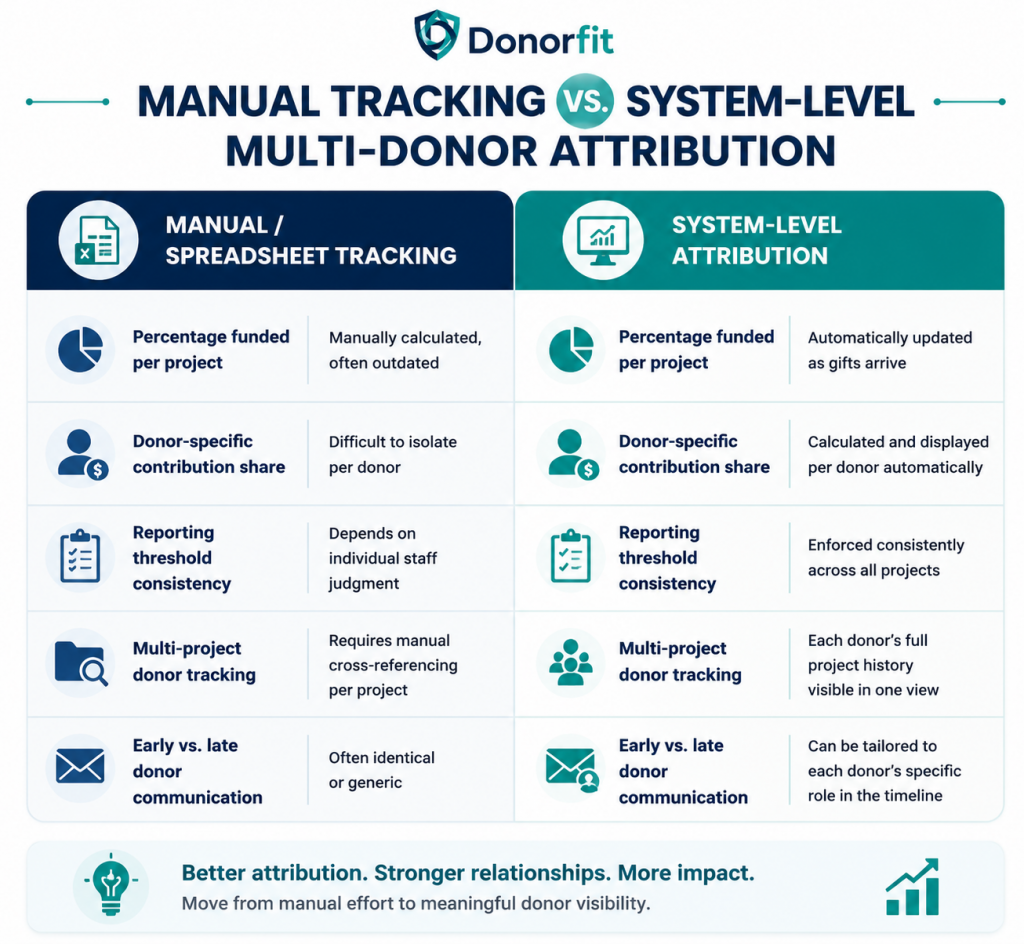
- Partial funding is hard to track without a running total tied to the project, not just the donor. Spreadsheets can log individual gifts, but connecting “this specific gift” to “this percentage of this specific well” requires cross-referencing that most manual systems don’t do automatically — so organisations often can’t say with confidence exactly how funded a given project is at any moment.
-
- Attribution gets murkier as project count grows. An organisation running five concurrent well projects with donors spread unevenly across them is managing a matrix, not a list. Manually reconciling which donor funded which share of which project, across dozens of active builds, is exactly the kind of task that quietly stops happening at scale.
-
- Reporting cadence and threshold decisions are inconsistent without a system enforcing them. Should an update go out at 25% funded, 50%, or only at completion? Without a rule built into the system, different staff members answer that question differently — donors on the same project can end up getting inconsistent communication.
-
- Donors who funded the “last mile” of a project often get the least personalised story. The donor whose gift completed a well gets to feel like they finished something. The donor who gave early, when the project was still 20% funded, often gets a generic update with none of that specificity — even though their gift was arguably what made the project possible in the first place.
What does this cost a water charity specifically?
Donors who can see their specific contribution mapped clearly to a project’s progress are more likely to give again, because the impact feels concrete rather than diffused into a pool. When attribution is fuzzy — when a donor can’t tell whether their $50 gift actually moved a specific well forward — the emotional specificity that makes water fundraising compelling in the first place gets lost. That’s a retention cost hiding inside a reporting problem: the organisation isn’t failing to communicate, it’s failing to communicate accurately enough to feel personal, and donors notice the difference even when they can’t articulate why an update feels generic.
Manual Tracking vs. System-Level Multi-Donor Attribution
The fix is attribution infrastructure, not more detailed spreadsheets
Adding more columns to a tracking spreadsheet doesn’t solve this — the problem isn’t a lack of data, it’s the lack of a system that automatically calculates and maintains the relationship between many donors and one project as gifts arrive and projects progress. What actually fixes this is software that ties each gift to a specific project at the point of donation, calculates real-time funding percentages, and generates donor-specific updates reflecting each person’s actual share — whether they were donor #1 or donor #40.
This is a different fix than the one covered in Donorfit’s piece on the donor-to-project visibility gap — that piece is about the silence between funding and completion for any donor. This one is about ensuring that when the update is released, it accurately reflects the specific contributions of each donor, rather than a generic broadcast to everyone associated with the project.
CTA: See how Donorfit handles multi-donor project attribution for water and WASH organisations → donorfit.com
Frequently Asked Questions
How do you calculate what percentage of a project a donor funded? It requires dividing each gift by the project’s total funding goal (or total raised, depending on the reporting model), which is tracked continuously as new gifts arrive — a task that becomes increasingly difficult to maintain accurately by hand once a project has more than a handful of contributors.
Should early donors and late donors to the same project get different updates? There’s a reasonable case for it — an early donor’s gift often carried more funding risk, since the project wasn’t guaranteed to reach completion yet, while a later donor’s gift may have been what pushed it over the finish line. Reflecting that distinction requires a system that knows each donor’s specific timing and share, not just their total gift amount.
What’s the difference between multi-donor attribution and general donor updates? General donor updates communicate project status to everyone associated with it. Multi-donor attribution goes a level deeper — calculating and communicating each specific donor’s individual share and role in a project that many people funded together.