








The First 30 Days: A New Member Onboarding Playbook That Lifts First-Year Renewals

New member onboarding is the deliberate set of touches an organisation makes in the weeks right after someone joins, designed to get them using the membership before they’ve had time to forget why they signed up. The first 30 days are the part that matters most, because a member who engages early is far likelier to still be there a year later.
First-year members renew well below the average, and the difference is usually decided in the first month, not in the renewal reminder eleven months later. This playbook is what to do in those 30 days, in what order, and how to tell whether it’s working.
Year one is where the leak is
Look at where members actually disappear, and it’s rarely the long-tenured ones. It’s the newcomers.
Marketing General’s 2025 Membership Marketing Benchmarking Report puts the median overall renewal rate at 84%, while first-year members renew at roughly 75%. That nine-point gap is the single biggest retention opportunity most membership teams have, and it’s hiding in plain sight. A member who makes it past year one tends to keep renewing. A member who never really got started in year one quietly lapses, and the organisation often reads it as normal churn rather than a fixable onboarding failure.
The reason connects to why members leave at all. In the same MGI report, 52% of associations named lack of engagement as the top reason members don’t renew. Engagement doesn’t switch off at renewal time. It fails to switch on at the start. Someone who joined, got a receipt, and then heard nothing for three months has no reason to feel like a member by the time the first renewal notice arrives.
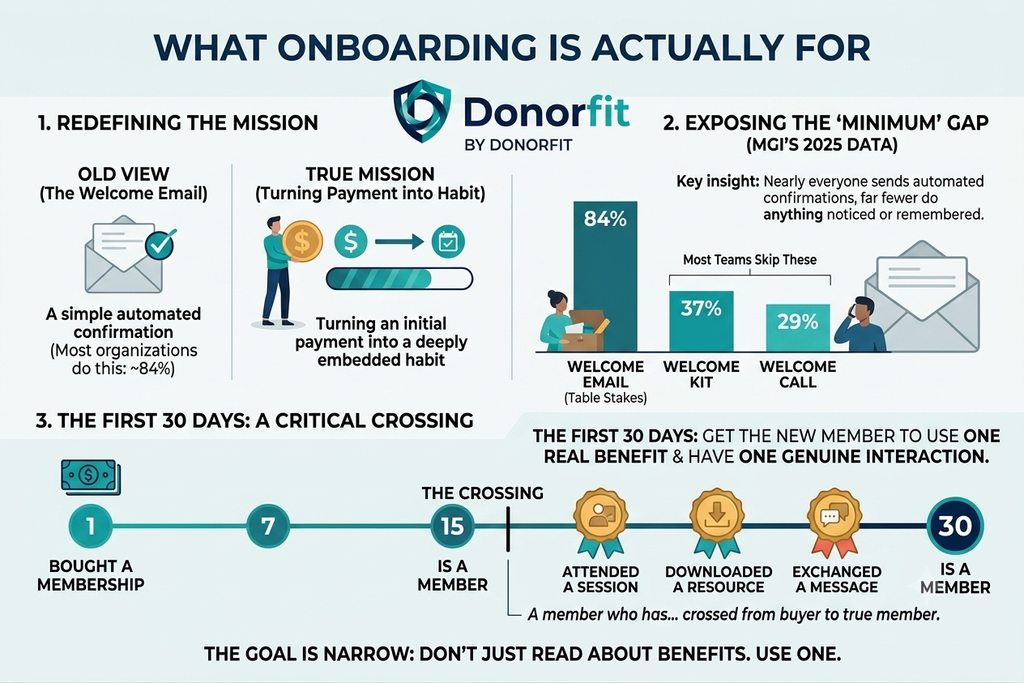
What onboarding is actually for
The 30-day playbook
The sequence matters as much as the content. Here’s the shape that works, with each touch doing a distinct job.
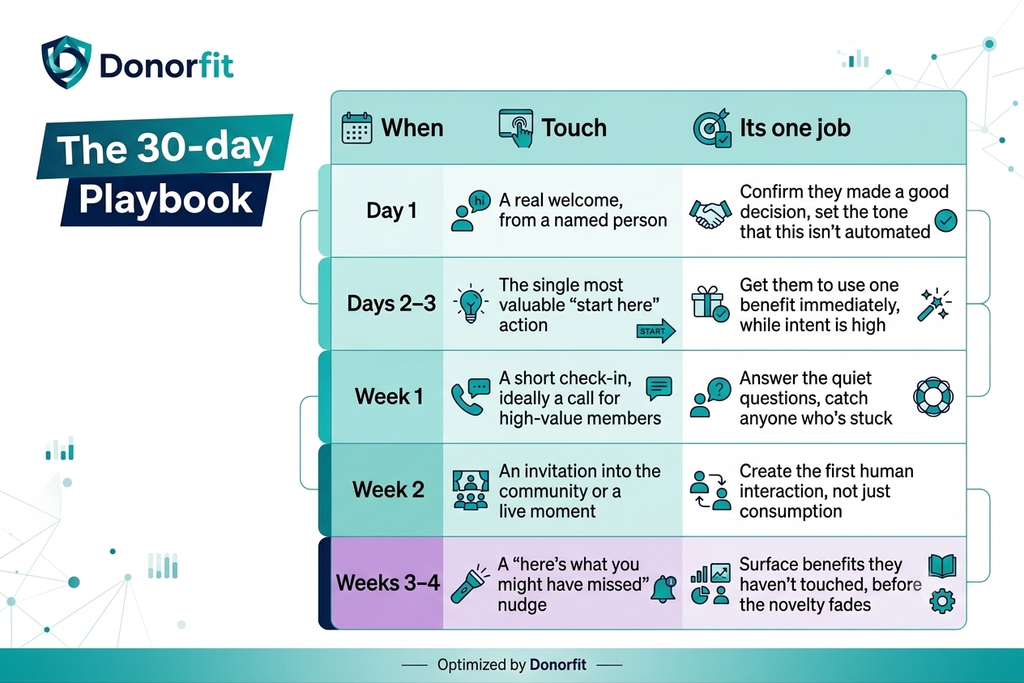
A few notes on making this real rather than theoretical. The Day 1 welcome should come from a person, with a reply-to that reaches a human, because the first impression of “automated system” is hard to undo later. The Days 2–3 action should be one thing, not a menu of twelve, since a long list of options is the same as no direction. And the Week 1 check-in is where the welcome call earns its place. It’s the touch that fewest organisations make, and the one new members remember, especially anyone who joined and then felt unsure what to do next.
The failure mode: welcome, then silence
The common version of onboarding is a welcome kit and a warm email, followed by nothing until the renewal ask. It feels like onboarding. It isn’t. It front-loads the effort into the moment the member is least in need of help (they just chose to join) and goes quiet exactly when doubt sets in.
Compare the two paths a new member can take in their first month:
| Onboarded | Welcomed, then dropped | |
| First month | Uses a benefit, talks to a human | Reads a welcome email, files it |
| Month three | Recognises value, feels like a member | Can’t recall what the membership is for |
| Renewal notice | Confirms a decision already made | Meets a stranger asking for money |
The renewal reminder does the same work in both cases. The difference was set months earlier, in whether the first 30 days built a habit or a receipt.
How to tell it’s working
Don’t wait for the renewal rate to tell you, because that verdict arrives a year too late to act on. Watch first-month engagement instead. What share of new members took the Day 2–3 action? How many attended something live in the first two weeks? How many replied to a human? Those numbers move within weeks and predict the renewal you won’t see for months. If early engagement is flat, the renewal problem is already baked in, and no reminder sequence will fully undo it.
One dependency sits under all of this. You can only onboard members you can see. If new joins land in a spreadsheet that no automated welcome fires from, or if the first-30-days touches depend on someone remembering to send them, the playbook runs only as well as the busiest week on your team allows. Reliable onboarding needs the sequence to fire off the member record automatically.
Related reading:
| The Hidden Cost of Manual Membership Management | https://www.linkedin.com/pulse/hidden-cost-manual-membership-management-how-spreadsheets-hurt-lacnf/ |
| Why Membership Renewals Should Start 90 Days Before Expiration | https://donorfit.com/en/why-membership-renewals-should-start-90-days-before-expiration/ |
| First-Year Member Retention: Why New Members Renew at 74% — and How Onboarding Closes the Gap | https://donorfit.com/en/first-year-member-retention-why-new-members-renew-at-74-and-how-onboarding-closes-the-gap/ |
| The Lapse Window: Why the 30 Days After Expiry Decide Your Renewal Rate | https://donorfit.com/en/the-lapse-window-why-the-30-days-after-expiry-decide-your-renewal-rate/ |
| Building a Renewal Reminder Sequence: What to Send at 90, 60 & 30 Days | https://donorfit.com/en/building-a-membership-renewal-reminder-sequence-what-to-send-at-90-60-30-days/ |
Frequently asked questions
Why do first-year members renew at a lower rate? Because year one is where engagement either takes hold or doesn’t. MGI’s 2025 data shows first-year renewal around 75% against an 84% overall median. New members who don’t use a benefit or form a connection in their first weeks have little reason to renew when the notice arrives.
How long should new member onboarding last? The decisive window is the first 30 days, though light touches can extend to 90. The aim in the first month is to get the member to use one real benefit and have one genuine interaction, not to walk them through every feature.
What should a new member onboarding sequence include? A personal Day 1 welcome, one clear “start here” action within a few days, a check-in in week one, an invitation into the community in week two, and a “what you might have missed” nudge by week four. Each touch should do a different job.
Is a welcome email enough to onboard a new member? No. Around 84% of associations send a welcome email, so it’s the baseline, not a differentiator. The touches that build retention are the ones most teams skip: a welcome call, a specific first action, and an early human interaction.
How do you measure whether onboarding is working? Track first-month engagement rather than waiting for the renewal rate. The share of new members who take the first action, attend something live, or reply to a person predicts renewal months in advance and is something you can still act on.
Onboarding only lifts renewals if it actually happens for every new member, not just the ones a staff member had time to reach that week. That depends on new joins flowing into a system that can trigger the first-30-days sequence on its own, and on knowing which members haven’t engaged yet. If dependable, automatic onboarding is on your roadmap, that’s where DonorFit fits.