










Why Membership Renewals Should Start 90 Days Before Expiration
Membership renewal is a lagging indicator of engagement: by the time a renewal notice arrives, most members have already decided whether the relationship is worth continuing. Organisations with the strongest retention rates treat the 60–90 days before expiration — not the final 30 — as the real renewal window, because that is the last period during which engagement can still be influenced.
The data support starting even earlier. Marketing General Incorporated (MGI), which has benchmarked association membership practices annually since 2009, found that associations beginning renewal efforts five months or more before expiration were more likely to report renewal rate increases than those starting later (25.7% vs. 19.8%, MGI Membership Marketing Benchmarking Report, 2012). More than a decade of subsequent MGI research has reinforced the same theme: renew early, and renew through engagement rather than reminders alone.
Renewal rates look stable — until you look underneath them.
According to MGI’s 2025 Membership Marketing Benchmarking Report, the median renewal rate across professional and trade associations is 84%. First-year members renew at a much lower median, making them the highest-risk cohort in almost every organisation MGI has studied.
First-year members renew at roughly 74%, versus an 84% overall median — a 10-point gap that makes the first membership year the single largest retention opportunity most organisations have. (MGI 2025 Membership Marketing Benchmarking Report)
An 84% median means the typical organisation replaces roughly one in six members every year just to stay level. And because renewal decisions accumulate quietly across the membership year, that 16% loss is rarely visible until the fiscal reports land. The organisations that outperform the median are not sending better final-notice emails. They are intervening earlier.
Why is the renewal decision made before the renewal notice?
When MGI asked association staff why members fail to renew, the top answer was not price. It was a lack of engagement with the organisation, cited by 51% of respondents — ahead of lack of value (33%) and simply forgetting to renew (32%) (MGI Membership Marketing Benchmarking Report, 2023).
Disengagement is a gradual process, not an event. Members stop opening emails, then stop attending events, then stop using benefits — usually in that order, and usually over a period of months. Each signal is small enough to miss on its own. Together, they describe a member who has already begun to leave.
Consider a composite example. A member joins a professional association in July, attends two events in her first six months, and opens nearly every newsletter. In March, her open stops. In April, she registers for an event but doesn’t attend. In May, nothing. Her renewal invoice goes out in late June — and to the renewal team, she looks like every other member on the list, because the invoice is the only thing they can see. The renewal notice doesn’t trigger her decision; it reveals a decision that engagement data would have surfaced a full quarter earlier.
This is why organisations that concentrate their renewal effort into the final 30 days consistently underperform. By that point, the intervention available to them is a reminder — and a reminder cannot rebuild value that stopped being experienced three months ago.
The 90-day window: the last point of real influence
Starting renewal work 90 days before expiration matters because that window sits at the intersection of two curves: engagement has usually begun declining for at-risk members, but the relationship is still recent enough to recover. Inside that window, staff can act on what the data shows:
- Personal outreach to members whose email or event activity has dropped, before the conversation becomes about an unpaid invoice
- Benefit recommendations matched to what the member actually joined for — MGI’s research consistently finds that members who use benefits renew at higher rates than those who don’t
- Event invitations targeted at members whose participation has lapsed, since event attendance is one of the strongest engagement signals available
- Value recaps that make the year’s usage visible: sessions attended, resources accessed, savings realised
The evidence that structured engagement drives renewal is direct. MGI found that 78% of associations reporting improved renewal rates had a tactical plan to increase member engagement (MGI Membership Marketing Benchmarking Report, 12th edition, 2020). Improved retention is rarely an accident of good renewal copy. It is the output of a system that watches engagement and acts on it.
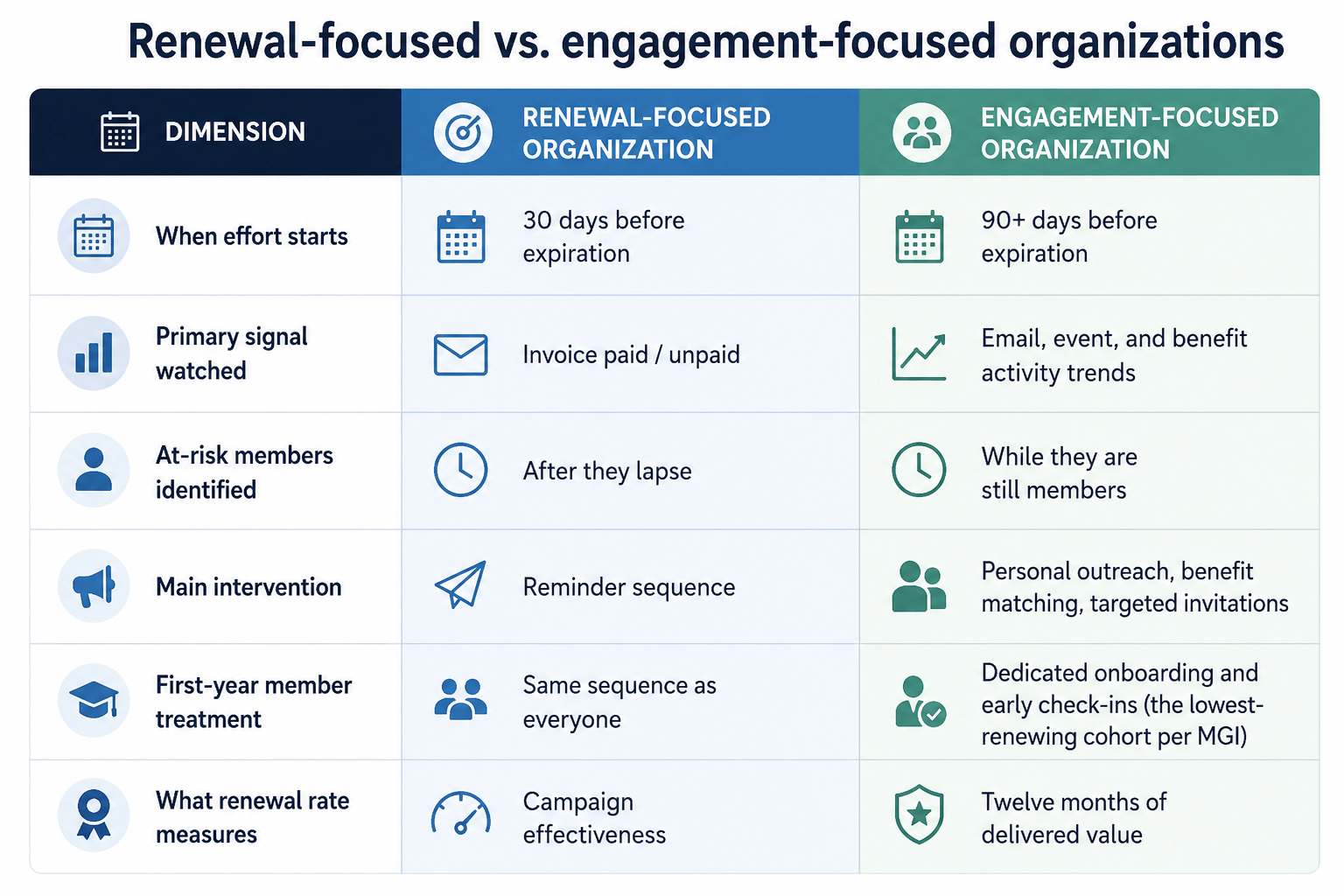
Renewal-focused vs. engagement-focused organizations
What to track — and why tracking it manually breaks down
An early-warning system for renewals rests on five engagement indicators:
Email engagement. Declining opens and clicks are typically the earliest signal, appearing well before any behavioural change is visible elsewhere.
Event participation. A member who attended three events last year and none this year is telling you something no survey will.
Benefit utilization. Members renew what they use. MGI’s research ties unused benefits directly to the “lack of value” non-renewal reason.
Communication history. If no one on staff has interacted with a member in six months, the organisation has no relationship to renew — only a transaction.
Activity trend direction. A single low-engagement month means little. Three consecutive declining months, 90 days before expiration, is an actionable risk flag.
Each of these signals lives in a different place — the email platform, the event registration list, the benefits log, and individual staff inboxes. This is where the manual-tracking gap covered in The Hidden Cost of Manual Membership Management compounds: a spreadsheet can record that a member exists, but it cannot tell you that her email opens stopped in March, her event attendance stopped in April, and her renewal is due in July. Assembling that picture by hand for one member is tedious. Assembling it for eight hundred members, every month, is not a staffing problem — it is a system problem.
A membership management platform like Donorfit closes that gap mechanically rather than heroically. Because email activity, event participation, benefit usage, and communication history are consolidated in one member record, declining engagement becomes visible as a trend rather than a post-mortem. Staff see which members are entering the 90-day window with falling engagement — and can spend their time on outreach instead of on reconciling exports from four different tools.
Retention is the growth strategy, not the defensive one.
The economics favour early intervention. At a median 84% renewal rate, an organisation of 1,000 members must recruit 160 new members annually just to hold steady, before any growth. Retention losses set the floor that recruitment has to climb over every single year.
Retention gains also compound in a way recruitment gains do not. Every point of retention recovered reduces the recruitment burden, extends member lifetime value across additional dues cycles, and stabilises the revenue that programs depend on. MGI’s benchmarking has repeatedly found that associations reporting membership growth are more likely to report higher renewal rates, not just stronger recruitment.
Most organisations know exactly who failed to renew last quarter. Far fewer can name who is likely to fail to renew next quarter. That distinction — between a lapsed-member report and an at-risk-member list — is the difference between recovery efforts and retention efforts. Renewals don’t start when the invoice is sent. They start 90 days earlier, with visibility.
Frequently Asked Questions
How early should a membership renewal campaign start? At a minimum of 90 days before expiration. MGI benchmarking data (2012) found that associations starting renewal efforts five or more months before expiration were more likely to see renewal rate increases (25.7% vs. 19.8%). Early contacts should focus on value reinforcement; urgency belongs in the final weeks only.
What is a good membership renewal rate? The median renewal rate for associations is 84%, with first-year members at roughly 74% (MGI 2025 Membership Marketing Benchmarking Report). Rates vary meaningfully by organisation type, so trend direction over time matters more than any single benchmark comparison.
What is the number one reason members don’t renew? Lack of engagement with the organisation — cited by 51% of association staff in MGI’s benchmarking research, ahead of lack of value (33%) and forgetting to renew (32%). Engagement decline is measurable months before the renewal date, which makes it the most actionable retention signal available.
Which engagement signals best predict membership renewal? Email engagement, event participation, and benefit utilisation are the three strongest leading indicators, with communication history and overall activity trend providing context. No single signal is decisive; the pattern across signals over 60–90 days is what identifies at-risk members.
Why do first-year members renew at lower rates? First-year members are still testing whether membership value justifies dues, and MGI’s lifecycle research consistently identifies them as the lowest-renewing cohort. Frequent, positive interactions during the first year — onboarding contact, early benefit usage, event participation — correlate with higher first-year renewal.