






Why Donor Engagement Determines Nonprofit Growth
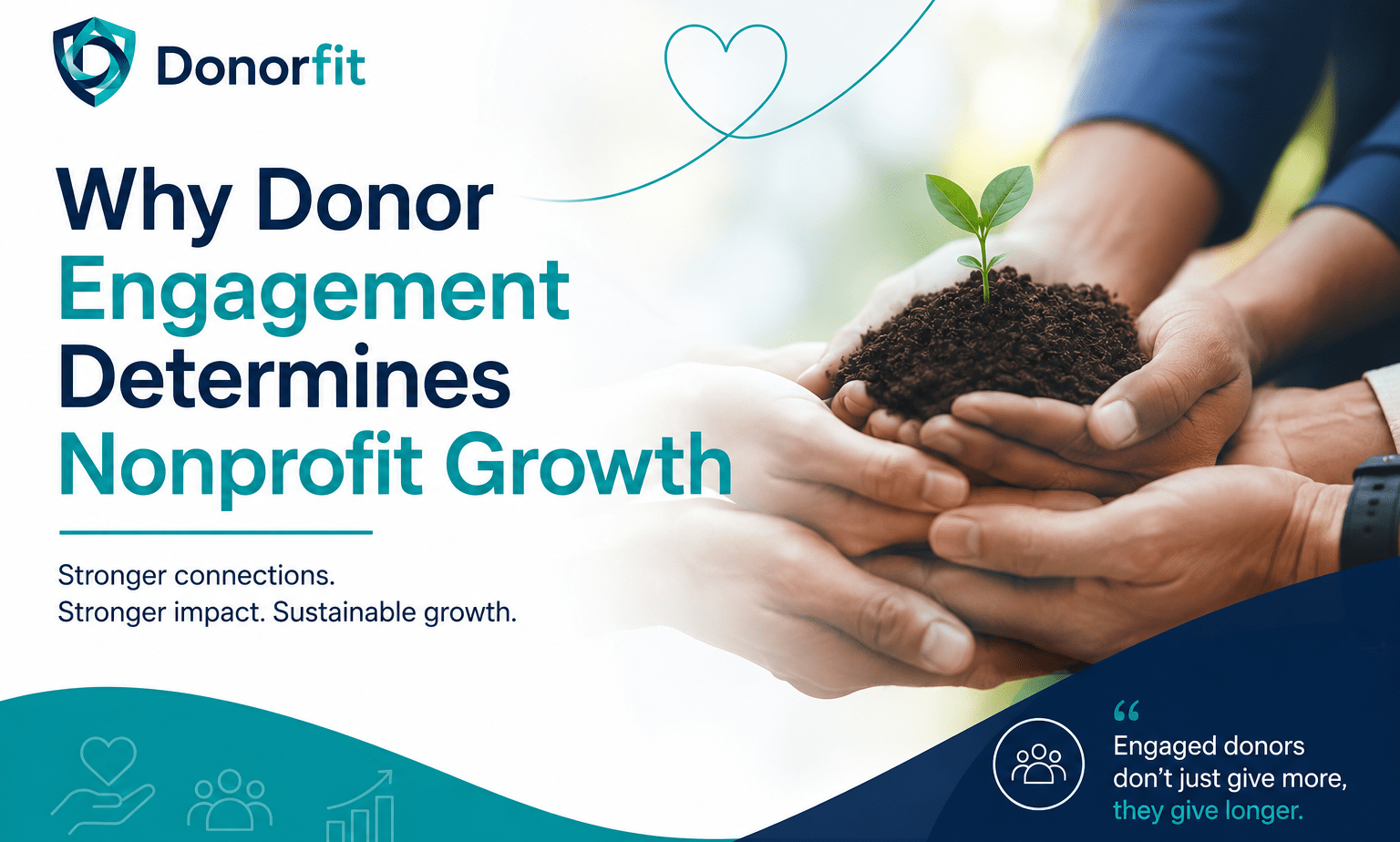
Donor engagement is the ongoing pattern of communication and interaction between a nonprofit and its supporters — acknowledgements, impact updates, event invitations, and every other touchpoint that keeps a donor connected to the outcome their gift funded. It is the single biggest lever nonprofits have over long-term revenue, and most organisations are underinvesting in it relative to acquisition.
The data backs this up directly. Nonprofits are reasonably good at keeping donors they’ve already engaged — and still struggling to turn a first gift into a second one. That gap is an engagement problem before it’s an acquisition problem.
| Metric | Figure | Source |
| Overall donor retention (Q4 2025) | 43.3%, up from 43.1% — driven entirely by donors with an existing relationship | FEP Q4 2025 |
| First-to-second gift conversion | 14.0% | FEP-sourced, via Keela 2026 |
| Cost to acquire a new donor vs. retain one | ~5x more expensive | Keela 2026 |
Why Donor Engagement Matters More Than Acquisition
The compounding math favours retention heavily. Donors who give seven or more times a year retain at 87.3%. One-time donors retain at just 19.2%.
| Donor giving frequency | Retention rate |
| 7+ gifts per year | 87.3% |
| One-time donors | 19.2% |
Source: FEP-sourced data, via Keela’s 2026 donor retention guide.
That gap is almost entirely a function of engagement, not gift size or donor wealth.
When engagement is consistent, donors are more likely to:
- Give a second and third gift
- Increase donation size over time
- Move into recurring or monthly giving
- Refer other donors
- Stay retained through a lapse-risk window instead of dropping off silently
5 Signs Your Donor Engagement Strategy Needs Improvement
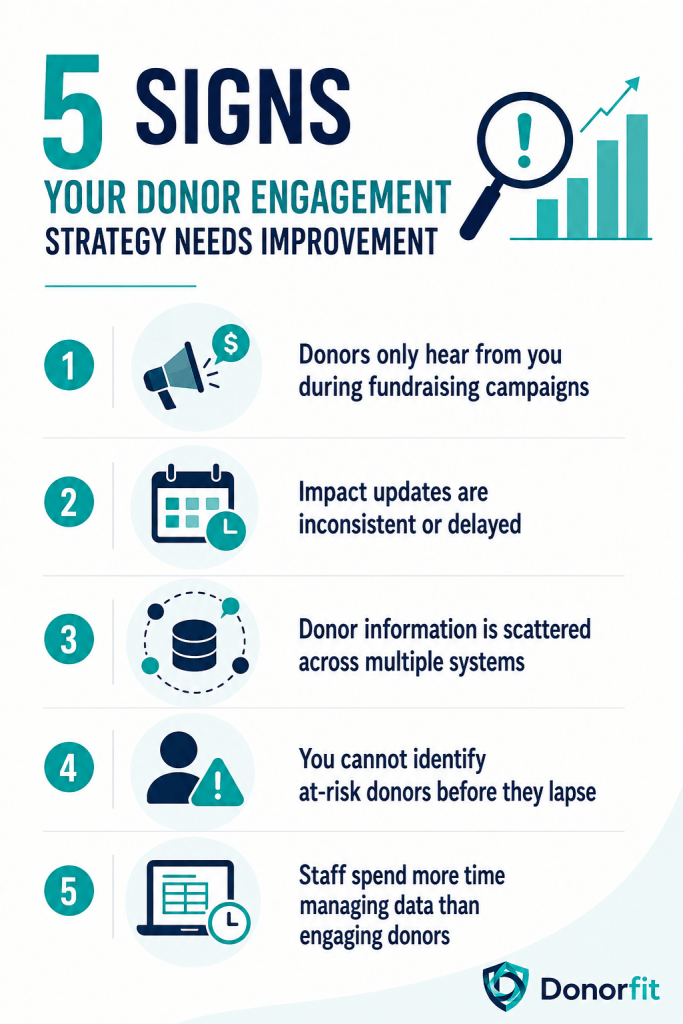
1. Donors Only Hear From You During Fundraising Campaigns
When every touchpoint is an ask, donors have no reason to feel connected between campaigns. Regular impact updates — separate from solicitations — are what convert a transactional donor into a relational one.
2. Impact Updates Are Inconsistent or Delayed
Donors give again when they can see, promptly, what their last gift did. Delayed or inconsistent updates erode the confidence that drives a second gift — directly relevant given how low first-to-second conversion already is sector-wide.
3. Donor Information Is Scattered Across Multiple Systems
Spreadsheets and disconnected platforms fragment donor histories. A centralised donor database is what makes accurate retention tracking, segmentation, and personalised communication possible in the first place — not a nice-to-have layered on top of manual tracking.
4. You Cannot Identify At-Risk Donors Before They Lapse
Disengagement shows warning signs before a donor stops giving: fewer email opens, skipped events, smaller or less frequent gifts. Without a system tracking engagement activity, organisations typically discover a lapsed donor only after the fact, well past the point of low-cost re-engagement.
5. Staff Spend More Time Managing Data Than Engaging Donors
Every hour spent manually updating spreadsheets, pulling reports, or reconciling donor records is an hour not spent on stewardship — the activity most directly tied to closing the first-to-second-gift gap.
Why These Gaps Persist
These aren’t commitment problems. They’re system problems. Most donor management infrastructure at growing nonprofits was built for a smaller donor base and never re-architected as the organisation scaled. As donor counts grow, manual processes that once worked start producing exactly the fragmentation and inconsistency described above.
This pattern isn’t unique to general fundraising — it shows up in sharper form in verticals with longer or more complex donor journeys. See how this plays out in water and WASH fundraising →
Manual Tracking vs. Centralised Donor Engagement Tracking
| Manual / Spreadsheet-Based | Centralised (DonorFit) | |
| Donor history | Fragmented across files, email, and memory | Complete profile in one record |
| At-risk donor detection | Discovered after the donor has lapsed | Flagged for declining engagement signals |
| Impact update timing | Dependent on staff bandwidth | Consistent, trackable cadence |
| First-to-second gift follow-up | Ad hoc | Built into the stewardship workflow |
| Reporting | Manually compiled | Available on demand |
What Closes the Gap
The FEP’s own Q4 2025 recommendations for improving new donor retention are specific: timely multi-channel stewardship tailored to new donors, prompt demonstration of impact after the first gift, and personalised gratitude in the earliest stage of the relationship. Every one of those recommendations depends on knowing, reliably, who a donor is, what they gave to, and where they are in the relationship, which is exactly what fragmented, manual tracking makes difficult at scale.
Centralising donor profiles, giving histories, and engagement activity in a single system doesn’t replace stewardship — it’s what makes consistent stewardship operationally possible as an organisation grows past the size where staff can track every donor relationship from memory.
FAQ
What is donor engagement in nonprofit fundraising? Donor engagement is the ongoing relationship between a nonprofit and its supporters, encompassing every interaction — acknowledgements, impact updates, event communication — that keeps a donor connected to the outcomes their giving supports.
What is a good donor retention rate? Benchmarks vary by methodology and reporting window. FEP’s Q4 2025 data puts sector-wide retention at 43.3%. The Virtuous 2026 Nonprofit Benchmark Report, using a 24-month lookback across 771 mid-sized U.S. nonprofits, puts the sector average at 54.73%, with top-quartile organisations reaching 69.64%. Because these figures use different methodologies and sample sets, use them as directional ranges rather than a single universal target, and prioritise your own year-over-year trend.
Why is new donor retention lower than repeat donor retention? FEP data attributes this to a gap in early-stage stewardship — new donors often don’t receive the same timely, personalised follow-up that repeat donors get by virtue of an established relationship. Only 14.0% of first-time donors give a second gift, making the first 90 days after an initial gift the highest-leverage window for retention.
Does centralising donor data actually improve retention, or is it just record-keeping? Centralised data is the prerequisite for the stewardship actions that drive retention — identifying at-risk donors, timing impact updates, and personalising follow-up all depend on having a complete, current donor record. It doesn’t replace relationship-building; it’s what makes relationship-building trackable and repeatable at scale.