









Failed Recurring Donations: Common Causes, Recovery Strategies, and Ways to Reduce Lost Fundraising Revenue

A failed recurring donation is a scheduled gift that doesn’t go through, usually because the card or bank account behind it has changed or come up short, while the donor still means to keep giving. Most of these failures can be fixed. The expensive ones are the failures nobody follows up on.
Monthly giving carries real weight in most fundraising programmes. In M+R Benchmarks 2026, monthly gifts made up 27% of all online revenue for the nonprofits studied in 2025. When that much income depends on a payment clearing every single month, handling failed payments is part of fundraising. It isn’t an admin chore to get to when there’s time.
This guide covers why recurring donations fail on cards and on SEPA Direct Debit, how to tell a payment problem from a donor’s decision, and which recovery steps are worth setting up. For the wider picture of how these losses get misread as donor attrition, read our earlier piece on involuntary churn in recurring giving.
Why the first successful payment isn’t the finish line
A recurring donation only works if every future payment works as well. The sign-up form gets all the attention: the design, the suggested amounts, the monthly default. Then the first charge clears, the donor moves into the “active” column, and the team turns to the next campaign.
Meanwhile, the card in that record will expire one day. The donor may move house and close their bank account. A month with a tight balance will come around. None of this is a decision to stop giving, yet each one stops the gift unless someone notices.
M+R Benchmarks 2026 found that 10% of new sustainers stop giving within two months of setting up a monthly gift. The report doesn’t split that figure into cancellations and payment failures, which is the same blind spot most organisations have in their own data.
Is there a benchmark for how many recurring donations fail?
We could not find a reliable, published, sector-wide failure rate for recurring donations, either in the DACH region or internationally. Payment providers publish numbers about their own customers, but they measure in different ways and nobody audits them, so we don’t quote them here.
The benchmark that matters is your own. Pull twelve months of recurring transactions, count the failed attempts, and sort them by reason. That one exercise will tell you more about your programme than any industry average.
Common causes of failed recurring donations
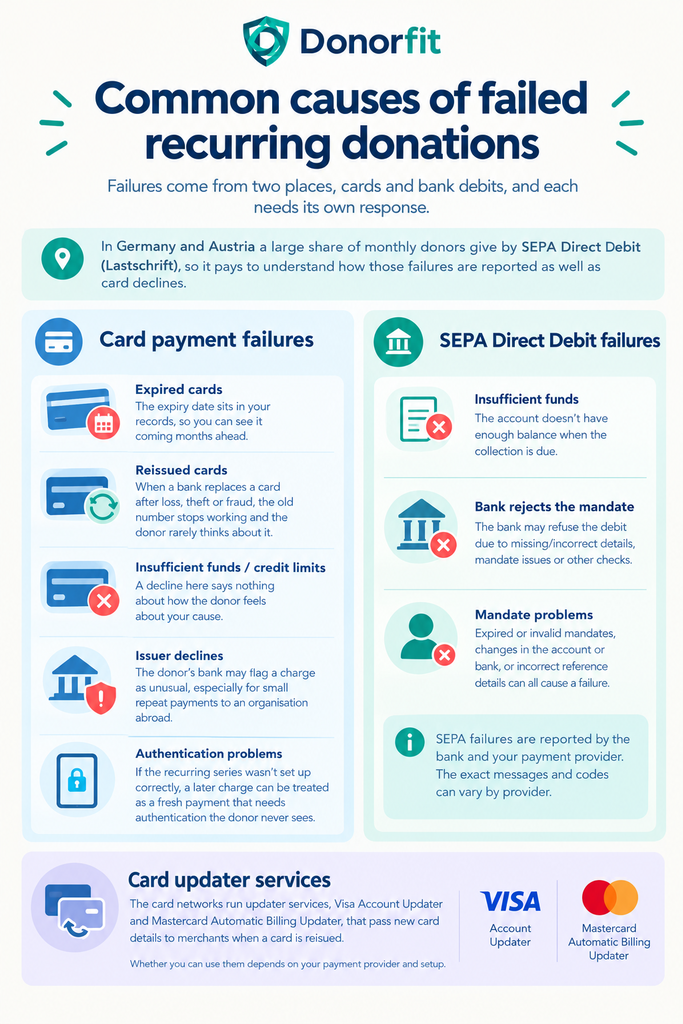
Failures come from two places, cards and bank debits, and each needs its own response. In Germany and Austria, a large share of monthly donors give by SEPA Direct Debit (Lastschrift), so it pays to understand how those failures are reported as well as card declines.
Card payment failures
Expired cards are the most predictable failure of all. The expiry date sits in your records, so you can see it coming months ahead.
Reissued cards cause the same problem with less warning. When a bank replaces a card after loss, theft or a fraud precaution, the old number simply stops working, and the donor rarely thinks about the charities attached to it.
Insufficient funds and credit limits catch committed donors at the wrong time of the month. A decline here says nothing about how the donor feels about your cause.
Issuer declines happen when the donor’s bank flags a charge as unusual. Small repeat payments to an organisation abroad can trip these checks.
Authentication problems are less visible. Under the EU’s Strong Customer Authentication rules, the donor authenticates when they sign up. If the recurring series wasn’t set up correctly with your payment provider, a later charge can be treated as a fresh payment that needs authentication the donor never sees, and it fails.
The card networks run updater services, Visa Account Updater and Mastercard Automatic Billing Updater, that pass new card details to merchants when a card is reissued. Whether you can use them depends on your payment provider and setup.
SEPA Direct Debit failures
When a SEPA debit fails, the bank sends back a message called an R-transaction with a reason code attached. The European Payments Council publishes guidance on these codes, and they are the most useful piece of information you get about a failed debit. Here is what the common ones mean and what to do next.
| Failure | What it usually means | Retry? | Best next step |
| Card expired | Donor has a new card with a new date | No | Ask for updated details, ideally before the expiry date |
| Card reissued or replaced | Number changed after loss, theft or fraud check | No | Use a card updater if available, otherwise contact the donor |
| Card declined, insufficient funds | Temporary shortfall | Yes, a few days later | Retry on a spaced schedule, then contact |
| SEPA AM04 | Insufficient funds in the account | Yes, once or twice | Re-present after a typical payday, then contact |
| SEPA AC04 | Account closed | No | Ask the donor for a new IBAN and a fresh mandate |
| SEPA MD01 | No valid mandate | No | Check the mandate record, then contact the donor |
| SEPA MS02 | Donor refused the debit, no reason given | No | Personal contact. Something didn’t match their expectation |
| SEPA refund (MD06) | Donor reclaimed an authorised debit | No | Personal contact and a check of your pre-notification and statement text |
The refund window most teams forget
Under the SEPA Core scheme, a donor can ask their bank to refund an authorised debit within eight weeks with no reason needed, and up to 13 months for a debit they say they never authorised. The European Banking Authority sets this out in its Single Rulebook Q&A 2019_4573 under PSD2.
So a SEPA gift isn’t fully settled the day it lands. A refund isn’t a technical failure, but it is a signal. Often the donor didn’t recognise the name on their bank statement or wasn’t expecting the amount on that date.
Failed payment or cancelled donation? Why the difference matters
A cancellation is a decision. A failed payment usually isn’t, and the two need completely different responses. When both end up under “lapsed”, teams answer a card problem with a stewardship campaign, or answer a genuine goodbye with three automated “please update your details” emails.
Give each its own status in your CRM. At minimum: active, payment failed (recovering), paused, and cancelled by donor. That small change makes everything else in this guide possible, because you can finally see which problem you have.
Recovery strategies for failed recurring donations
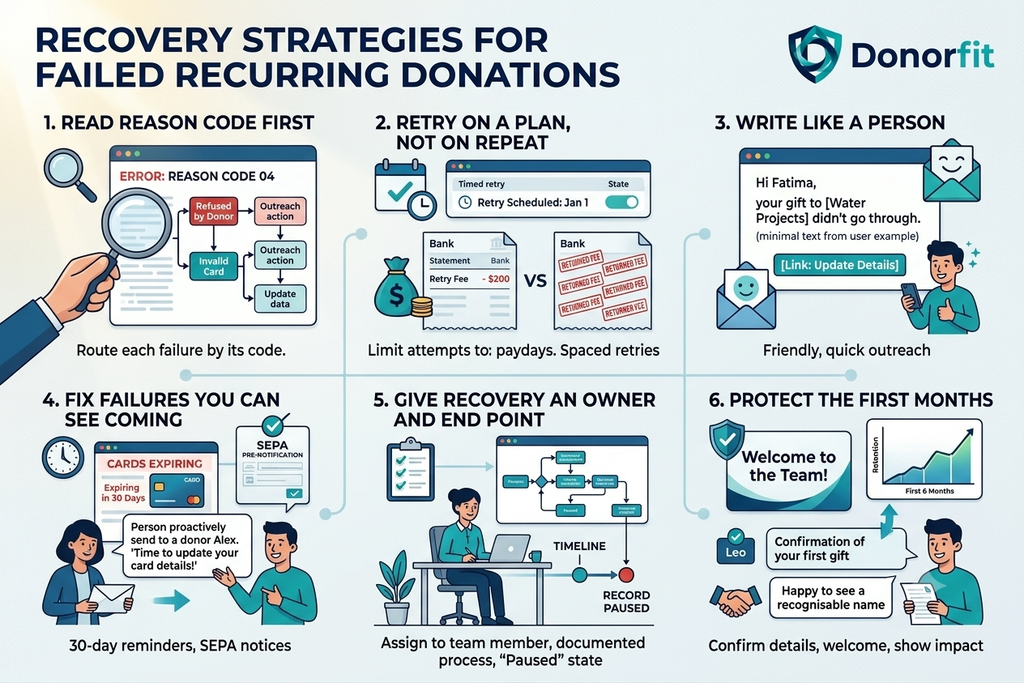
1. Read the reason code before you react
The reason for the failure decides the right next step. Retrying a closed account wastes a bank fee and achieves nothing. Retrying a debit the donor actively refused can turn a misunderstanding into a complaint. Route each failure by its code, using the table above as a starting point.
2. Retry on a plan, not on repeat
Retries make sense for temporary problems such as insufficient funds. For SEPA, one re-presentation timed after a common payday (around the start of the month in Germany) is a sensible default. Most banks charge the creditor for every returned debit, so check your fee schedule before deciding how many attempts are worth it.
For cards, space retries over several days rather than hours. Set a limit, and once it’s reached, move the record to “paused” instead of letting it fail every month.
3. Write to the donor like a person
The recovery message is a donor touchpoint, so it should sound like your organisation and not like a collections notice. Keep it short, skip the guilt, and give one clear way to fix it. Something like this:
Hi Fatima, your monthly gift to our water projects didn’t go through this month. This usually happens when a card is renewed or a bank account changes. If you’d like to keep giving, you can update your details here [link]. Thank you for standing with the families we serve.
Send it soon after the failure. Follow up once by email, and for larger or long-standing donors, consider a phone call before the record moves to paused.
4. Fix the failures you can see coming
Card expiry dates are in your data. A friendly reminder 30 days before a card expires catches many failures before they happen. For SEPA, clear pre-notification and a recognisable name on the bank statement reduce refunds. SEPA rules require you to tell donors about an upcoming debit in advance, and your payment provider can confirm the notice period that applies to your mandates.
5. Give recovery an owner and an end point
Someone on the team should own the failed-payment queue, even if it takes them 30 minutes a week. Decide in advance how many attempts happen, what messages go out and when, and at what point a record becomes paused. Write it down once so it doesn’t depend on someone remembering.
6. Protect the first months
New donors are most likely to drop off early, as the M+R figure above shows. Confirm the amount and the date of the first debit or charge, tell donors what name will appear on their statement, and send a short welcome that shows where their money is going. Each of these reduces refunds and early failures.
How to know whether recovery is working
Track a handful of numbers every month, split by payment method:
- Failure rate: failed attempts as a share of scheduled payments
- Recovery rate: failed payments that were later collected or updated
- Time to recovery: days from failure to the next successful payment
- Refund count: SEPA refunds within the eight-week window
- Lapse split: share of lapsed donors who failed to pay versus those who cancelled
You don’t need a dashboard to start. A monthly export and a spreadsheet will show whether recovery is getting better.
Frequently asked questions
What is a failed recurring donation? A failed recurring donation is a scheduled monthly or regular gift that the payment system could not collect. Common reasons are an expired or replaced card, insufficient funds, a closed bank account, or a SEPA debit the donor refused or reclaimed.
What is dunning in fundraising? Dunning is the process of following up on failed recurring payments. It usually combines planned payment retries with messages that ask the donor to update their card or bank details. In fundraising it works best when the tone is warm and the steps depend on why the payment failed.
Why do SEPA Direct Debit donations fail? The most common reasons are insufficient funds (reason code AM04), a closed account (AC04), a missing or invalid mandate (MD01), and the donor refusing the debit (MS02). The reason code arrives with the bank’s return message and tells you what to do next.
Should we retry a failed SEPA Direct Debit? Only for temporary problems such as insufficient funds. Retrying a closed account or a debit the donor refused won’t succeed and may cost a bank fee or upset the donor. Contact the donor in those cases instead.
Can a donor reverse a SEPA Direct Debit donation? Yes. Under the SEPA Core scheme a donor can request a refund of an authorised debit within eight weeks without giving a reason, and up to 13 months for a debit they say they did not authorise.
How many times should we retry a failed card donation? There’s no fixed standard. A small number of retries spaced over several days, followed by a message to the donor, is a common approach. Set a limit so a failing record moves to paused rather than failing every month.
How do we reduce failed recurring donations? Separate failed payments from cancellations in your CRM, route each failure by its reason, send reminders before cards expire, use a card updater service if your payment provider offers one, and make your bank statement name easy to recognise.
This article is general information, not legal, tax or banking advice. Scheme rules, fees and notice periods depend on your payment provider and bank, so confirm the details with them.
Related reading
https://donorfit.com/en/why-donor-engagement-determines-nonprofit-growth/
https://donorfit.com/en/why-donor-engagement-stalls-and-the-data-blind-spot-behind-it
https://donorfit.com/en/from-scattered-spreadsheets-to-one-donor-record-a-migration-playbook/
Recovering failed gifts is much easier when your system shows them the moment they happen. Donorfit keeps failed payments separate from cancellations and gives your team a clear view of which recurring donations need attention. See how Donorfit handles recurring giving.