





Sponsor Self-Service Portal: How It Simplifies Water Sponsorship and Keeps Donors Connected
A sponsor self-service portal is a secure, logged-in space where a sponsor can see the projects they support, check progress, download receipts, manage recurring contributions and read impact reports without contacting the charity. For water sponsorship, where a project can take many months to move from funding to flowing water, it gives the sponsor somewhere to go during the wait and gives the team fewer emails to answer.
Most water charities put real care into the moment of giving. The donation page is tested, the thank-you email is written well, the receipt goes out. Then the sponsor’s experience splits into pieces. Progress arrives by newsletter, receipts arrive by email in January, a change to a monthly gift means writing to the office, and the impact report sits in a PDF somewhere on the website. None of this is broken on its own. Together, it means the sponsor has no single place where their sponsorship lives.
This article looks at what a sponsor self-service portal should contain for water projects, what it changes for the fundraising team, and where its limits are.
Why water sponsorship needs a place to live after the gift
Water sponsorships are long, multi-stage relationships, and the sponsor’s questions change at every stage. In the first weeks a sponsor wants to know the money arrived and was assigned. During construction they want to know whether anything is happening. After completion they want to see the result, and later still they want to know the water point is being kept running. Each of those questions usually reaches the charity as an email or a phone call to someone who then has to look the answer up.
That pattern costs time on both sides. It also creates long stretches where the sponsor hears nothing at all, which is the gap our earlier piece on why water donors don’t give twice described: the build is slow, and silence during the build is where sponsors drift.
The retention data points the same way, with a caveat on scope. The Fundraising Effectiveness Project’s Q3 2025 report (US data) found that donors who had given only once retained at about 19 per cent, while donors with seven or more gifts retained at around 87 per cent. Neon One’s 2026 Recurring Donor Report, covering 2025, found recurring donors retained at roughly four in five, against about one in three for one-time donors. Neither study measures portals, and both are US, all-cause figures. What they show is that ongoing, repeated contact with a cause is where loyalty is built. A portal is one practical way to make that contact available every day rather than only when the next newsletter goes out.
What a water sponsor should be able to access
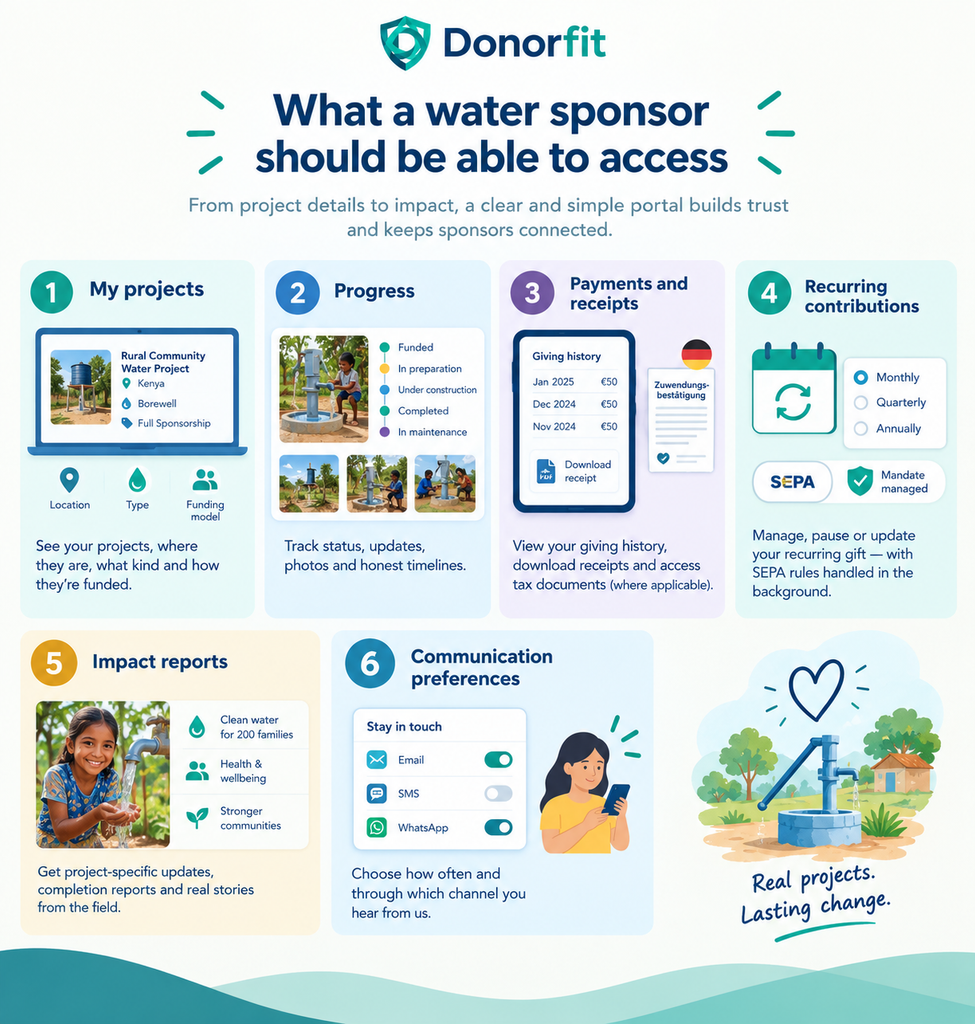
A useful sponsor portal answers the questions sponsors actually ask, in the order they tend to ask them. Based on the sponsorship lifecycle, these are the areas that matter most.
My projects. A clear list of the water projects the sponsor supports, with the name, the community or region at the level your safeguarding policy allows, the type of project and how the sponsorship is structured (full, partial, shared or maintenance). If you offer several funding models, as covered in our piece on water project funding options, this is where the sponsor sees which one they chose.
Progress. A status for each project, such as funded, in preparation, under construction, completed or in maintenance, with dated updates and photos added as the field team reports them. Honest timelines belong here too. If a project is delayed by the rainy season or a supply problem, saying so in the portal is better than saying nothing.
Payments and receipts. A full giving history and downloadable receipts. In Germany, organisations that have notified their tax office that they issue machine-generated receipts may send the Zuwendungsbestätigung electronically as a write-protected document such as a PDF, under a Federal Ministry of Finance letter from February 2017. A portal download fits that well. In Austria, recognised organisations have transmitted donation data directly to the tax office since 2017, so Austrian sponsors don’t need a receipt to claim the deduction, but they still like to see what was reported. Our guide to Zuwendungsbestätigung rules across DE, AT and CH covers the differences in detail. This is general information, not tax or legal advice.
Recurring contributions. The ability to view, adjust, pause or update payment details for a monthly or annual sponsorship. For sponsors paying by SEPA direct debit, changes need to follow the mandate rules your payment provider applies, so the portal should make the request easy while the system handles the mandate correctly in the background.
Impact reports. Completion reports, maintenance updates and annual summaries tied to the specific project the sponsor funded, not a general annual report shared with every donor.
Communication preferences. Control over how often and through which channel the sponsor hears from you. Sponsors who can turn the volume down are less likely to unsubscribe from everything.
What changes for the fundraising team
The biggest operational change is that routine requests become self-served, and the team’s inbox shifts toward conversations that need a person. The requests that typically fill a supporter care inbox at a water charity are predictable: a lost receipt, a change of bank account, a question about project status, a request to pause during a difficult month. Each takes only minutes, but they arrive constantly and spike in January when receipts are due.
| Sponsor need | Without a portal | With a sponsor self-service portal |
| “Has my project started?” | Email to the office; staff check the project file and reply | Sponsor sees current status and the latest dated update |
| Lost or missing receipt | Staff find the record, regenerate and resend | Sponsor downloads it from their giving history |
| Change monthly amount or pause | Email or call, manual update, confirmation letter | Sponsor submits the change; the record and payment schedule update together |
| New bank details | Paper or emailed form, manual mandate handling | Guided update that follows the provider’s mandate process |
| “What did my gift achieve?” | Generic annual report, if anything | Impact report for the specific project sponsored |
| Too many emails | Sponsor unsubscribes from all communication | Sponsor adjusts frequency and channel |
There is a second, quieter change. When sponsors can see their own data, errors surface sooner. A sponsor who notices that a gift is assigned to the wrong project, or that their address is outdated, can flag it before it turns into a returned letter or an incorrect receipt.
A portal only works if the data behind it is current. If project updates live in one system, payments in another and receipts in a third, the portal becomes another place to keep in sync by hand. The underlying records need to be connected first, which is the case we made in one platform for many ways to give.
Designing the portal around trust
The sponsor portal is a promise that the charity will keep the sponsor informed, so the content inside it matters more than the number of buttons. A few principles hold up well in practice.
Show the real timeline. Water projects take time, and charities that set expectations about this in advance tend to face fewer anxious emails later. A status that has not changed for four months with no explanation does more harm than no portal at all.
Protect the community’s dignity and safety. Photos and stories should follow your safeguarding and consent policy. Show the infrastructure and the progress; be careful with identifiable images of people, especially children.
Keep the sponsor’s actions simple. Downloading a receipt, changing an amount or pausing a gift should each take a few clicks. If sponsors still need to email for common tasks, the portal is not doing its job.
Make the shared and maintenance models visible. A sponsor who funded a share of a project should see the whole project and their part in it. A sponsor who funds maintenance should see maintenance updates, which are the reports most charities never send.
Respect data protection. Under DSGVO, sponsors have rights over their personal data, and a portal that shows them what you hold supports transparency. It does not replace your formal process for access or deletion requests, and your data protection officer should review the setup.
The honest limits
There is no published, independent benchmark showing that a sponsor portal raises water sponsor retention by a specific amount, and we won’t invent one. The vendor figures we found were not based on primary research, so we have left them out. What the evidence supports is narrower: repeated contact and recurring giving are strongly associated with retention, and a portal makes repeated contact easier to deliver at scale.
A portal also does not replace personal stewardship. Many sponsors will never log in. They still need the updates sent to them, a thank-you that sounds like a person, and someone to call when something goes wrong. Treat the portal as the place where everything is available, and your communication plan as the way the most important parts reach the sponsor whether they log in or not. Measure the effect against your own figures: login rates, receipt requests in January, pause-versus-cancel ratios and second-year sponsor retention.
Frequently asked questions
What is a sponsor self-service portal? A sponsor self-service portal is a secure online account where sponsors can see the projects they support, track progress, download donation receipts, manage recurring contributions and read impact reports without contacting the charity’s staff.
What is the difference between a donor portal and a sponsor portal? A donor portal usually shows giving history and receipts. A sponsor portal adds the ongoing link to a specific project or beneficiary, with progress updates and project-level impact reporting, which matters for long-running water sponsorships.
Can a charity send donation receipts through a portal in Germany? Under a Federal Ministry of Finance letter from February 2017, organisations that issue machine-generated Zuwendungsbestätigungen and have notified their tax office of that procedure may provide them electronically as write-protected documents such as PDFs. A portal download is one way to do this. This is general information, not tax advice; check your own setup with your tax adviser.
Should sponsors be able to pause or cancel a recurring sponsorship themselves? Offering a pause option alongside cancellation gives sponsors a way to step back during a difficult period without ending the relationship. How changes to SEPA direct debits are handled depends on your payment provider and mandate setup.
Does a sponsor portal improve donor retention? No independent study has measured this for water sponsorship specifically. Broader data from the Fundraising Effectiveness Project and Neon One shows that donors who give repeatedly and on a recurring basis retain at much higher rates, and a portal supports the ongoing contact behind that. Measure the effect on your own sponsors.
What should a water project impact report include? The project the sponsor funded, what was built or repaired, when it was completed, how many people it is intended to serve, maintenance status, and photos that follow your consent and safeguarding policy.
Donorfit gives water sponsors one place to follow their project, download receipts and manage their recurring sponsorship, on the same records your team already works from. See how the Water module works.