




How to Choose a Water Project to Sponsor: Six Things to Check Before You Give
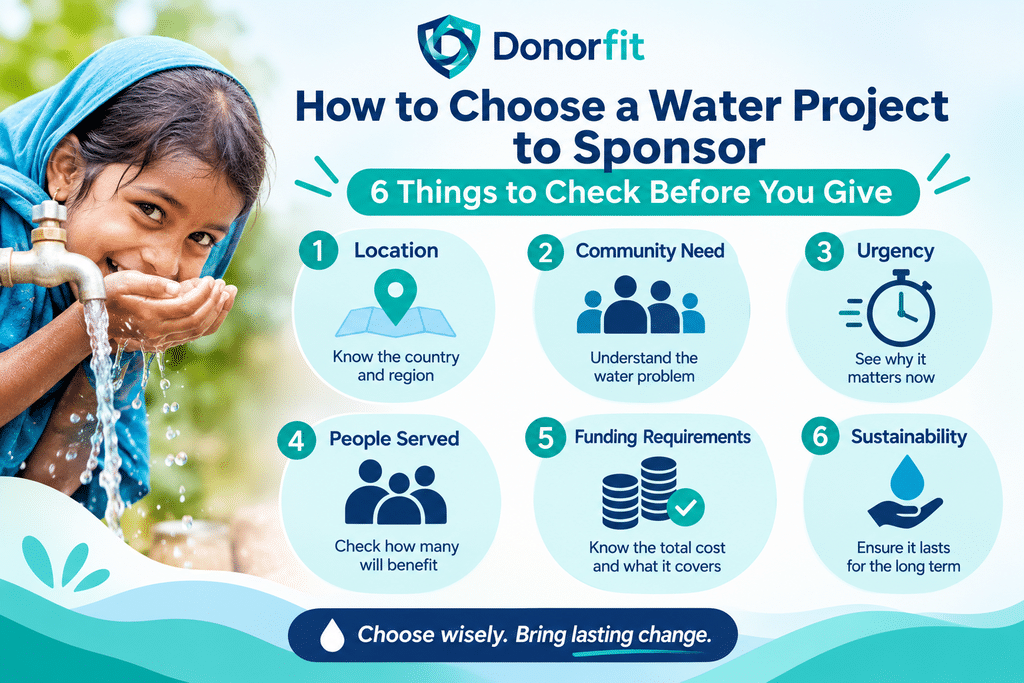
Choosing a water project to sponsor means matching a specific, named project to what you care about, using six pieces of information: where it is, who it serves, how urgent the need is, how many people it reaches, what it costs, and what keeps it working after the ribbon is cut. If a project page can’t tell you those six things, you are being asked to fund a photo rather than a project.
This guide to how to choose a water project is for anyone deciding where a water gift should go: an individual sponsor, a family pooling a Sadaqah Jariyah gift, a mosque committee, or a company with a giving budget. The last section is for the charities on the other side of that decision.
Why the choice matters more than it used to
The global gap is large enough that almost any water project is “needed”, which is exactly why need alone can’t guide your choice. The WHO/UNICEF Joint Monitoring Programme’s 2025 report estimates that in 2024 about 2.1 billion people, roughly one in four, still lacked safely managed drinking water, and 106 million drank directly from rivers, ponds or other untreated surface sources. The same report found coverage in fragile contexts 38 percentage points lower than in other countries, and rural areas still trailing.
When the need is that wide, the useful question changes. It’s no longer “does this community need water?” (it almost certainly does) but “is this the project where my money does what I want it to do?” That’s a question about fit, and fit depends on information.
1. Location: country and region, not just “Africa”
A sponsor should be able to see the country and the region or district a project sits in, because that detail is what makes a project specific and checkable. “A well in Africa” describes a continent of 54 countries. “A borehole in a village in Kassala State, Sudan” describes a place someone can follow.
Location also carries practical meaning. It tells you whether the charity has a track record there, whether the area is stable enough to finish construction on schedule, and whether family, community, or diaspora ties make the gift personal to you. Many sponsors in Germany, Austria and Switzerland choose a country they or their parents come from, and that is a perfectly good reason.
What to look for: country, region or district, and the name of the local partner delivering the work.
2. Community type and water need
The kind of community and the kind of water problem tell you what the project will actually change. A deep borehole for a village of 800, a rainwater harvesting system for a primary school, a pipeline extension to a health clinic, and emergency water trucking in a displacement camp are all “water projects”. They solve different problems on different timelines.
Useful categories on a project page:
| Community type | Typical water need | What the project usually changes |
| Rural village | No reliable source within walking distance | Time spent fetching water, especially for women and girls |
| School | No safe drinking water or handwashing on site | Attendance, hygiene, girls staying in school |
| Health facility | Unreliable or unsafe supply | Infection control, safe deliveries |
| Displacement or refugee setting | Sudden loss of supply | Short-term survival needs, then a longer-term fix |
| Mosque or community centre | Shared access point, wudu facilities | Daily access for many households at one point |
If a project lists only “clean water for a community”, ask which of these it is. The answer shapes everything that follows, including how urgency and sustainability should be judged.
3. Urgency: why now, explained in a sentence
Urgency is useful only when the project says why it is urgent and what happens if funding is late. A red “urgent” badge on every listing tells you nothing. A sentence like “the existing hand pump failed in August and families now walk 6 km to a seasonal river” tells you a great deal.
It’s worth separating three kinds of project:
- Emergency response: water trucking, repairs or treatment after a flood, drought or displacement. Time-critical, often shorter-lived.
- Rehabilitation: fixing or upgrading a source that already exists. Often good value per person reached.
- New construction: a new borehole, system or connection. Longer to deliver, longer to last if well planned.
None of these is better in the abstract. A sponsor who wants immediate relief and a sponsor who wants a permanent asset should simply be choosing from different lists.
4. Beneficiaries: how many people, and how they were counted
“People served” is one of the most quoted numbers on a water project and one of the least explained, so look for how the figure was arrived at. Was it the number of registered households multiplied by an average household size? The enrolment of a school? A rough estimate of everyone within walking distance?
Each method is reasonable. What matters is that the charity tells you which one it used, so you can compare projects fairly. A project that says “approximately 1,200 people (240 households in the village register, average household of five)” is more trustworthy than one that says “5,000 lives changed” with no workings.
Two further things worth checking: whether the source is shared with neighbouring communities, and whether the number refers to people who will use it daily or people who could reach it in theory.
5. Funding requirements: what the money actually buys
A good project listing shows the total cost, what it covers, and how much is still needed, so you can see whether your gift completes it or contributes to it. Water projects vary widely in cost. A hand pump repair and a solar-powered borehole with a distribution network can differ by a factor of ten or more, and neither price is suspicious on its own.
Ask what is included. Drilling and the pump, yes, but also: water quality testing, a handwashing point, training for a local water committee, and a maintenance reserve. A cheaper project that leaves out maintenance can end up costing more per year of working water than a more expensive one that includes it.
If the full cost is beyond your budget, many charities let several sponsors share a project or fund a defined part of it. We cover those structures in water project funding options.
For sponsors in Germany: if a tax receipt matters to you, check that the organisation is recognised as tax-privileged and issues a Zuwendungsbestätigung (the German donation receipt) for project gifts abroad. Our guide to donation receipts in Germany, Austria and Switzerland explains the differences. This is general information, not tax advice.
6. Sustainability: who keeps it working
The most important question about any water project is what happens in year three, and the evidence says it’s the question most worth asking. A 2019 review by Foster, Furey, Banks and Hope, published in the International Journal of Water Resources Development and hosted by the Water Point Data Exchange, estimated that roughly one in four handpumps in sub-Saharan Africa is not working at any given time. Those figures draw mostly on data from the 2010s and vary a lot by country and by how “working” is defined, but the direction is well established: building a water point is the easier half of the job.
A credible project page answers a few plain questions:
- Who owns and manages the source once it’s built (a village water committee, a school, a local utility)?
- Is there a maintenance fund, and who pays into it?
- Who is trained to do basic repairs, and where do spare parts come from?
- Will the charity report on the project after completion, and for how long?
That last point connects to something sponsors often feel but rarely say: they want to hear about the project again. We look at what sponsors should be able to see after the gift, and what a sponsor self-service portal should offer.
A quick comparison: a thin listing versus a useful one
| What you need to decide | Thin listing | Useful listing |
| Location | “East Africa” | Country, region, named local partner |
| Community and need | “A community in need” | Village of ~240 households, nearest safe source 6 km away |
| Urgency | “URGENT” badge | Hand pump failed August 2026; seasonal river dries by December |
| People served | “5,000 lives” | ~1,200 people, counted from village register |
| Funding | “Sponsor a well: €X” | Total cost, what it covers, amount still needed |
| Sustainability | Not mentioned | Water committee trained, maintenance fund, updates for 3 years |
Matching a project to what you care about
Once a charity gives you this information, choosing gets easier, because you can filter by the things that matter to you rather than scrolling through near-identical photos. Some sponsors start from a country. Some start from a cause within water, such as schools or clinics. Some start from a budget and want a project they can fund in full. Some want an ongoing Sadaqah Jariyah and care most about the maintenance plan.
There’s no single right order for how to choose a water project. The point is that each of these starting points needs the six pieces of information above to work. We explain why letting supporters choose in this way changes how they relate to their gift in sponsor a water project: why letting donors choose changes giving.
For water charities: does your project page answer these six questions?
If you run water programmes, read the comparison table above as a sponsor would. Knowing how to choose a water project is only useful to a sponsor if your pages give them something to choose with. Most organisations have this information somewhere, in a partner report, a proposal to an institutional funder, a field officer’s spreadsheet. It rarely makes it onto the page a private sponsor sees, and the gap shows up later as donors who give once and drift, a pattern we looked at in why water donors don’t give twice.
We’re not aware of any published benchmark that measures how much more sponsors give when project pages carry these details, so we won’t invent one. The case rests on something simpler: a sponsor can’t choose well from information they never see.
Frequently asked questions
How do I choose a water project to sponsor?
Look at six things: the project’s country and region, the type of community and water need, why it is urgent now, how many people it serves and how that was counted, the total cost and what it covers, and the plan for maintenance after construction. Then pick the project whose answers best match your priorities and budget.
What is the most important thing to check before sponsoring a well?
Sustainability. Ask who will manage and repair the water point after it’s built and whether there is a maintenance fund. Research reviewed in 2019 estimated around one in four handpumps in sub-Saharan Africa is non-functional at any time, so the maintenance plan matters as much as the construction.
Is it better to fund a new well or repair an existing one?
It depends on your goal. Rehabilitation often reaches people faster and at lower cost per person. New construction can serve communities with no source at all. Either can be a good choice if the project explains the need and the maintenance plan.
How can I tell if a “people served” number is reliable?
Check whether the charity explains how it counted: household registers, school enrolment, or an estimate of everyone within reach. A modest number with a clear method is more reliable than a large round number with none.
Can I sponsor part of a water project?
Many charities allow shared or partial sponsorship, where several donors fund one project or one sponsor covers a defined component. See our guide to water project funding options.
Do I get a tax receipt for sponsoring a water project abroad from Germany?
Generally yes, if the organisation is recognised as tax-privileged in Germany and issues a Zuwendungsbestätigung for the gift. Rules differ in Austria and Switzerland. This is general information, not tax advice; check with the organisation or a tax adviser.
Donorfit’s Water module lets charities publish project details like these and lets sponsors filter by country, community type, need, urgency and budget, then follow the specific project they chose. If your project pages are thinner than your project files, see how the Water module works.