



Sponsor a Water Project: Why Letting Donors Choose Changes Giving
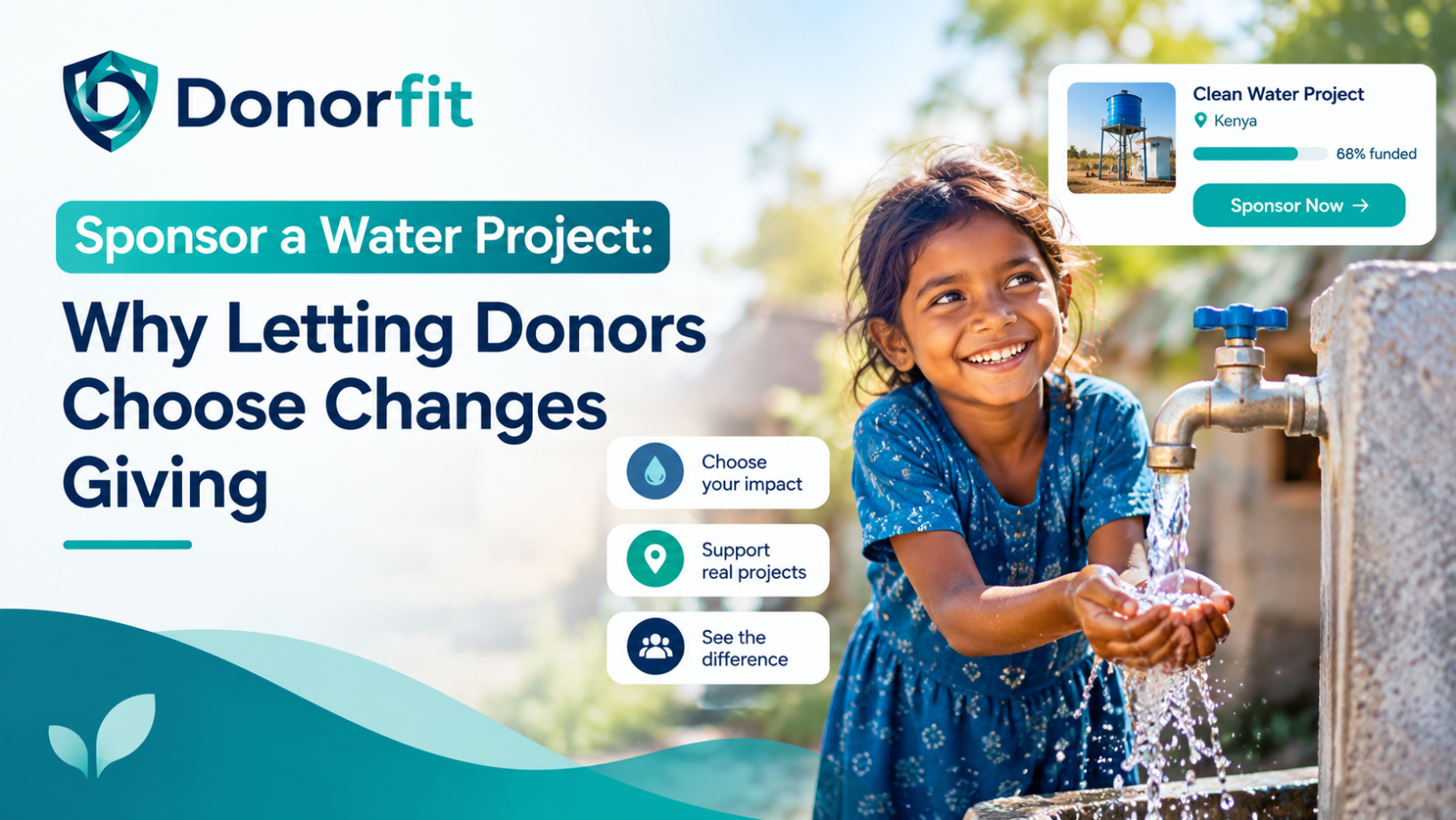
When a supporter can find and choose the specific water project they want to fund, rather than giving to a general “clean water” pool, their gift stops being a donation to a cause and becomes a commitment to a place. That shift is small in the interface and large in the relationship. Most water and sanitation fundraising still asks people to care about an abstraction- several people without safe water somewhere in the world- and then wonders why the connection feels thin. The problem is not that donors care less about water than about children or emergencies. It is that “clean water”, as usually presented, gives them nothing specific to hold onto.
This piece is about what changes when you let them hold onto something real: a named project, chosen by what they actually care about.
The abstraction problem in water giving
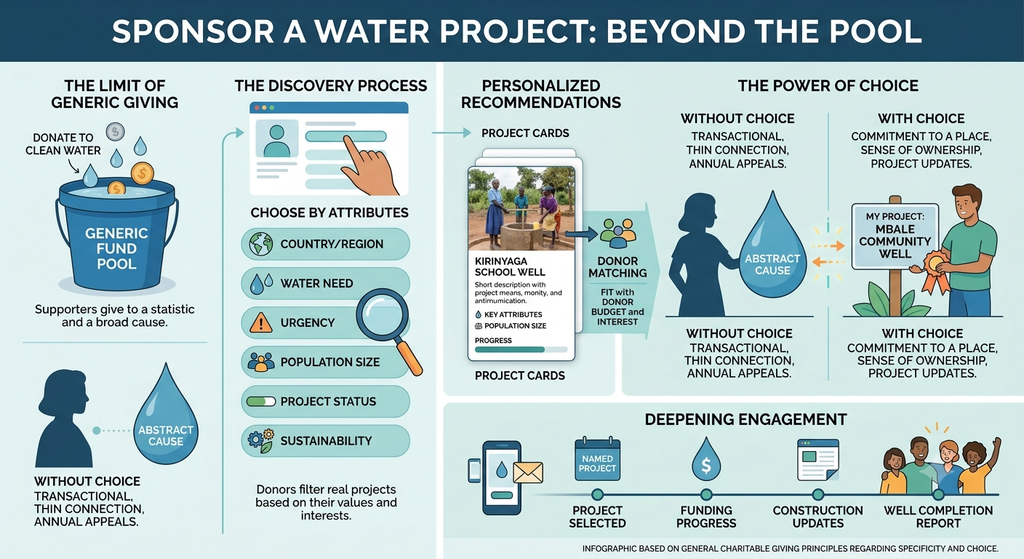
“Donate to clean water” asks a person to feel something about a statistic, and decades of giving research say that is the hardest possible request. Water fundraising is unusually prone to this. The need is enormous and easy to express in large numbers, so appeals reach for the large numbers, and the large numbers are exactly what dampens the response.
The evidence here is well established, if usually discussed in other corners of fundraising. In their 2007 study on identifiable and statistical victims, Small, Loewenstein, and Slovic found that people give more readily to a single, identified individual than to an equivalent group presented as a statistic, and that adding statistics alongside a specific story tends to lower giving rather than raise it. Related work summarised by Cryder, Loewenstein, and Scheines found donors gave roughly 60 percent more on average when a recipient was identified by concrete details rather than described in the aggregate, because those details make the impact easier to picture. These are general findings about charitable giving to people, not measurements of water projects, so treat them as a principle to apply rather than a water-specific number. The principle transfers cleanly enough: the more specific and tangible the thing a donor is supporting, the more real their part in it feels.
A water project is a natural unit of specificity. It has a place, a community, a need, a scale, and a state of progress. The trouble is that most fundraising flattens all of that back into “water” before the donor ever sees it.
What project discovery actually means
Project discovery is letting a supporter search and filter real projects by the things they care about, and be matched to the ones that fit, so the choice is theirs rather than the organisation’s. It is worth being precise about what this is and is not.
It is attribute-based. A donor can narrow by country and region, by the specific water need, by urgency, by the size of the population a project serves, by its current status, and by how sustainable the solution is meant to be. Someone who cares most about durability can look for projects built to last and be maintained. Someone moved by urgency can find where the need is most acute. Someone with a particular country connection can start there. Personalised recommendations can then surface the projects that fit a supporter’s stated interests and their budget, so a modest gift is pointed at a project it can meaningfully move rather than lost in a general fund.
The connection it builds is to a specific, named project and the community it serves, followed by real updates on that project as it progresses. What matters is the match between what a donor cares about and the project they support, not where it sits on a map. Discovery here is a filter for values and means, and the relationship it opens is with a project and its people.
Choice is part of the gift
Letting a donor choose their project does more than help them find one; the act of choosing is itself what turns a transaction into a relationship. A supporter who selected a specific project because it matched their concern for, say, a durable solution serving a school has already invested something before the money moves. They have made a decision that reflects their values. That decision is the seed of ownership, and ownership is what makes someone come back to see how their project is doing rather than treating the gift as closed the moment it clears.
This connects directly to a problem we have written about before: the way water charities lose donors in the long silence between a donation and a visible result. Discovery is the front end of that same relationship. Choosing the project is the beginning; being kept updated on that named project is the rest. One without the other only half works. A donor who chose a project and then heard nothing is arguably more disappointed than one who never chose at all, because the expectation was higher.
| Generic “donate to water” | A discovered, chosen project | |
| What the donor sees | A cause and a large number | A specific project matched to what they care about |
| The donor’s role | Contributor to a pool | Supporter of a named project |
| Basis of the choice | Trust in the organisation | Their own values and budget |
| Emotional starting point | Abstract sympathy | A decision they made |
| What invites them back | An annual appeal | Updates on a project that is theirs |
The honest limits
Discovery raises the ceiling on connection; it does not manufacture connection on its own. It would be easy to overclaim here, and we will not. Matching a donor to a fitting project makes a stronger relationship possible. Whether that relationship actually forms still depends on the project being real, the updates being honest, and the follow-through being there. A good discovery experience attached to projects that then go silent will disappoint faster than no discovery at all, because it sets a higher expectation. The tool opens the door. The programme still has to walk through it.
There is also no verified figure, in water fundraising specifically, that says “letting donors choose increases retention by X per cent.” We are not going to invent one. What the general giving research supports is a direction that specificity and choice tend to deepen giving, and that direction is reason enough to make choosing easy, measured against your own results rather than a borrowed statistic.
Frequently asked questions
What does it mean to let donors sponsor a specific water project? It means a supporter can find and choose a particular project to fund, rather than giving to a general water fund, and then follow that named project’s progress. The gift is attached to a specific piece of work with a place, a community, and a purpose.
How should donors be able to filter water projects? By the attributes that reflect what supporters actually weigh: country and region, the specific water need, urgency, the size of the population served, current status, and how sustainable the solution is. Recommendations can then match projects to a donor’s interests and budget.
Does letting donors choose their project really change giving? General charitable-giving research consistently finds that specific, tangible causes draw stronger giving than abstract or statistical ones (Small, Loewenstein, and Slovic, 2007; Cryder, Loewenstein, and Scheines). Those studies are about giving to people rather than to water projects, so treat the effect as directional and measure your own outcomes.
Is this about putting wells on a map? No. The value is in matching a donor to a project that fits their values and budget, and in the ongoing connection to that specific named project, not in mapping locations.
What makes a water project “sustainable” in this context? Generally, a solution designed to keep working after it is built, with maintenance and community ownership considered, rather than one installed and left. Letting donors filter for durability lets values-driven supporters back the kind of project they believe in.
The part worth keeping
The deepest reason to let people choose is not conversion rate. It is that choosing is how a stranger becomes a participant. When a supporter picks the project that matches what they care about, they stop being a source of funds for your cause and start being a partner in a particular piece of it. The water sector has spent a long time asking people to care about the size of a problem. It may do better to ask them to care about one project they chose themselves.
If your organisation runs water and sanitation programmes across the DACH region, Donorfit lets supporters find and filter your projects by country, region, need, urgency, population, status, and sustainability, and matches them to projects that fit their interests and budget, with each supporter connected to a specific named project they can follow. It exists to turn “donate to water” into “this project is mine.”
This article is general information for fundraising teams. The giving-behaviour research cited concerns charitable giving to individuals and is applied here to project-level giving by inference, not as a water-specific measurement. Measure your own programme’s results.