



Donorfit vs FundraisingBox: Which Fits a DACH Islamic Charity?
For a German-speaking Islamic relief organisation, choosing a fundraising CRM comes down to two questions most comparisons treat as one: does the tool speak DACH fiscal compliance, and is it built around how your program actually gives (Zakat, Sadaqah, Qurbani, orphan sponsorship)? FundraisingBox and Donorfit answer those questions differently, and the honest short version is that the right choice depends on whether your challenge is mainly fundraising or mainly program structure. This is a comparison from Donorfit, so read the recommendation with that in mind, which is exactly why the section on where FundraisingBox is the better pick is a real one, not a courtesy.
What FundraisingBox is, accurately
FundraisingBox is an established, DACH-native fundraising platform built specifically for nonprofits, and it’s a strong one. Per its public profile on review platforms such as OMR Reviews (2026), it’s used by more than 2,000 organisations, including large names like Aktion Deutschland Hilft and SOS-Kinderdorf. Its core is a payment cloud that handles the methods German donors use, SEPA direct debit included, plus recurring subscriptions, and a CRM to manage donors, donations, and communications. It automates donation receipts, offers responsive donation forms, peer-to-peer campaigns, and analytics dashboards, and connects to other tools through its API. Commercially, it’s accessible: a free fundraising plan at 4% per transaction (plus payment-provider fees and VAT), with the CRM add-on starting around €15/month, usage-based.
None of that is faint praise. For a broad range of German nonprofits, FundraisingBox is a capable, payment-first choice that handles German receipting natively. Any comparison that pretends otherwise isn’t worth reading.
The thing general DACH tools aren’t built for
The gap isn’t compliance or payments. It’s program shape.
Islamic relief giving has a structure that general fundraising tools treat as a set of custom fields rather than a first-class model. Zakat is restricted by its nature: it can only go to eligible categories of recipients, which means it has to be tracked and reported separately from Sadaqah, from Qurbani, and from unrestricted funds, and many organisations run a strict policy about how it’s handled. Qurbani is seasonal and share-based, spiking hard around Eid al-Adha and needing per-share fulfilment in a tight window. Orphan sponsorship (kafala) is a recurring, child-linked relationship, not a one-off gift, with a beneficiary record that has its own history and its own safeguarding requirements. Ramadan concentrates a large share of annual giving into a few weeks.
A tool built around donors and gifts can record all of this. What it usually can’t do is model it: keep Zakat cleanly segregated for reporting, handle Qurbani shares, and treat a sponsored child as a real record rather than a note on a donor. That’s the same donor-versus-beneficiary limitation we’ve written about for orphan-sponsorship programs on generic CRMs — it just shows up with an extra fiscal layer in DACH.
Where the market actually leaves a DACH Islamic charity
It’s worth naming the real landscape, because it explains the gap. The tools that are built around Zakat, Qurbani, and orphan sponsorship as first-class workflows- the genuinely Islamic-relief-native platforms- are mostly built for the UK or US context: Gift Aid and HMRC, or American payment processing. The tools that are DACH-fiscal-native, FundraisingBox among them, are general nonprofit platforms rather than Islamic-relief-specific ones.
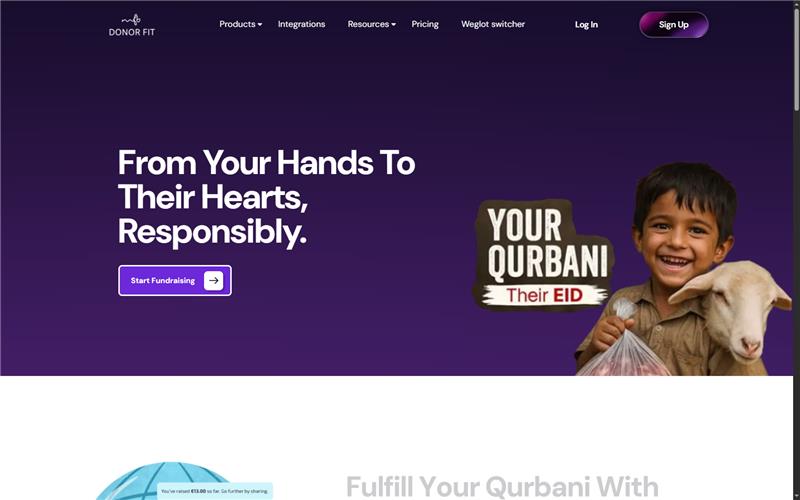
So a German-speaking Islamic relief organisation tends to fall into the overlap between those two groups, where neither side was designed for it. That overlap- DACH compliance and Islamic-relief program structure in one system- is the specific place Donorfit is built to sit.
The comparison: what actually decides it
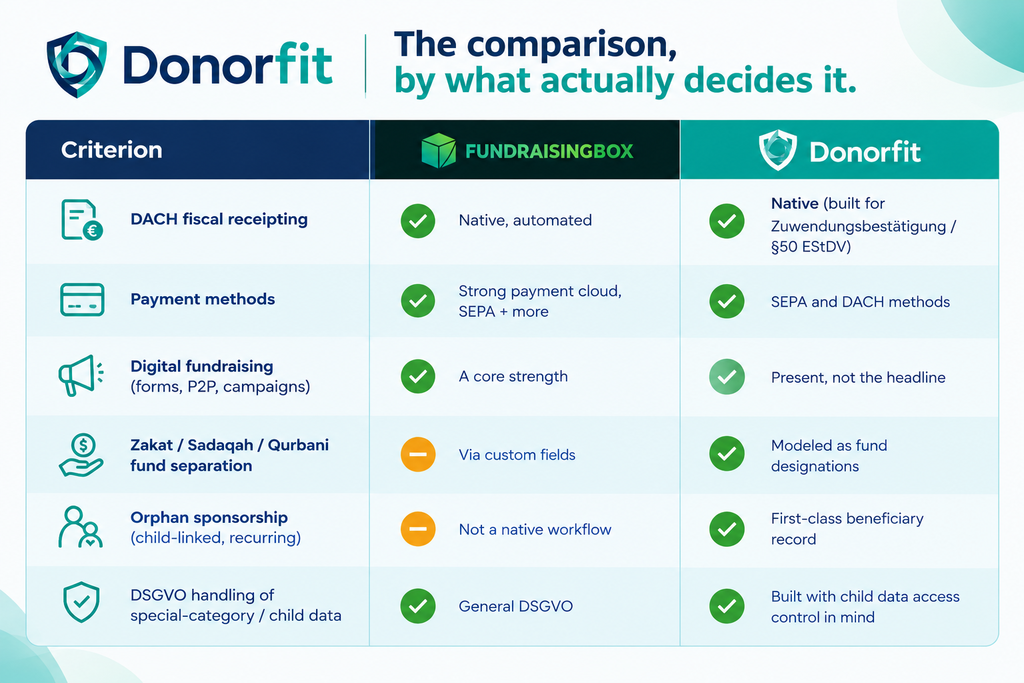
The pattern is that FundraisingBox wins on breadth of fundraising tooling and an established payment cloud, while the case for Donorfit is narrower and more specific: the fund-designation and beneficiary structures an Islamic relief program lives on. If those structures aren’t central to how you operate, that advantage doesn’t apply to you.
When FundraisingBox is the better fit
Plainly: if your organization’s main need is digital fundraising — donation forms, peer-to-peer campaigns, a solid payment cloud, automated German receipts — and your program doesn’t hinge on Zakat segregation, Qurbani shares, or child-linked sponsorship, FundraisingBox is a well-proven, cost-accessible choice, and its large base of DACH nonprofits reflects that. Its free-to-start pricing also lowers the risk of trying it. Choosing it in that situation isn’t a compromise; it’s a good fit for the problem you actually have.
Donorfit’s case gets stronger the more your work looks like Islamic relief specifically: restricted funds that have to stay clean for reporting, seasonal share-based giving, and sponsored beneficiaries who need to be real records with real safeguarding. That’s the overlap, and it’s a narrower claim than “better for everyone,” on purpose.
Evaluating either without a six-month implementation
Whichever way you lean, you don’t have to bet six months to find out. A short, honest evaluation beats a long one: load your real data shapes, not the demo’s (a Zakat gift, a Qurbani share, a sponsored child, a €300-plus donation needing a formal receipt), and see whether each is a native workflow or a field you’re bending to fit. Ask where donor data is hosted and get the AVV in front of your data-protection person before, not after. And test the receipting against the actual §50 EStDV threshold rather than assuming it — the full DSGVO and Zuwendungsbestätigung checklist is the companion piece to run alongside this. The tools that fit reveal themselves in an afternoon of your own data; the ones that don’t reveal themselves in month five.
FAQ
Is FundraisingBox a good fundraising tool? Yes. It’s an established, DACH-native platform used by 2,000+ nonprofits, with a strong payment cloud, automated German receipting, donation forms, and peer-to-peer campaigns, on accessible free-to-start pricing. For general digital fundraising in German-speaking countries, it’s a solid choice.
Why would a DACH Islamic charity need something different? Because Islamic relief giving has structures — Zakat restrictions, Qurbani shares, orphan sponsorship — that general tools record but don’t model. If those are central to your program, a system that treats them as first-class workflows reduces manual work and reporting risk.
Aren’t there Islamic-relief-native CRMs already? There are, but most are built for the UK or US context (Gift Aid, HMRC, or US processing), not German Zuwendungsbestätigung and DSGVO. That’s the gap a DACH Islamic relief organisation falls into.
How do we compare them fairly? Test both against your own data shapes — a Zakat gift, a Qurbani share, a sponsored child, a receipt above €300 — rather than the vendor’s demo. Native workflows and bent-to-fit custom fields look identical in a demo and very different in month five.
Donorfit is built for the overlap this comparison is about: DACH fiscal compliance and Islamic-relief program structure — Zakat and Sadaqah kept separate, Qurbani handled, orphan sponsorship as a real record — in one DSGVO-grade system. If your program lives on those structures and your current tool treats them as afterthoughts, that’s the specific gap it exists to close.