






The Orphan-Program Gap: What Generic CRMs Miss
A generic CRM is built to record a donation. An orphan or child-sponsorship program is built around a relationship between a specific sponsor and a specific child. That difference sounds small until you try to run one on the other. Most of the daily friction sponsorship teams live with comes from forcing a relationship-shaped program into a donation-shaped database. The gap between a general-purpose donor database and a purpose-built child sponsorship CRM isn’t cosmetic. It’s structural, and it surfaces everywhere the relationship, not the gift, is the thing you actually have to manage.
A donation-shaped tool answers one question well: who gave how much, and when. A sponsorship program has to answer harder ones. Which sponsor is linked to which child. What has changed for that child since the last report. Whether this month’s recurring gift actually cleared. Whether the receipt the sponsor needs for their tax authority is compliant. None of those live naturally in a system designed around a gift record, so teams end up bridging the gap with spreadsheets and memory. That is where the risk accumulates.
A donation is an event. A sponsorship is a relationship.
In a standard CRM, the central object is the gift. A donor record hangs a series of transactions beneath it. That model is efficient for one-off and annual giving, and it is genuinely hard to improve on for that job.
Sponsorship breaks the model because the child is not a transaction. The child is a record in their own right, with a history that has nothing to do with money: care milestones, schooling, health notes, guardianship status, and eventually aging out of the program. The sponsor relationship sits on top of that, sometimes one sponsor to one child, sometimes several sponsors to one child or one sponsor to several. A CRM that can only attach data to a donor cannot hold the child as a first-class record, so the child’s story ends up somewhere else. Usually a shared drive full of documents nobody can query.
What the gap actually costs, in four places
The gap is not abstract. It shows up in specific operational places where a generic CRM leaves the team to improvise.
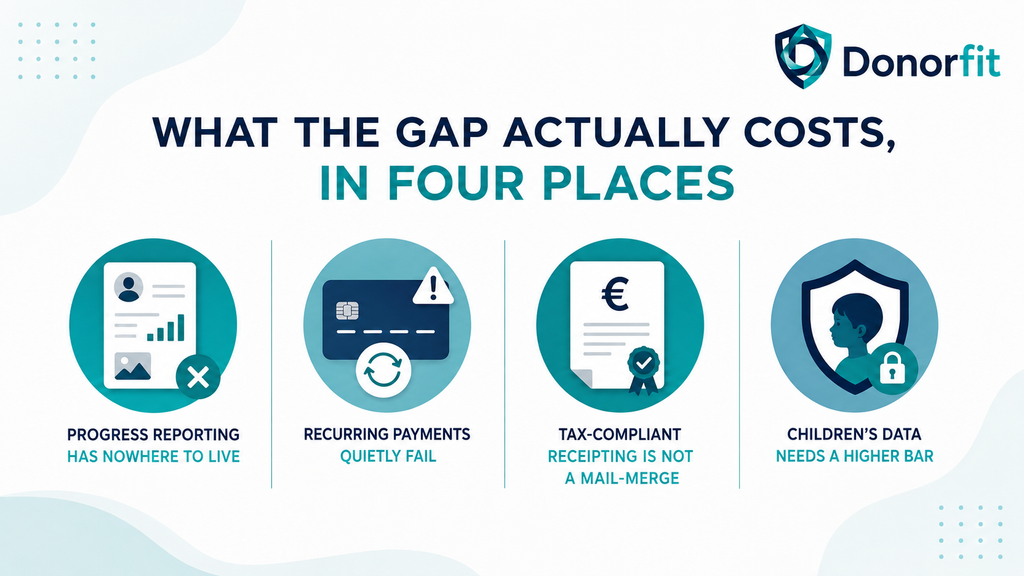
Progress reporting has nowhere to live
Structured child-progress reporting is the main thing that keeps sponsors, because sustained proof of impact is what stops a sponsorship from going quiet. But a report is tied to a child, and a generic CRM has no child to tie it to. So updates get assembled by hand from scattered notes, the process depends on whoever remembers, and the rhythm collapses the first busy month. The retention consequence is direct, and we cover the mechanism in how structured child-progress reporting affects sponsor lifetime value.
Recurring payments quietly fail
Sponsorship revenue is recurring by nature, and recurring revenue has a failure mode generic CRMs handle poorly: involuntary churn. A card expires or gets blocked, and the gift silently stops, with no cancellation and no complaint. In the SEPA countries, this is why direct debit matters. A SEPA-Lastschrift mandate (the standing authorisation to collect a recurring gift) does not expire the way a card does, which is one reason direct-debit and bank-transfer donors have historically shown the strongest retention. A CRM that treats every payment as a fresh event, rather than tracking a mandate’s lifecycle, gives you no way to see the slow leak until the numbers are already down.
Tax-compliant receipting is not a mail-merge
For DACH programs, this is the sharpest edge. In Germany, the donation receipt, the Zuwendungsbestätigung, is not a document a nonprofit designs. It has to follow the official template issued by the Bundesministerium der Finanzen (the federal finance ministry), and only organisations recognised as gemeinnützig with a valid Freistellungsbescheid may issue one. The organisation is legally liable for errors on it. Thank-you messages and any promotional wording have to sit in a separate letter, not on the certificate. For gifts up to €300, a simplified proof such as a bank statement is generally accepted, but above that the formal certificate is required, and programs that issue receipts by machine have to register that process with their tax office under § 50 EStDV.
A generic CRM’s receipting feature is usually a flexible template designed for a US-style acknowledgement. Pointed at a German program, it produces something that looks like a receipt but is not the compliant one, and the liability for that sits with the organisation, not the vendor.
Children’s data needs a higher bar
Sponsorship data includes minors, which raises the stakes under GDPR (the DSGVO in German-speaking countries) and under basic safeguarding practice. Photos, locations, health details, and family circumstances are not ordinary CRM fields. A system that was never designed to distinguish a child’s sensitive record from a routine contact field leaves that judgment to the individual user every time, which is exactly the wrong place for it.
Why the spreadsheet workaround makes it worse
The natural response to all of this is to bolt spreadsheets onto the CRM: one for the child roster, one for reporting status, one to reconcile payments. It feels like control. It adds risk. Spreadsheet-error research by Raymond Panko at the University of Hawaii found that careful individual review catches only around half of the errors present in a sheet, which means a manually maintained sponsorship roster is quietly wrong in ways nobody will spot until a sponsor is matched to the wrong child or a receipt goes out with the wrong figure. The workaround that was supposed to close the gap becomes the least trustworthy part of the system.
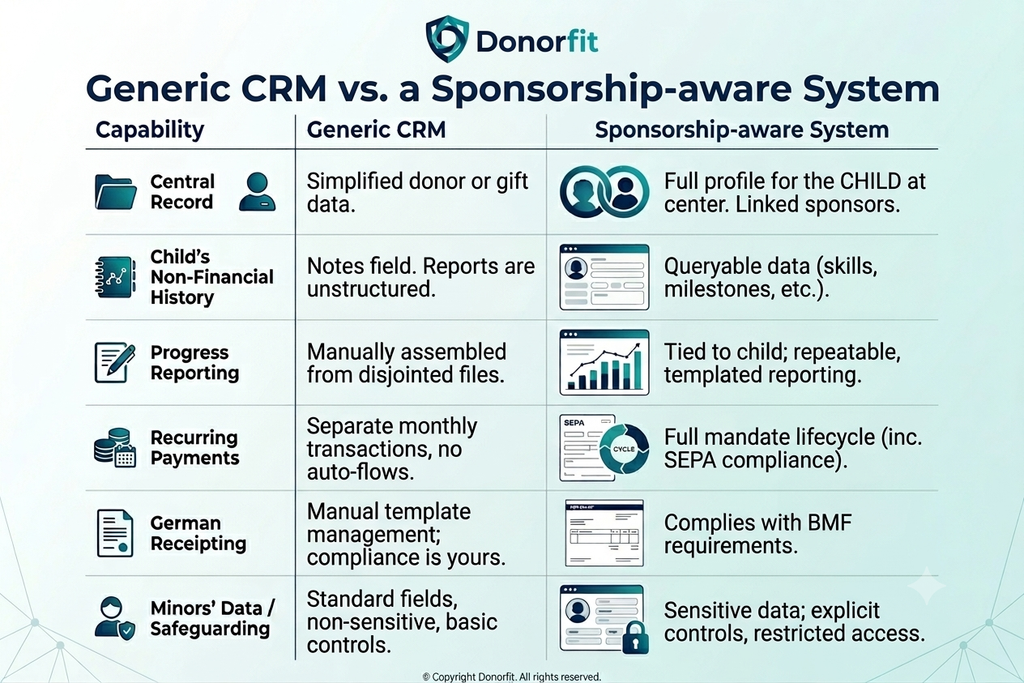
Generic CRM vs. a sponsorship-aware system
Frequently asked questions
Can’t we just customise a general CRM to handle sponsorship? Sometimes, to a point. You can add fields and objects. What is hard to retrofit is the core relationship model, the recurring-payment lifecycle, and country-specific compliance like the German Zuwendungsbestätigung. Those are foundations, not fields. It’s the difference between a general CRM with sponsorship fields bolted on and a child sponsorship CRM built around the relationship from the start, and bolting the foundations on afterwards is where the spreadsheets creep back in.
What makes SEPA direct debit better than card for sponsorships? Stability. Cards expire and get blocked, which stops recurring gifts silently and drives involuntary churn. A SEPA-Lastschrift mandate persists until it is cancelled, so the recurring relationship is less likely to break by accident. It is one of the clearest retention levers in the SEPA region.
Is a US-style donation receipt valid for a German program? No. Germany requires the official BMF template, issued by a recognised gemeinnützig organisation, with the organisation liable for accuracy. A generic acknowledgement is not a substitute. Always confirm current rules against the BMF’s own guidance rather than a software template.
We’re a small orphan program. Does this really apply to us? The smaller the team, the more the gap costs, because there is less slack to absorb manual reporting, payment reconciliation, and receipting by hand. Small programs are usually where the spreadsheet workaround does the most quiet damage.
For the retention side of this, see how structured child-progress reporting affects sponsor lifetime value, and for the reporting itself, what to put in a sponsor update.
Donorfit is built around the sponsor-and-child relationship rather than a single gift record, with recurring-payment and receipting workflows that account for realities like SEPA mandates and the German Zuwendungsbestätigung. If your program is currently held together with a general CRM and a stack of spreadsheets, that’s the specific gap it exists to close.