







What to Put in a Sponsor Update — and What to Leave Out

A sponsor update is a short, regular message that tells a sponsor what their support made possible — what happened, who benefited, what changed, and what comes next. It isn’t a formal report, and it isn’t a fundraising ask. It’s the thing that keeps a sponsor feeling connected to the work between the moments they’re asked to give.
Most sponsor updates that go unread don’t fail because sponsors stopped caring. They fail because the one or two things the sponsor actually wanted to know are buried under everything else — the org history, the process notes, the numbers with no story attached. The sponsor skims, doesn’t find the part that matters, and quietly stops opening.
A good sponsor update answers four questions: what happened, who benefited, what changed, and what happens next. Get those four across clearly, and you’ve done the job — usually in far fewer words than a long report would take. The rest of this piece is how to do that well, and what to cut so the important parts aren’t lost.
Why sponsor updates get ignored
It’s rarely one big mistake. It’s an accumulation of small ones that add up to “I’ll read this later,” and later never comes.
- Too much information. When everything is included, nothing stands out. A sponsor reading three screens of text can’t tell what they’re supposed to take away.
- Repetition. If this update repeats what the last one said, there’s no reason to read it. Sponsors learn the pattern fast.
- Generic language. “Your support is making a real difference” could describe any sponsor, any program, any year. It reads as a form letter because it is one.
- No clear story. Facts stacked without a thread — a date, a statistic, a thank-you — give the reader nothing to follow.
- No obvious reason to keep reading. If the first two lines don’t signal that something specific and new is inside, the sponsor never gets to the part that would have moved them.
The fix for all five is the same: decide what the sponsor most needs to know, lead with it, and let the four questions give the rest a shape.
The four things every sponsor update needs
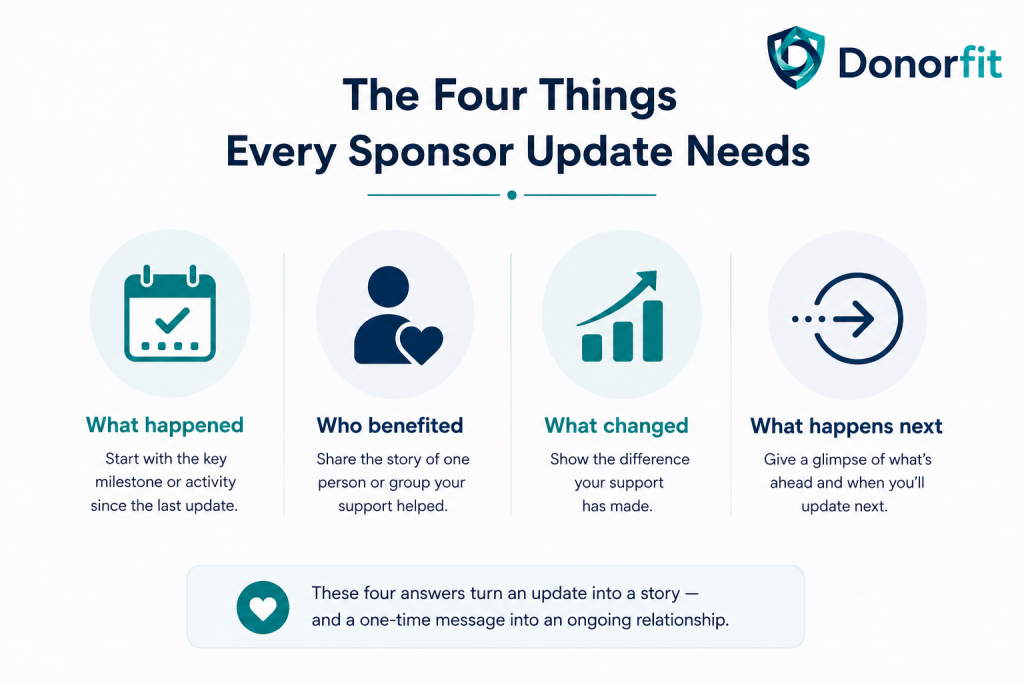
These four aren’t boxes to tick in order. The best updates weave them into one short, natural story — a sponsor should feel like they’re hearing from a person, not reading a status report with four labelled sections. Think of them as the questions your update should quietly answer, not headings you paste in.
What happened
Start with what’s actually new since the sponsor last heard from you. This is the anchor — the concrete thing that took place. A milestone reached, a session delivered, a piece of work completed, a season finished.
It matters because it’s the reason the update exists. Without a specific event, everything else floats. “The program continued this term” says nothing; “the after-school group met twice a week all term and finished its first community project” gives the sponsor something real to picture.
The thing to avoid here is vagueness dressed up as progress. If you can’t name what happened, the update probably isn’t ready to send.
Who benefited
Bring one person, family, or group into focus rather than describing the whole program. Sponsors don’t connect to caseloads; they connect to a face and a name — even a first name, even a composite, as long as it’s honest and consented.
A short, specific detail does more than a paragraph of context. What a young person said after finishing a course, how a family’s week changed, what a group can now do that they couldn’t before. That specificity is what makes the sponsor feel their contribution landed somewhere real.
What to avoid: generic beneficiaries who could be anyone. “A local child was helped” is technically true and emotionally empty. And a genuine caution — never invent a story or stretch the facts to sound more moving. A sponsor relationship runs on trust, and one embellished anecdote isn’t worth the risk to it.
What changed
Show the difference between the last update and this one — that’s what makes it worth reading. Progress is the point. A sponsor wants to see movement: a skill gained, a problem worked through, a milestone that wasn’t there before.
Change doesn’t have to be triumphant. A challenge honestly described — and how the team is responding to it — often builds more trust than another clean success. Sponsors are adults; they know real work has setbacks, and being told about them makes the good news credible.
Avoid the update that could have been sent last quarter with the date changed. If nothing has changed, either the update can wait, or the honest thing to report is the delay and why.
What happens next
Give the sponsor a reason to expect the next update, so the relationship feels ongoing rather than closed. A single forward-looking line does it: what the program is working toward, when they’ll hear from you again, what the next milestone is.
This is the element most updates drop, and it’s the one that turns a one-off message into a continuing relationship. It quietly tells the sponsor their support is part of something still in motion — not a transaction that’s now complete.
What to avoid: vague promises or a hard pivot into a fundraising ask. “We’ll be in touch about renewing your support” turns an update into an invoice. Save the ask for its own moment.
Short vs. long: relevance beats length
A shorter update often gets read where a long one gets saved for later and forgotten. But short isn’t the goal — relevant is.
A three-line update that says nothing specific is worse than a longer one full of meaningful detail. The aim is to include what matters and cut what doesn’t, and for most sponsor updates that lands somewhere brief. Length should be a result of relevance, not a target you set first. If a milestone genuinely needs more room to explain — a major project completed, a significant challenge navigated — take the room.
An example of the four elements in one short update
Here’s how the four questions can sit inside a single, concise update. This is an illustrative template, not a real person or organisation — the specifics are placeholders to show the shape:
Hi [Sponsor name],
This term, the reading group you support met twice a week and finished its first set of one-on-one sessions. (What happened.)
One of the students — I’ll call her M — started the term reading well below her age level and rarely speaking up. By the end, she read a short passage aloud to the whole group. Her mentor said it was the first time she’d volunteered without being asked. (Who benefited + what changed.)
We did hit a snag: two sessions were cancelled when our venue flooded, so we’re adding catch-up time next month to keep the group on track. (Honest challenge — transparency kept in.)
Next term the group moves on to longer texts, and we’ll send you an update in [month] with how M and the others are getting on. Thank you for making this possible. (What happens next.)
Four questions answered, one challenge disclosed honestly, no jargon, no org boilerplate, no ask. A sponsor finishes it in under a minute and knows exactly what their support did.
Sponsor updates vs. organisational reports
These two get confused, and the confusion is why so many updates read like reports. They’re different tools for different jobs:
| Sponsor update | Organizational report | |
| Purpose | Build the relationship; show impact | Document operations and accountability |
| Audience | The individual sponsor | Board, funders, regulators, whole org |
| Length | Short, relevance-driven | As long as completeness requires |
| Tone | Personal, warm, plain | Formal, precise |
| Focus | One story: what their support did | Full operational, financial, compliance picture |
| Statistics | Only with context that aids meaning | Comprehensive, for the record |
| Frequency | Regular, ongoing | Periodic (quarterly, annual) |
A sponsor update isn’t a shrunken report. It’s a different kind of communication — and a formal report still has its place for the operational, financial, and compliance detail an update deliberately leaves out.
How better updates support long-term engagement
Sponsors renew relationships they feel part of. Consistent, relevant, honest updates do quiet work over time: they build trust, they make the impact of a gift visible, and they keep the sponsor connected between asks.
The mechanism is straightforward. A sponsor who regularly sees where their support goes has a reason to keep giving. A sponsor who hears nothing for a year has only the renewal notice to go on — and industry analyses of why sponsors leave point consistently to that silence, not to price, as the driver of churn. (The sponsor retention piece covers that evidence in detail.) A good update isn’t a nicety on top of the relationship; for many sponsors, it is the relationship between one gift and the next.
Common sponsor update mistakes
- Leading with the organisation instead of the sponsor’s impact. The sponsor’s contribution should be the subject, not your institution.
- Sending the same template every time. Recognisable repetition trains sponsors to stop opening.
- Burying the one moving detail under logistics. If the best line is in paragraph five, most people never reach it.
- Turning every update into an ask. Updates that always want something get read as bills.
- Over-polishing until it’s lifeless. A little roughness reads as human; corporate perfection reads as mass mail.
- Numbers without meaning. “We served 4,000 meals” lands only if the sponsor can see what that represents.
- Going silent when there’s a problem. Silence during a setback does more damage than the setback itself.
Frequently asked questions
What should be included in a sponsor update? Four things: what happened since the last update, who benefited, what changed or progressed, and what comes next. Woven into a short, specific story rather than four separate sections, those answer what sponsors actually want to know.
How long should a sponsor update be? Long enough to answer the four questions with real specifics, and no longer. For most updates, that’s short — a few short paragraphs. Length should follow relevance; don’t pad to look thorough or cut to look brief.
How often should sponsors receive updates? Regularly and predictably enough that the relationship feels ongoing — many organisations land on quarterly, with additional updates at meaningful milestones. Consistency matters more than frequency: a reliable rhythm beats occasional bursts followed by long silences.
What makes a sponsor update effective? Specificity and honesty. A real detail about a real change, told plainly, with any challenges disclosed rather than hidden. Effective updates feel like they came from a person who was there, not from a template.
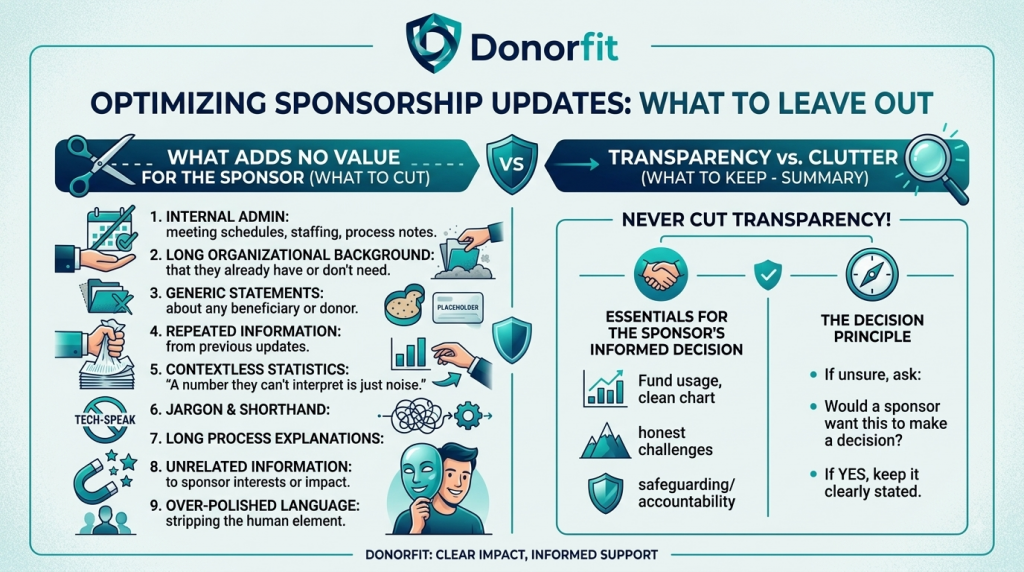
What should you not include in a sponsor update? Internal admin, long organisational background, repeated information, uncontextualized statistics, jargon, and anything unrelated to the sponsor’s support. Keep transparency — fund use, honest challenges, safeguarding — and cut the clutter that hides it.
How do you write a meaningful sponsorship update? Decide the one thing the sponsor most needs to know, lead with it, and let the four questions shape the rest. Bring one person or group into focus, show what changed, disclose any setbacks honestly, and end with what’s next.
How can charities improve sponsor communication? Make updates consistent, specific, and sponsor-focused, and cut the detail that buries the impact. Having sponsor information and communication history organised in one place makes it far easier to send the right update to the right sponsor on a reliable schedule.
Keeping sponsor updates consistent and personal gets hard when sponsor details, giving history, and past communications live across spreadsheets and inboxes. It’s tough to send the right update to the right sponsor on time when you’re reconstructing who supports what from scattered records. A purpose-built donor and sponsorship platform keeps that information in one place, so a well-timed, relevant update is a quick task rather than a research project. If keeping sponsor communication organised is a challenge for your team, that’s where DonorFit fits.