








Building a Membership Renewal Reminder Sequence: What to Send at 90, 60 & 30 Days

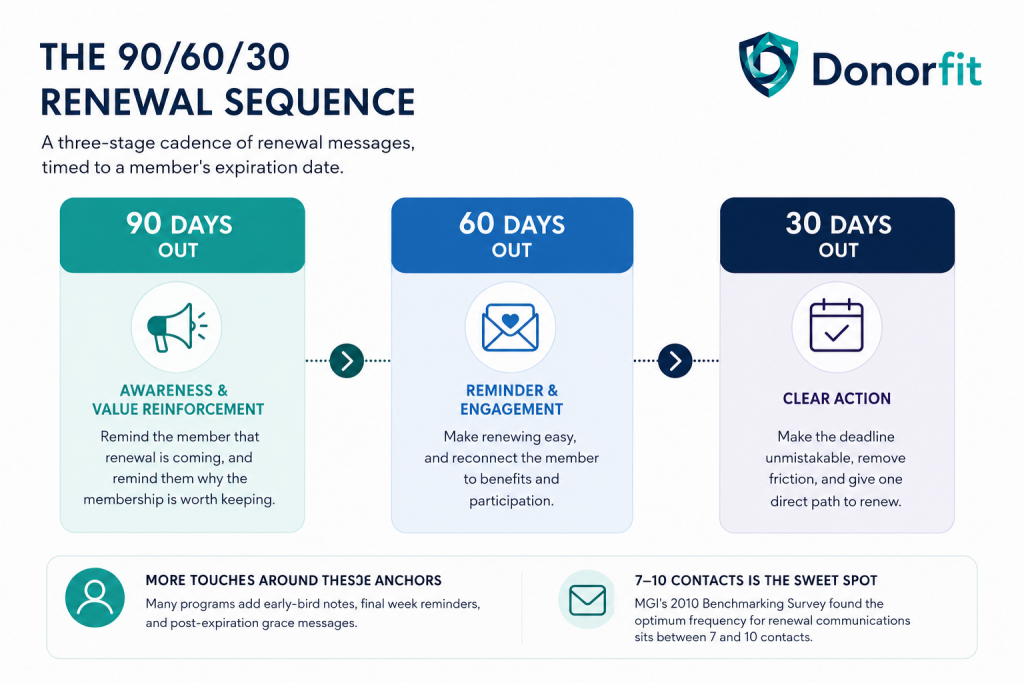
A membership renewal reminder sequence is a planned series of communications sent in the months before a membership expires — usually anchored at 90, 60, and 30 days out — where each message does a different job instead of repeating the same “renew now” request. Done well, it catches the members who intended to stay but drifted, without pressuring the ones who were always going to renew.
Start renewal communication about 90 days before expiration, and change the job of the message at each stage rather than the wording of the same ask. That’s the short version. The rest of this piece is what belongs in each message, what to leave out, and how to tell whether the sequence is actually working.
According to Marketing General Inc.’s Membership Marketing Benchmarking Report, the average association’s renewal campaign already starts roughly three months before expiration. The 90/60/30 structure isn’t a new invention — it’s a way of making that three-month runway deliberate instead of accidental.
What is a 90/60/30 renewal sequence?
Why renewal timing matters
Renewal rarely fails at the renewal notice. It fails earlier, quietly.
When association staff are asked why members don’t renew, the top three answers cluster around timing and attention, not price. In MGI’s 2023 report, staff named lack of engagement with the organisation (51%), lack of value (33%), and simply forgetting to renew (32%) as the leading reasons members lapse. Two of those three are directly addressable by a well-timed sequence: the forgetters need reminding, and the disengaged need re-connecting to value before the invoice arrives.
That’s why a reminder sent only in the final week works against you. By then, the only tool left is pressure. A message that lands 90 days out still has room to rebuild the relationship; a message that lands 5 days out can only chase a payment.
There’s a hard number under this. The median membership renewal rate across associations sits around 84% (MGI 2025), and first-year members renew at closer to 74%. A few points of accidental lapse — the forgetters, the expired-card renewals, the “I meant to do that” members — is often the difference between a program that grows and one that quietly shrinks. The sequence exists to recover those points.
This piece focuses on the communication cadence itself. For why engagement signals predict renewal months before the invoice does, see the companion piece on the 90-day renewal window.
The 90-day message: awareness and value
The 90-day message should reconnect the member to value, not ask for money.
At three months out, most members aren’t thinking about renewal at all — and that’s fine. This message isn’t a request; it’s a warm reminder that the relationship exists and has been worth something. The best 90-day notes are barely recognizable as renewal messages.
What works here:
- A short year-in-review framed around the member: sessions they attended, resources they downloaded, savings or credits they used, the community they’re part of.
- A heads-up that renewal is approaching, phrased as a courtesy (“your membership renews in early [month]”) rather than a demand.
- A single, low-pressure path to renew early for members who are ready — an early-bird link catches your most loyal members before they need chasing.
The tone is relationship, not transaction. If a member reads the 90-day message and feels reminded of why they joined, it’s doing its job — even if nobody renews from it that day.
The 60-day message: reminder and engagement
At 60 days, make renewal easy and reconnect the message to participation.
This is the working middle of the sequence. The member now knows renewal is coming; the 60-day message makes the case and lowers the effort. It’s more direct than the 90-day note but still not a hard push.
What works here:
- A clear, specific benefit reminder tied to what this member actually uses — event access, a certification, a directory listing, a discount they’ve redeemed before.
- A frictionless renewal link that lands them one click from paying, not five.
- A gentle nudge toward re-engagement for members who’ve gone quiet: an upcoming event, a new resource, a reason to come back before deciding.
The 60-day message is also where segmentation starts to pay off. A highly engaged member and a member who hasn’t logged in for six months should not receive identical copy. The engaged member needs a reminder; the disengaged member needs a reason.
The 30-day message: clear action
The 30-day message removes friction and makes the deadline obvious.
Now it’s direct — appropriately so. The member has had two prior touches without being pushed, and that earns the right to be clear. This message is about closing the loop, and here clarity beats cleverness every time.
State the deadline plainly, and state what changes at it: loss of access, a lapse in benefits, a return to non-member rates. Give the single most direct renewal path you have — ideally one click, ideally pre-filled — because every extra step is another place a ready member gets distracted and drifts off. And put a human in the message: a line saying who to reply to or call if something’s in the way. A stalled renewal at this stage is usually a broken card or a forgotten password, not a decision to leave, and the fastest fix is often a person, not another email.
This is also the one stage where a phone call earns its cost. MGI’s channel guidance fits the sequence almost exactly: email is the least expensive channel and is used to launch the series, while phone calls are the most costly and are best saved for the end of the campaign, aimed at the most difficult-to-convince members. A call at 90 days feels like pressure. A call at 30, to a high-value or clearly at-risk member, is often the renewal itself.
Example renewal sequence
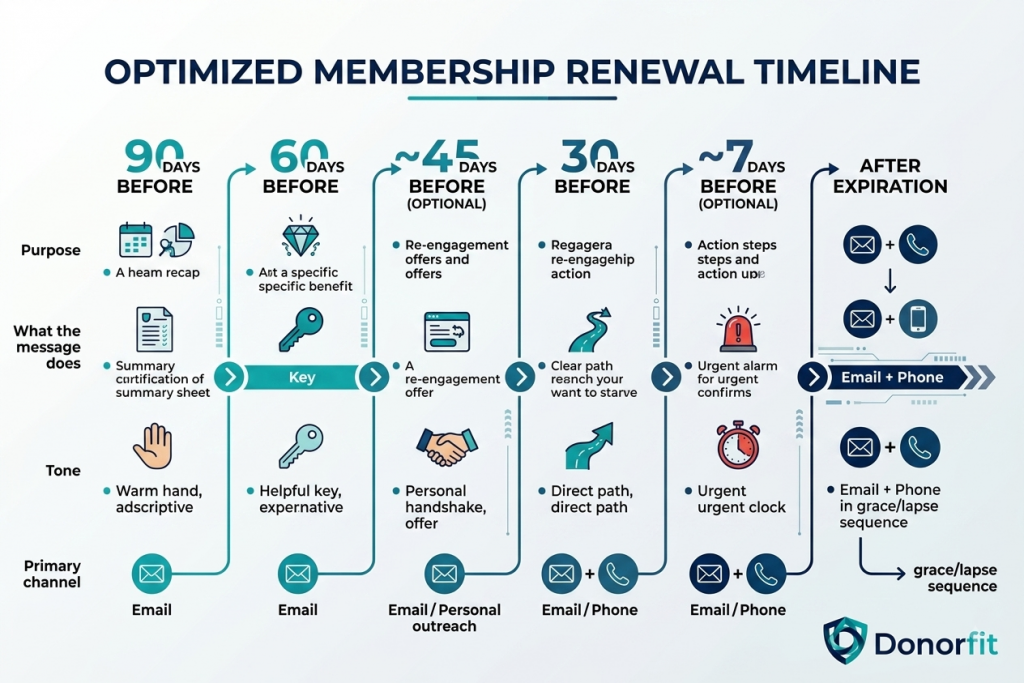
Here’s the spine of a 90/60/30 sequence, with the anchors and the common in-between touches most programs add:
Treat the optional rows as the difference between a competent sequence and a strong one. The three anchors prevent accidental lapse; the in-between touches recover the members already drifting.
Related reading:
What each message should contain
Across all three stages, a renewal message earns its send when it includes:
- One clear purpose. Awareness, reminder, or action — not all three at once.
- Something about the member. Their usage, their tenure, their benefits — anything that signals this isn’t a mass blast.
- One primary path to renew. Multiple competing links dilute the action.
- A human point of contact. Someone to reply to when a renewal stalls for a practical reason.
- An honest deadline. State what changes at expiration, without inventing false urgency.
What NOT to do
The most common failure mode isn’t sending too few messages — it’s sending the same message three times. The gap between a weak sequence and a strong one isn’t the number of sends; it’s whether each send does a different job:
| Dimension | Weak sequence (one message, repeated) | Strong sequence (staged 90/60/30) |
| Each message’s job | Identical “renew now” ×3 | Value → ease → action, one job per stage |
| The 90-day message | An invoice three months early | A value recap, no ask |
| Segmentation | Same copy to every member | Engaged and disengaged members split apart |
| Phone calls | None, or wasted early | Reserved for 30-day at-risk and high-value members |
| After expiration | Silence | Grace-and-recovery handoff |
| Who it catches | Members already committed to renewing | Also the forgetters and drifters who meant to stay |
The specific mistakes below are all versions of the left-hand column.
- Don’t send “Renew now” three times. Three identical asks read as three identical demands. The member who ignored the first has no new reason to act on the third. Change the job of each message, not just the date.
- Don’t lead with money at 90 days. An invoice three months early feels like a bill for something not yet used up. Lead with value; let the ask arrive as the deadline nears.
- Don’t treat every member identically. A member who attends everything and a member who hasn’t opened an email in six months are two different problems. One needs a reminder; the other needs re-engagement — or you’ll lose them regardless of how clean your renewal link is.
- Don’t manufacture pressure. Fake scarcity and guilt language damage the relationship you’re trying to renew. The tone throughout is a nudge, not a threat.
- Don’t go silent after expiration. The member who most recently lapsed is the one most likely to come back. Ending the sequence at the expiration date forfeits your best recovery opportunity.
What happens after the 30-day reminder
The sequence doesn’t end at expiration — it hands off.
Members who haven’t renewed by their expiration date move into a grace-and-recovery flow, not a void. MGI reports the average association offers roughly a three-month grace period after expiration; that window is a recovery opportunity, not a formality. A short, understanding post-expiration message (“your membership ended 2026 — here’s how to pick up where you left off”) often recovers members who simply missed the earlier notes.
Once grace closes, the work shifts from renewal to reinstatement, which is a genuinely different campaign. For that stage, see the membership lapse window and winning back lapsed members.
How to measure whether the sequence is working
You can’t improve a sequence you’re not measuring. Track, at minimum:
- Renewal rate by stage. What share of renewals come in after the 90-, 60-, and 30-day messages? A sequence that only converts at 30 days is really a one-message campaign with extra sends.
- Time-to-renewal. Are members renewing earlier over time? Earlier renewals usually signal a healthier, better-timed sequence.
- Open and click trends across the series. Falling engagement across the three messages tells you the later sends are being tuned out — a signal to change the message, not just resend it.
- At-risk recovery. Of the members flagged as disengaged, how many did the sequence bring back? This is the number that separates a reminder system from a retention system.
- Post-expiration recovery. What share of non-renewers come back during grace? Weak recovery here usually points to timing or content, not to the members.
Frequently asked questions
When should you send a membership renewal reminder? Start about 90 days before expiration and continue through the expiration date, with anchor messages at 90, 60, and 30 days plus optional touches in between. MGI reports the average renewal campaign already begins around three months out; the value is in making that runway deliberate rather than sending everything in the final weeks.
How many membership renewal emails should you send? More than one, and each with a different job. The 2010 MGI Benchmarking Survey put the optimum at seven to ten total renewal contacts across a full campaign — a figure worth testing against your own data, but the direction holds: a single reminder underperforms a planned series. Three anchored stages with a few in-between touches is a reasonable target for most organizations.
What should a membership renewal email say? It depends on the stage. At 90 days, remind the member of the value they’ve received and that renewal is coming. At 60 days, reinforce a specific benefit and make renewing easy. At 30 days, state the deadline plainly and give one direct path to renew. Every message should include something specific to the member and one clear action.
What should you send 90 days before membership expires? A value-first, low-pressure message: a short recap of the member’s year, a courteous heads-up that renewal is approaching, and an optional early-renewal link. Avoid leading with an invoice this far out — it reads as a bill for something not yet used up.
What should you send 30 days before membership expires? A direct, action-focused message: an unmistakable deadline, what changes at expiration, and the single most frictionless renewal path you have. This is also the right stage for a personal phone call to at-risk or high-value members, since that channel is best reserved for late in the campaign.
How can membership organizations improve renewal rates? Start earlier, segment the sequence, and vary the message by stage instead of repeating the same ask. Because a large share of members lapse from disengagement or simple forgetfulness rather than a decision to leave, a well-timed sequence that reconnects value early and removes friction late recovers renewals that a last-minute reminder never could.
If your team is still tracking renewal dates by hand, the harder problem usually isn’t writing the reminder — it’s reliably knowing who needs one, when their membership expires, and which members are quietly disengaging before the deadline. A 90/60/30 sequence only works if it fires automatically off accurate, up-to-date member data. That’s the kind of visibility a purpose-built donor and membership platform is meant to provide. If automated, well-timed renewal sequences are on your roadmap, that’s where DonorFit fits.
Roslyn
Greetings! This is my first visit to your blog!
We are a collection of volunteers and starting a new initiative in a community in the same niche.
Your blog provided us beneficial information to work
on. You have done a extraordinary job!