










Why Sponsors Ghost After Year One (And It’s Not the Money)

Most sponsors who don’t renew didn’t have a bad experience—they had a bad reporting experience, and no proof of value they could carry back to their own leadership. When a sponsorship quietly disappears after year one, the exit reason on file usually says “budget.” The real reason is almost always silence: the partnership went dark after the event, the results were never packaged, and the sponsor’s marketing lead was left with nothing to justify the renewal internally.
If your sponsorship revenue leaks a little more every year and you keep responding by adding deliverables—bigger logos, another session break, one more email blast—this is the piece worth reading. The fix is rarely more inventory. It’s proof and contact.
Why “it was the money” is usually a cover story
Price is what sponsors say on the way out; unproven value is what actually pushed them there. A sponsor who can clearly see what they got rarely baulks at the invoice. A sponsor who can’t measure their return will hedge—downgrade a tier, ask for concessions, or “evaluate options” until the relationship fades.
The evidence points consistently at proof, not price. In its 2026 analysis of event sponsor retention, PheedLoop found that most sponsors who don’t renew didn’t have a bad event—they had a bad post-event reporting experience that left them unable to justify the spend to their own decision-makers. Bizzabo’s research adds shape to that: 30% of sponsors name lead quality as the single most important metric when evaluating ROI, and 20% cite limited access to attendee data as a major obstacle. When the thing a sponsor most needs to see is the thing they can’t get, “the price went up” becomes the easiest polite exit.
That said, price isn’t nothing. Flat-rate renewals in an inflationary market quietly erode your own economics, and Xarify’s 2026 pricing analysis makes a fair case that underpricing can even attract less loyal sponsors. But underpricing is a margin problem. Ghosting is a value-proof problem. Don’t confuse the two.
The silence gap: what sponsors need vs. what they get
Sponsorship churn is manufactured in the weeks after the event, when the data story ends but the renewal decision is only beginning. The pattern is remarkably consistent across the field. The post-event call sounds fine. No complaints. Then, as VenuIQ describes it, six weeks later, the renewal simply goes quiet—because the signals of disengagement were there during the event, but nobody translated them into a story the sponsor could act on.
Two structural failures drive most of it:
-
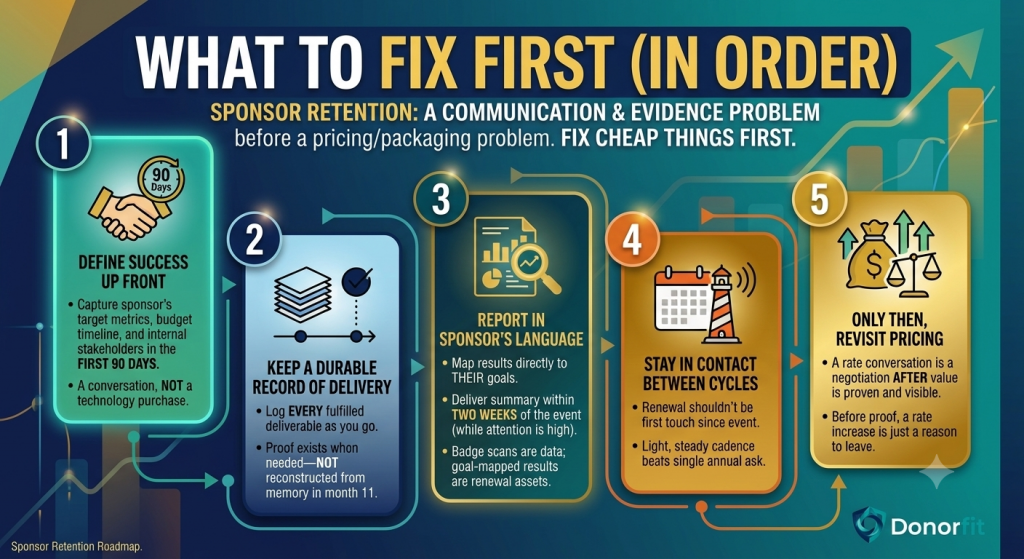
- No durable record of delivery. As Clarity Media Partners puts it, fulfilment failures erode renewals not because deliverables weren’t executed, but because there’s no lasting proof they were. If you can’t show it, you didn’t do it—as far as the renewal conversation is concerned.
-
- No shared definition of success. A source notes that renewals rarely fall apart at the negotiating table; they fall apart because the groundwork was never laid. If you don’t know, in the first 90 days, what metrics the sponsor tracks, when their budget cycle closes, and who else internally cares about the outcome, you’re negotiating blind a year later.
And there’s a human layer underneath the metrics. A sponsor who feels genuinely valued and recognised is more likely to renew, even when not every target was hit (BishopMcCann, 2025). Silence doesn’t just withhold data—it signals indifference.
What organisers assume vs. what’s really happening
| What it looks like | Common assumption | More likely driver | First fix |
| Sponsor drops after year 1 | “Our price was too high” | No ROI summary they could take to their own boss | Send a sponsor-ready results report within 2 weeks |
| Sponsor downgrades a tier | “They’re cutting budgets” | They can’t measure last year’s return | Prove tier-level value with lead quality + engagement data |
| Renewal call goes quiet | “They lost interest” | Disengagement signals appeared during the event, unaddressed | Flag flight-risk signals live, not after |
| “Let us evaluate options” | “A competitor undercut us” | No shared definition of what success meant | Set success metrics in the first 90 days |
What to fix first (in order)
Frequently asked questions
Why do sponsors leave after the first year? Most first-year sponsors leave because they couldn’t prove the value internally, not because the price was too high. When the event ends and the reporting goes silent, the sponsor’s champion has nothing to justify a renewal to their own leadership—so the partnership quietly lapses.
Is sponsor churn really not about price? Price is usually the stated reason, not the root cause. A sponsor who can clearly measure their return rarely leaves over cost; a sponsor who can’t measure it will cite budget. Pricing matters for your margins, but unproven value is what drives most year-one ghosting.
What’s the most common reason sponsors don’t renew? A weak or absent post-event reporting experience. Sponsors need results packaged in terms of their own goals—lead quality, engagement, audience fit—delivered promptly. Without that, even a well-executed event fails to convert into a renewal.
When should you start the renewal conversation? In the first 90 days of the relationship, not at renewal time. That’s when you learn what the sponsor measures, when their budget cycle closes, and who else needs convincing—the roadmap you’ll need a year later.
What should a post-event sponsor report include? Results mapped to the sponsor’s stated goals: lead quality and volume, engagement metrics, audience fit, and completion of promised deliverables—summarized so their team can drop it straight into an internal renewal case. Speed matters; send it within about two weeks.
Is there a standard sponsor renewal-rate benchmark? Not a reliable, industry-wide one. Unlike membership renewal (where the MGI benchmark is well established) or donor retention (tracked by the Fundraising Effectiveness Project), sponsor renewal rates vary too much by event type, tier, and sector to support a single credible figure—and donor or membership numbers shouldn’t be borrowed as stand-ins. Track your own sponsor renewal rate by tier instead.
Related reading
| The Hidden Cost of Managing Orphan Care Programs with Spreadsheets | https://donorfit.com/en/the-hidden-cost-of-managing-orphan-care-programs-with-spreadsheets/ |
| How Real-Time Child Welfare Updates Build Donor Trust and Sponsor Retention | https://donorfit.com/en/how-real-time-child-welfare-updates-build-donor-trust-and-sponsor-retention/ |
Sponsors ghost when the relationship goes dark and the proof never arrives. Keeping partners requires the unglamorous infrastructure—recording what you delivered, tracking each sponsor’s goals and contacts, and staying in touch between cycles—so nothing slips into silence. That’s the connective tissue a purpose-built platform is meant to hold. See how DonorFit helps you keep partners, not just win them.