










First-Year Member Retention: Why New Members Renew at 74% — and How Onboarding Closes the Gap

First-year retention is the single largest fixable gap in most membership programs: new members renew at roughly 74%, against an 84% median across all members, and almost the entire difference is decided in the first 90 days of membership — long before the first renewal notice. The organisations that close that gap do not do it with a better renewal campaign. They do it with a structured onboarding period that converts a new signup into an engaged member before the value question is ever asked.
The pattern is consistent across more than a decade of benchmarking. Marketing General Incorporated (MGI), which has surveyed association membership practices annually since 2009, reports a first-year renewal rate of approximately 74–75%, compared to the overall median of 84% (MGI, 2025 Membership Marketing Benchmarking Report). That 10-point gap is not spread evenly across the membership base. It is concentrated almost entirely in the newest cohort — which means the newest members are also the highest-leverage ones.
The first-year cliff is a lifecycle problem, not a value problem
The overall 84% median flatters the picture, because it blends long-tenured members — who renew almost automatically — with the newest members, who are still deciding whether membership belongs in their working life at all. Separate the cohorts and the shape changes: a program showing 84% overall can easily be running low-90s among three-year members and low-70s among first-years. The site-wide number hides exactly the group that needs attention.
At roughly 74% first-year renewal, about one in four new members is gone before their second year. It is tempting to read that as a value-proposition problem — the benefits weren’t good enough. The benchmarking points elsewhere. When MGI asked association staff why members fail to renew, the top answer was lack of engagement with the organisation, cited by 51% of respondents, ahead of lack of value at 33% and simply forgetting to renew at 32% (MGI Membership Marketing Benchmarking Report, 2023). Members who leave in year one usually don’t test the value and reject it. They never connected to it in the first place.
That distinction matters because it changes where the intervention goes. A value problem is solved by changing benefits. An engagement problem is solved by changing what happens in the first 90 days.
Why are the first 90 days deciding the renewal?
A new member arrives with more intent than they will have at any later point — they just paid, they chose to join, and they are briefly curious about what they bought. That window closes quickly. If the first weeks pass without a login, an event, a useful resource, or a single human interaction, the membership quietly becomes a line item the member has no particular reason to keep.
The sequence is the same one covered in Why Membership Renewals Should Start 90 Days Before Expiration, only compressed and moved to the front of the relationship. A disengaging long-tenured member drifts over months. A new member who never engaged was never anchored to begin with — so the drift starts on day one, and the renewal decision is effectively made long before it’s formally asked.
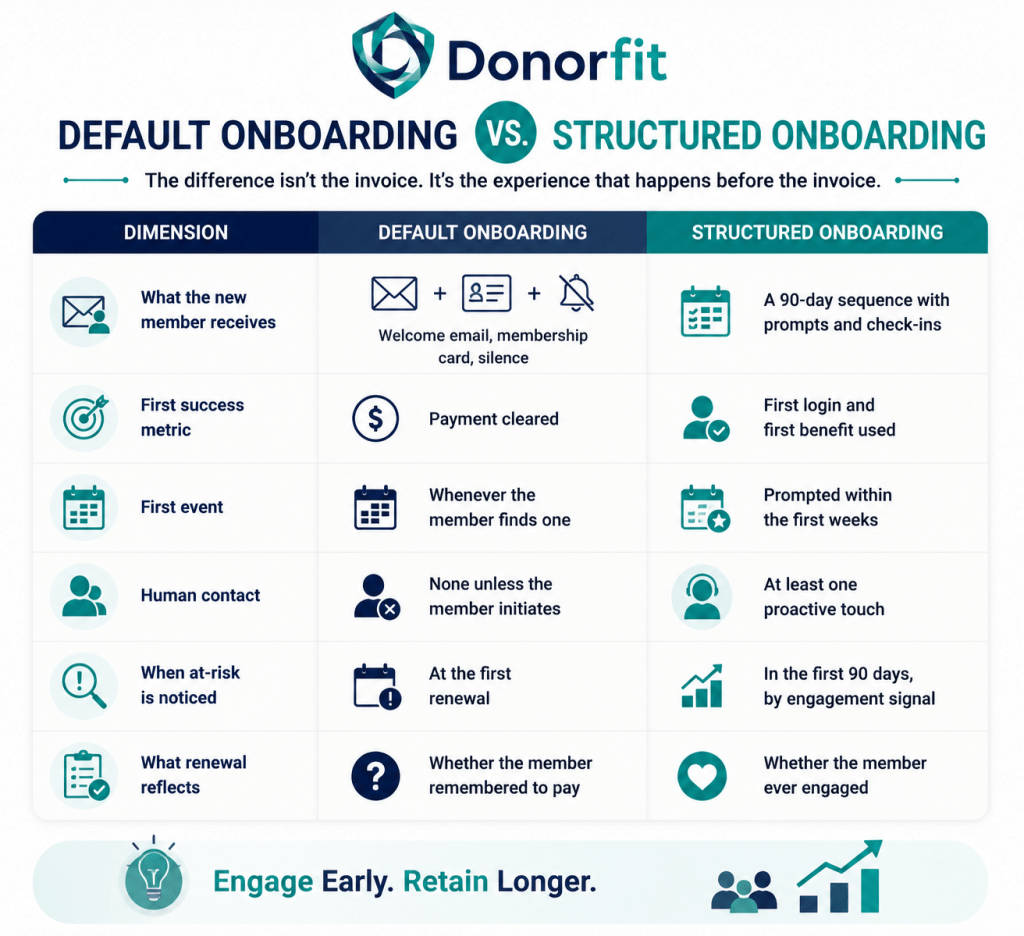
Consider a composite example. A member joins in January. A welcome email goes out automatically. A membership card arrives. And then — nothing scheduled, nothing prompted. They mean to explore the member portal “when things calm down.” They skim two newsletters and stop opening the third. No event feels quite relevant enough to block out an afternoon for. By the time the renewal invoice arrives the following January, they have received twelve months of membership and experienced almost none of it. To the renewal team, they look like any other name on the list. The invoice doesn’t lose this member. The empty first quarter did.
What onboarding actually does
Structured onboarding is not a warmer welcome email. It is a deliberate sequence designed to get a new member to use something — a benefit, an event, a connection — before the initial intent fades. The mechanism is straightforward: usage builds the experience of value, and experienced value is what renews. MGI’s research repeatedly ties benefit usage to renewal, and members who engage with several benefits in their first quarter renew at rates far closer to established members than to the 74% first-year average.
Inside the first 90 days, the highest-leverage moves are:
Get the first login. Portal access in the first weeks is the earliest proxy for whether a member will engage at all. A member who never logs in has no surface on which value can happen.
Drive one early event. Event attendance is among the strongest engagement signals available. The first event a new member attends — in person or virtual — is often the moment membership stops being abstract.
Match benefits to the reason they joined. Members join for specific reasons and then forget which benefits serve them. Surfacing the two or three benefits aligned to their stated interest, early, does more than a full benefits catalogue ever will.
Make one human contact. A welcome call, a check-in, or a peer/mentor pairing turns a transaction into a relationship. If no one on staff has ever interacted with a member, there is no relationship to renew.
Remove the renewal decision where you can. MGI notes that associations offering automatic renewal see substantially higher renewal rates, and the effect is especially pronounced among first-year members (Marketing General Inc.). Auto-renew doesn’t fix disengagement — but it stops involuntary lapses from compounding it.
The through-line is that none of these is renewal tactics. They are engagement tactics, run eleven months before renewal, that make the renewal a formality instead of a decision.
Default onboarding vs. structured onboarding
What to track in the first 90 days — and why it breaks manually
An early-warning system for first-year members watches a small, specific set of signals, on a much shorter clock than the renewal cohort:
First login (months 1–3). The single earliest indicator that a member will engage. Absence here is the first red flag.
Onboarding email engagement. Open and click rates on the welcome sequence show whether the content is landing. A member who ignores the onboarding emails is telling you early.
First event attendance. Attended or not, in the first year — a binary that predicts far more than its simplicity suggests.
Early benefit usage. Which benefits, if any, the member has touched in the first quarter. Zero usage by day 90 is an actionable flag, not a wait-and-see.
Human touch on record. Whether any staff interaction has happened at all. Six months of silence on a first-year member is a relationship that was never started.
Each of these signals lives in a different place — the member portal, the email platform, the event registration list, the benefits log, and individual staff inboxes. This is where the manual-tracking gap covered in The Hidden Cost of Manual Membership Management hits hardest, because first-year tracking is the most time-sensitive tracking a membership team does. A spreadsheet can record that a member joined in January. It cannot tell you that they never logged in, ignored the welcome series, skipped every event, and used no benefits — until the renewal doesn’t come. Assembling that picture by hand, for every new member, every month, inside a 90-day window, is not a staffing problem. It is a system problem.
A membership management platform like Donorfit closes that gap mechanically rather than heroically. Because portal activity, email engagement, event attendance, benefit usage, and communication history live in one member record, a new member’s first 90 days become visible as they happen — not reconstructed a year later. Staff can see which new members never activated and reach them while the intent is still recoverable, instead of reconciling exports from five different tools after the renewal is already lost.
The math makes first-year retention the highest-ROI work
Most associations spend the majority of their membership effort on recruitment, and recruitment is the more expensive of the two by a wide margin. Every first-year member lost is not just churn — it is the full acquisition cost written off before the member ever contributed a second dues cycle. That makes the first-year cohort, dollar for dollar, the highest-return place a membership team can spend its attention.
The compounding runs the other way, too. A member retained past year one behaves like an established member: they renew at the higher rate, they use more benefits, and their lifetime value extends across dues cycles that recruitment never has to pay for again. Closing even part of the 10-point first-year gap doesn’t just raise this year’s number — it lowers the recruitment burden every year after.
Most organizations can tell you their overall renewal rate. Far fewer can tell you their first-year renewal rate as a separate number — and fewer still can name which of this year’s new members have gone quiet in their first 90 days. That gap, between an overall rate and a first-year at-risk list, is the difference between hoping new members stick and making sure they do. First-year retention isn’t won at renewal. It’s won in the first quarter, with visibility.
Frequently Asked Questions
What is a typical first-year membership renewal rate? Roughly 74–75%, compared with an 84% overall median across associations (MGI 2025 Membership Marketing Benchmarking Report). The gap is consistent across years of benchmarking and is concentrated in the newest cohort, which is why first-year members should be tracked as their own segment rather than blended into the site-wide rate.
Why do first-year members renew at lower rates than established members? They haven’t yet built the experience of value that drives near-automatic renewal in tenured members. MGI’s research points to lack of engagement — not lack of value — as the leading non-renewal reason (51%, MGI 2023), which means most first-year losses are members who never fully connected rather than members who tried membership and rejected it.
How long should new member onboarding last? The first 90 days carry the most weight, because that is when initial intent is highest and most recoverable. The goal within that window is concrete: a first login, one event, early benefit usage, and at least one human interaction — usage that builds value before the value question is ever asked.
Which first-year signals best predict renewal? First login, onboarding-email engagement, first event attendance, early benefit usage, and any staff interaction on record. No single signal is decisive; a new member who is missing several of them by day 90 is the actionable at-risk case.
Does automatic renewal improve first-year retention? It helps, particularly by preventing involuntary lapses. MGI reports that associations offering automatic renewal see higher renewal rates, with a pronounced effect among first-year members (Marketing General Inc.). It is a complement to engagement work, not a substitute — auto-renew keeps an engaged member; it cannot rescue one who never engaged.