






Shared-Project Receipts: Giving 40 Donors Proof of One Well
A shared-project receipt is a donor-facing report that ties one funded outcome to every person who paid for a share of it — so the forty donors behind a single well each receive proof of that well, not a generic thank-you. It is different from a tax receipt, which confirms a transaction. This kind of proof confirms an outcome, and in water and WASH fundraising, where one project is almost always funded by many gifts, it is the difference between a donor who gives once and a donor who gives again.
Most water charities can produce a tax receipt for every gift without thinking about it. Far fewer can hand a donor proof of the specific project their gift helped complete. That gap is quiet, it is common, and it is where a lot of second gifts are lost.
The many-to-one problem most WASH teams live with
A well rarely has one funder. Depending on the build, a single water point can cost a few thousand to well over ten thousand dollars, which means it is usually funded by dozens of gifts of very different sizes. Call it forty donors for one well. That number is illustrative, not a benchmark, but it describes the everyday reality: the unit a donor cares about (a finished well) and the unit your system records (an individual gift) are not the same thing.
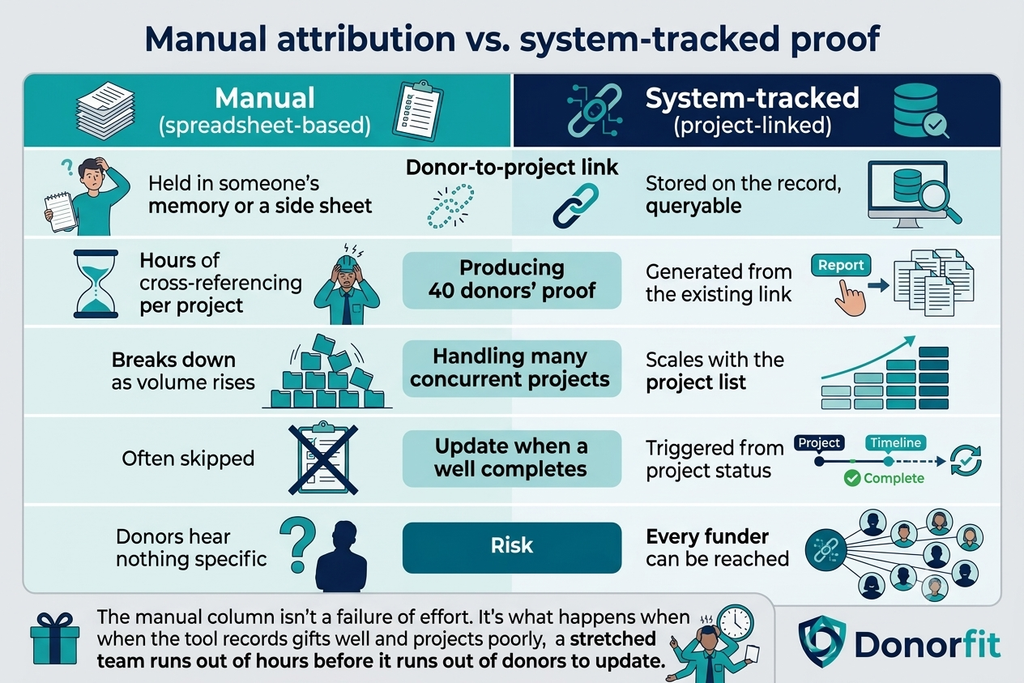
When those two units aren’t connected, proof becomes manual. Someone has to remember which campaign funded which project, cross-reference a spreadsheet of donors against a list of completed sites, and stitch together an update by hand. At ten donors that is tedious. At four hundred across a dozen concurrent projects, it simply doesn’t happen, and the donor hears nothing specific after their gift.
The result isn’t that donors are told a lie. It’s that they’re told nothing. And silence, not disappointment, is what usually ends the relationship.
What a shared-project receipt actually is (and isn’t)
It helps to separate three things that often get collapsed into the word “receipt.”
| Document | Confirms | Answers the donor’s question |
| Tax/gift receipt | The transaction happened | “Is my gift recorded and deductible?” |
| Generic impact newsletter | The organisation did work | “Is this charity doing something?” |
| Shared-project receipt | Their gift funded a share of this specific project | “Where did my money actually go?” |
The third one is the one most systems can’t produce automatically, because it requires a link that a donor-first database doesn’t hold by default: this donor → this project → this proof. A shared-project receipt carries the project’s identity (name, location, sometimes GPS coordinates), its status or completion date, a photo or field report, and the donor’s own place in it. Several donors can receive a version of the same project’s proof, each acknowledging their contribution to the shared outcome.
Why proof of a specific project earns the next gift
The link between “seeing your impact” and “giving again” is one of the better-supported patterns in current donor research.
In Zeffy’s 2025 Donor Behaviour & Giving Trends Report, based on a survey of 1,000 U.S. donors, only about a third of donors, 36%, said they currently have easy access to information about what their gift made possible. The same report found that when donors do understand the impact of their gift, they are more likely to give again and to give more. CCS Fundraising, as reported in Neon One’s 2026 fundraising statistics, puts it more bluntly: 97% of donors cited the real or perceived impact of their gift as a major factor in their decision to give.
Retention data points in the same direction. Per Fundraising Effectiveness Project figures for 2025, first-time donors are retained at roughly 19%, while donors with a prior giving history are retained at closer to 59–69% depending on the source and year. The exact repeat figure varies, and it’s worth treating as a range rather than a single number, but the gap is consistent: a donor you keep is several times more likely to still be with you next year than a donor you’ve just met. Proof of a specific outcome is one of the few levers a small team can pull to move a first-time giver into that second, stickier category.
There is no clean published statistic that says “project-level proof lifts retention by X%,” and this article won’t invent one. What the evidence supports is narrower and still useful: donors want to know what their gift did, most don’t feel they can find out easily, and the ones who can are measurably more likely to give again.
The organisation that made proof its whole model
The clearest real-world example of shared-project proof at scale is charity: water. From its earliest years the organization has published photos and GPS coordinates for every water project it funds, and its WaterProof program frames the donor experience as “give water, get proof.” Once a project a donor helped fund is complete, they receive a customized Impact Report with project photos, GPS coordinates, and specific information about the community reached. While the work is underway, an ongoing feed called The Current carries interim updates rather than leaving donors in silence.
Two details matter for the many-to-one problem specifically. First, charity: water connects donors to specific funded projects — an early profile of the organisation described being able to search a supporter’s name and see the project they funded, down to the village. Second, the organisation openly notes that to protect residents’ privacy, many household-level water points share the same community name and GPS coordinate, so multiple donors and multiple points map onto one shared record. That’s the shared-project model working in practice: a single verified outcome, connected to many donors, each shown their part in it.
Most organisations aren’t going to rebuild charity: water’s field infrastructure, and they don’t need to. The transferable idea is the data structure underneath the storytelling: a project is a first-class record, donors are linked to it, and proof is generated from that link rather than assembled by hand.
Manual attribution vs. system-tracked proof
What good shared-project receipting includes
A shared-project receipt doesn’t need to be elaborate. It needs to be specific and repeatable. The elements that carry the most weight:
The project’s identity, so the donor can locate it — a name, a place, and where possible a coordinate or map link. The project’s status or completion, so the update marks a real moment rather than a generic check-in. A piece of field evidence: one photo or a short report beats a paragraph of adjectives. The donor’s own connection, acknowledging their share of the shared outcome without overstating that they funded it alone. And a cadence the team can actually sustain, since a receipt sent once reliably is worth more than an elaborate one promised and skipped.
For teams already thinking about when to communicate across the long gap between a gift and a finished well, that timing question is its own subject. We cover it in the companion pieces on the funding-to-completion gap and the six-month silence
e that costs the second gift. A related question is whether your current system can even hold the donor-to-project link in the first place, which we take up in can your CRM show a donor their well?. This article is about a third piece: making the proof itself specific enough to matter, even when a project belongs to many donors at once.
FAQ
What is a shared-project receipt? It’s a donor-facing report that connects a specific funded project to each donor who contributed a share of it, showing the project’s identity, status, and field evidence. Unlike a tax receipt, which confirms the transaction, it confirms the outcome the gift helped fund.
How do you give 40 donors proof of one well without doing it 40 times by hand? By storing the donor-to-project link on the record rather than in a spreadsheet. When the project is the unit the system tracks, one completion update can be issued to every donor attached to it, each acknowledging their own contribution.
Isn’t a tax receipt enough? A tax receipt satisfies a compliance need, but it answers “is my gift recorded,” not “where did my money go.” Donor research consistently shows the second question is the one that drives repeat giving, and it’s the one a tax receipt doesn’t touch.
Is there a benchmark for how much project-level proof improves retention? Not a clean, published one, and it’s better to say so than to invent it. The supported findings are that most donors can’t easily see their impact (about 36% say they can, per Zeffy’s 2025 report) and that donors who understand their impact give again more often.
Does this only work for organisations as large as charity: water? No. charity: water is a useful example because it built proof into its model at scale, but the underlying idea — treat the project as a record, link donors to it, generate proof from that link — works for a program funding a handful of wells a year.
Donorfit records the project alongside the gift, so the donors behind a single well stay connected to that well through completion. If producing specific, per-donor proof is currently a manual scramble your team runs out of hours for, that’s the gap it’s built to close.