


One Cause, Many Kinds of Giving: What Flexible Fundraising Software Actually Means
Flexible fundraising software is a platform that can run many distinct kinds of giving in one place, without forcing them all into a single donation form or scattering them across separate tools. That definition sounds modest until you see what a real cause collects in a year. A charity rarely makes just one kind of ask. It is a general appeal and a monthly membership and a seasonal campaign and a sponsored child and an emergency response, each with its own rhythm, rules, and reporting. Flexibility is simply whether your software can hold all of that as it really is, or whether your work has to be trimmed to fit the software.
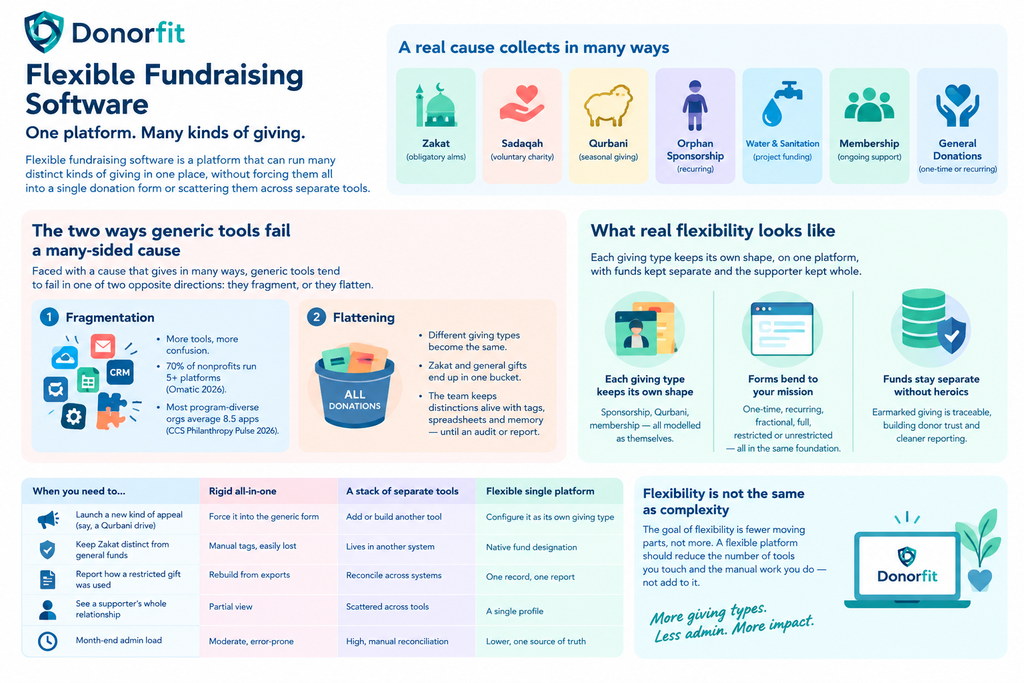
An Islamic-relief organisation makes the point vividly. In a single year it may collect Zakat, the obligatory annual alms that must reach eligible recipients and be kept separate from other funds; Sadaqah, voluntary charity given freely; Qurbani, share-based giving concentrated around Eid al-Adha; orphan sponsorship, a recurring commitment tied to a specific child; water and sanitation project funding; ordinary memberships; and a general donation stream. Seven different shapes of generosity, each with its own logic. A tool that treats them all as “a donation” is quietly asking the organisation to do the sorting by hand.
The two ways generic tools fail a many-sided cause
Faced with a cause that gives in many ways, generic tools tend to fail in one of two opposite directions: they fragment, or they flatten. Both are expensive, and most organisations end up paying one bill or the other.
Fragmentation is the more visible cost. When each new kind of appeal needs its own tool, the stack grows quietly until no one can see the whole picture. The Omatic 2026 Nonprofit Technology Ecosystem Trends Report, which surveyed more than 800 nonprofit professionals, found that 70 per cent of nonprofits now run five or more core platforms, up from 62 per cent a year earlier, and that the most program-diverse organisations average around 8.5 core applications. The CCS Philanthropy Pulse 2026 report, drawing on more than 600 nonprofits, found roughly a third naming data and CRM issues as a top challenge, about double the share the year before. These are general figures about tech-stack sprawl rather than a measure of fundraising flexibility specifically, but the pattern behind them is exactly the one a many-sided cause lives: more tools, less agreement between them, and a small team spending its evenings reconciling exports.
Flattening is the quieter cost, and often the one people do not notice until reporting season. A rigid all-in-one tool avoids the sprawl by insisting that everything is the same thing. Zakat and a general gift land in the same bucket. A Qurbani share becomes a line item indistinguishable from a membership fee. The team keeps the distinctions alive with tags, colour-coded spreadsheets, and memory, which works until an audit, a funder report, or a departure exposes how much of the structure was living in one person’s head.
What real flexibility looks like
Flexibility done properly means each kind of giving is modelled as itself, on one platform, with the funds kept cleanly separate and the supporter kept whole. It is not a longer feature list. It is a small number of things working together.
Each giving type keeps its own shape. A sponsorship behaves like a sponsorship, with a child at the other end and a recurring commitment. A Qurbani campaign behaves like a seasonal, share-based drive. A membership behaves like a membership. None of them is bent into a shape it does not have.
The forms bend so the mission does not. When a new appeal appears, and in this sector they appear on the calendar of the moon as much as the calendar of the fiscal year, a flexible platform lets you build the ask around the cause rather than around the software’s assumptions. One-time and recurring, fractional and full, restricted and unrestricted, all sit on the same foundation.
And the funds stay separate without heroics. This is where flexibility meets trust. Earmarked giving carries a promise: a gift given for water is used for water, a Zakat contribution stays within its purpose. Keeping that promise traceable is partly a matter of donor confidence and partly a matter of clean reporting, and it is far easier when the separation is native to the system than when it is reconstructed each quarter from a spreadsheet.
| When you need to… | Rigid all-in-one | A stack of separate tools | Flexible single platform |
| Launch a new kind of appeal (say, a Qurbani drive) | Force it into the generic form | Add or build another tool | Configure it as its own giving type |
| Keep Zakat distinct from general funds | Manual tags, easily lost | Lives in another system | Native fund designation |
| Report how a restricted gift was used | Rebuild from exports | Reconcile across systems | One record, one report |
| See a supporter’s whole relationship | Partial view | Scattered across tools | A single profile |
| Month-end admin load | Moderate, error-prone | High, manual reconciliation | Lower, one source of truth |
Flexibility is not the same as complexity
The fear that a more flexible system means a more complicated one is reasonable, and it is worth answering directly: the goal of flexibility is fewer moving parts, not more. A platform that models many giving types natively should reduce the number of tools you touch and the amount of manual reconciliation you do, not add to it. If a “flexible” system leaves your team managing more complexity than the sprawl it replaced, it has missed the point. The test is not how many things the software can do. It is whether your Tuesday is simpler than it was.
A short note on the fiscal side, since it sits close to all of this. Keeping restricted and purpose-bound gifts traceable supports both trust and reporting, but recordkeeping convenience is not the same thing as meeting your legal and fiscal obligations. Treat this article as general information rather than tax or legal advice, and confirm your specific duties around restricted funds and gemeinnützigkeit with a qualified adviser.
Frequently asked questions
What is fundraising flexibility in nonprofit software? It is the ability of one platform to run many different kinds of giving, one-time and recurring, restricted and unrestricted, seasonal, sponsorship, and membership, without forcing them into a single donation type or splitting them across separate tools. It is measured less by feature count and more by whether your real programs fit the system without bending.
Why do charities end up with so many separate tools? Usually because each new kind of appeal was solved on its own, one tool at a time. General sector research points to significant tech-stack growth, with the Omatic 2026 report finding 70 percent of nonprofits running five or more core platforms. Each addition solves one problem and adds a little fragmentation.
Can a single platform really handle Zakat, Sadaqah, Qurbani, and sponsorship together? It can when those are modelled as distinct giving types with their own fund designations, rather than recorded as identical donations and separated afterwards by hand. The difference shows up not in the demo but in the quarter-end report.
What are restricted funds, and why do they matter here? Restricted or purpose-bound gifts are donations a supporter intends for a specific use. Keeping them traceable to that purpose matters for donor trust and for clean reporting. Flexible software helps by keeping the separation native rather than manual, though it does not replace your own compliance obligations.
Does more flexibility mean more complexity for a small team? It should mean the opposite. The purpose of running many giving types on one platform is to shrink the number of tools and the manual reconciliation a small team carries, not to enlarge it.
The part worth keeping
Every organisation eventually has a quiet conversation about what it can and cannot take on, and more often than anyone admits, the real limit is not the mission or the money. It is the software, deciding by omission what kinds of generosity are easy to accept and what kinds are too much trouble. A cause should be free to ask in every way its supporters want to give. The tools underneath it should make that freedom cheap to exercise, not something paid for in evenings and spreadsheets.
If your organisation runs several kinds of giving across the DACH region, Donorfit is built to hold them on one platform, Zakat and Sadaqah kept separate, Qurbani and water campaigns, orphan sponsorship, and membership each modelled as itself, with customisable forms and one-time, recurring, fractional, or full funding. It exists to keep the range of your fundraising from becoming a burden on the few people running it.
This article is general information, not tax, legal, or fiscal advice. Rules on restricted funds and charitable status differ by country and situation. Confirm your organisation’s specific obligations with a qualified adviser.