
What Is Orphan Management Software?
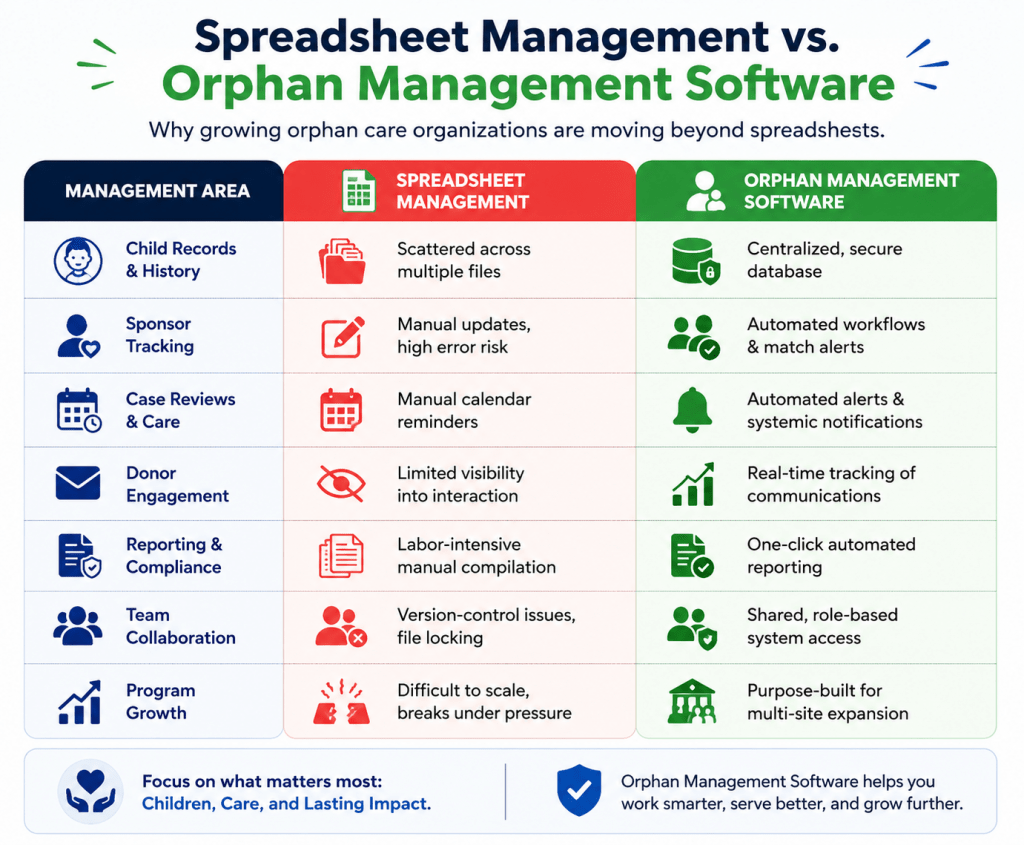
Orphan management software is a centralised platform designed specifically to help orphan care organisations manage child records, sponsor relationships, donor communications, case reviews, care milestones, and compliance reporting from a single system.
Unlike generic spreadsheets, specialised orphan management software automates reminders, tracks supporter engagement, centralises health/educational histories, and provides real-time visibility into both child welfare and donor activity. This allows nonprofit teams to spend less time managing fragmented data and more time supporting children and strengthening sponsor relationships.
Many orphan care organisations start tracking data with spreadsheets because they are accessible, free, and familiar. However, as programs grow, manual data entry and disconnected tracking methods create hidden operational vulnerabilities that directly impact efficiency, donor retention, and service delivery.
Why Do Many Orphan Care Organizations Still Use Spreadsheets?
Spreadsheets are typically the first tool organisations adopt when tracking children, sponsors, and donations. They require zero onboarding and are easy to set up over a single afternoon.
The challenge is that spreadsheets were designed to store static information—not to manage complex human workflows, ongoing relationships, and multi-layered care programs. As the number of children, international sponsors, and staff members increases, manual tracking quickly becomes difficult to maintain, leading to critical data silos.
Where the Hidden Cost Actually Lives
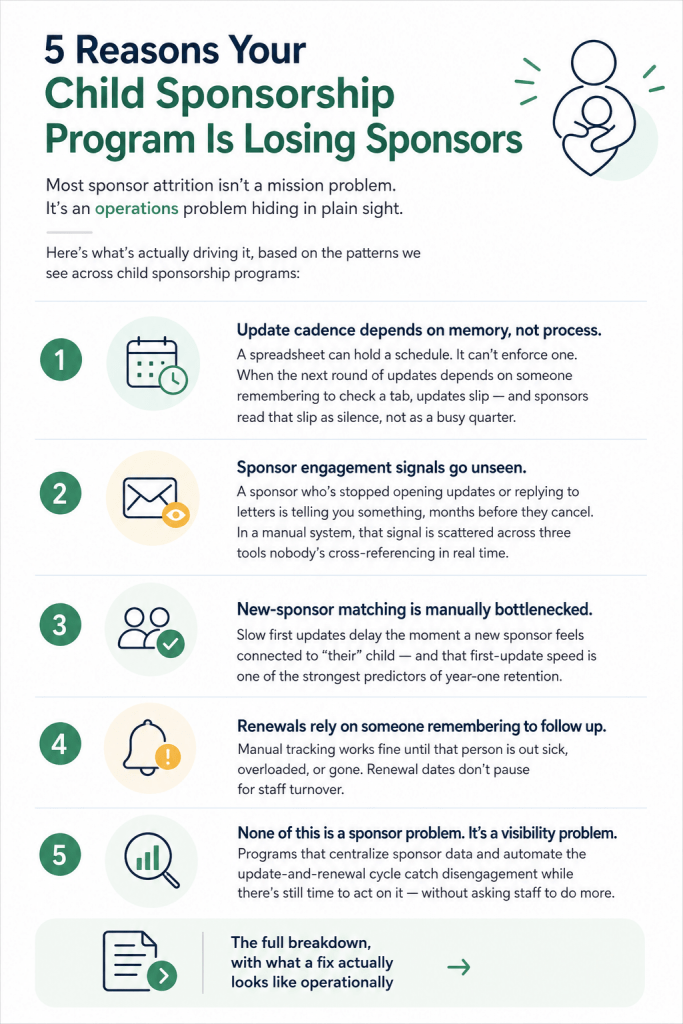
Care Milestones Depend on Memory Instead of Process
A spreadsheet can record medical appointments, school enrollment dates, case reviews, and sponsor update schedules. However, it cannot automatically prompt a caseworker when an action is required.
When milestone tracking depends on staff remembering to manually review rows of data, important activities can be delayed. For children, this may mean missed medical checkups or postponed educational interventions. For sponsors, it results in long, silent periods without meaningful progress updates.
Donor and Sponsor Engagement Signals Go Unnoticed
Sponsor retention depends heavily on consistent, emotionally resonant communication.
A sponsor who stops opening emails, engaging with updates, or responding to communications often provides early warning signs of disengagement. In spreadsheet-based systems, engagement data is typically spread across multiple unlinked platforms (like email marketing software, bank statements, and Excel), making it nearly impossible to identify these warning signs before a sponsorship is lost entirely.
???? The Retention Reality: Industry-wide, nonprofit donor retention remains a severe challenge, with many organizations retaining fewer than half of their donors year over year. Organizations that identify supporter disengagement early are positioned to step in and save long-term funding relationships.
Child-to-Sponsor Matching Barrows Down into a Manual Process
Spreadsheets cannot intelligently cross-reference data. They do not automatically identify:
- Children waiting for sponsorship matching
- Sponsors ready for a new or additional match
- Overdue case reviews or expiring documentation
- Inactive or lapsed sponsorship relationships
As programs expand, staff spend more time searching through files for information and less time building meaningful, high-touch experiences for sponsors.
Renewals and Reviews Depend on Individual Staff Members
When renewal reminders and case review schedules live inside disconnected spreadsheets, successful execution relies on specific staff members remembering to follow up. Staff absences, turnover, or increasing workloads immediately create gaps in critical operations that directly affect both vulnerable children and institutional donors.
Data Errors Reduce Supporter Trust
Common spreadsheet challenges include duplicate records, incorrect donor information, outdated child profiles, and inconsistent reporting. Because orphan care programs rely heavily on transparency and strict data accountability, even small, human administrative errors can deeply impact sponsor confidence and organisational credibility.
Growth Multiplies Administrative Work
Every new child, sponsor, donation, and case review adds another layer of manual labour. Rather than becoming more efficient as they scale, spreadsheet-reliant systems force organisations to dedicate an increasing amount of staff time to administrative maintenance, directly capping their capacity for mission-focused fieldwork.
What This Costs in Real Terms
In the nonprofit sector, retention is significantly more cost-effective than donor acquisition. When sponsors receive timely updates, understand the concrete impact of their giving, and remain digitally engaged with a child’s journey, organisations maintain long-term funding stability.
Conversely, operational friction—such as missed updates, delayed onboarding, fragmented communication, and inconsistent reporting—is a primary driver of preventable donor attrition. For orphan care organisations, these losses impact more than just fundraising metrics; they directly threaten sponsorship continuity, program stability, and the baseline resources available to support children in need.
⚠️ Real-World Risk Scenario: The Cost of a Missed Row
Consider an orphan care organisation supporting 300 children and managing hundreds of international sponsors. Child health histories are maintained in Excel, donor communications are stored in standard email inboxes, and case reviews are tracked separately.
A critical milestone update is accidentally missed because a row was overlooked in a spreadsheet. The sponsor receives no communication for several months, feels disconnected from the mission, and eventually stops their recurring donation.
The organisation now faces the immediate loss of sponsorship revenue, the high cost of acquiring a replacement donor, and reduced funding continuity for the specific child being supported—all due to an invisible software limitation.
How Orphan Management Software Solves These Challenges
Dedicated platforms replace memory-dependent tasks with automated infrastructure, providing:
- Centralised Records: A single source of truth for both child welfare data and donor records.
- Automated Milestone Tracking: Systemic alerts for healthcare checkpoints and case management goals.
- Scheduled Communications: Automated triggers that ensure sponsors receive timely updates, photos, and letters.
- Donor Health Analytics: Real-time monitoring to flag disengaged donors before they churn.
Key Takeaways
- Spreadsheets are effective for basic data storage but fundamentally limited for managing complex child welfare programs.
- Missed or delayed sponsor communications are a primary, preventable cause of donor attrition.
- Manual case management increases staff burnout and administrative overhead.
- Purpose-built orphan management software centralises information, automates compliance workflows, and builds a sustainable foundation for organisational growth.
Frequently Asked Questions
Why do orphan care organisations move away from spreadsheets?
As programs scale, spreadsheets become too complex to maintain, create security risks around sensitive data, and provide no real-time visibility into donor engagement or case reviews.
How does orphan management software improve sponsor retention?
It ensures that communication never slips through the cracks by automating sponsor updates, tracking engagement signals, and maintaining accurate records that foster donor trust.
What features should orphan management software include?
Organisations should look for a platform that offers secure child record management, sponsor relationship tracking (CRM), automated case management workflows, milestone tracking, secure donation processing, and built-in communication tools.
Is orphan management software suitable for smaller, growing organisations?
Yes. Adopting a centralised system early prevents the painful data migration process later and establishes structured workflows that allow small teams to scale without adding administrative staff.
Supporting Better Outcomes for Children and Sponsors
The operational challenges nonprofits face are rarely due to a lack of commitment from staff. More often, they are the natural limitation of software tools that were never designed to handle complex human sponsorship and child welfare programs.
By replacing manual spreadsheets with specialised platforms like Donorfit, organisations can eliminate administrative bottlenecks, protect sensitive records, and strengthen sponsor relationships. Donorfit is purposely built to manage child records, sponsor communication histories, and case reviews from a single dashboard—giving your team the clarity they need to focus on what matters most: creating a brighter future for the children in your care.