



Fractional and Shared Sponsorship: How to Widen Your Donor Base Without Diluting the Bond
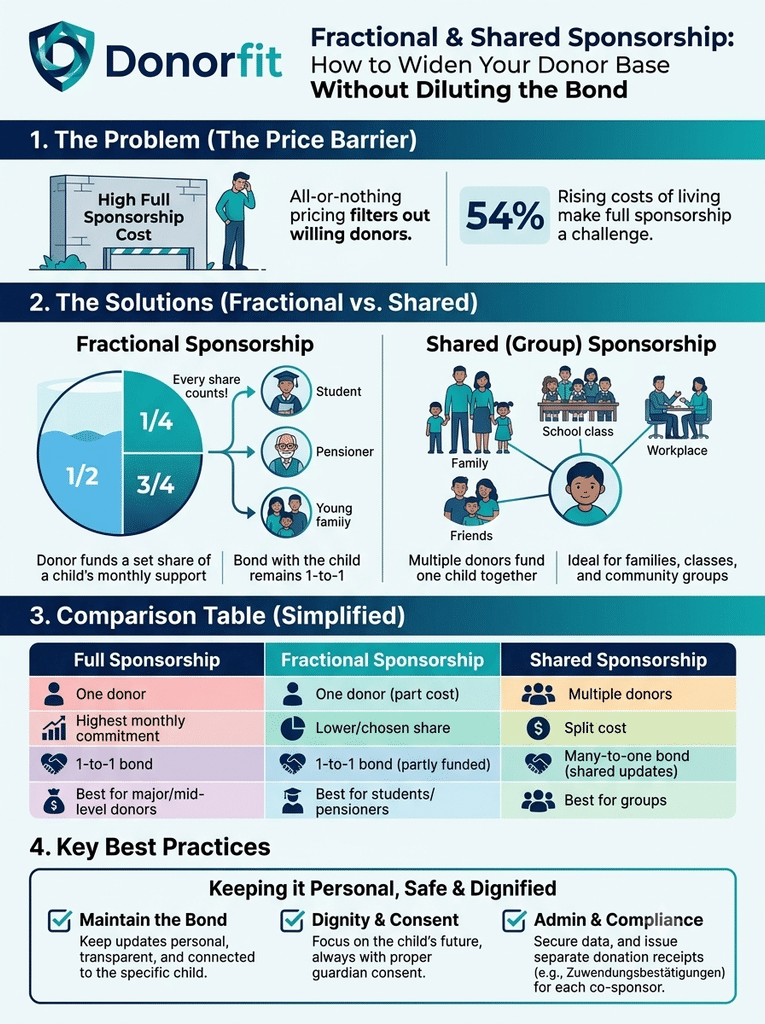
Fractional sponsorship lets a donor fund part of one child’s monthly support, while shared sponsorship lets several donors (a family, a class, a group of friends) fund one child together. Both sit alongside traditional full sponsorship. Together they turn a single price tag into an open door.
Picture someone on your sponsorship page right now. She’s read the child’s story. She’s already decided she wants to help. Then she sees the monthly amount, does the quiet maths of rent and groceries, and closes the tab.
You never learn her name. She never shows up in a report. But she was yours, and the price point sent her away.
This guide is for charities running orphan or child sponsorship programmes, especially in Germany, Austria and Switzerland. It walks through why all-or-nothing pricing shrinks your programme, how fractional and shared models work in practice, and how you keep the relationship personal when more than one person stands behind a child.
Why all-or-nothing sponsorship quietly shrinks your programme
A single fixed sponsorship price works as a filter, and it filters out donors who want to give but can’t commit the full amount.
Full sponsorship carries real costs, and those costs keep climbing. Tearfund New Zealand, for example, raised its monthly rate from $56 to $62, effective 1 October 2026 for most supporters, and explained that food, schooling and medical care simply cost more than they did five years ago (Tearfund NZ).
Every increase like that is honest. It is also another rung added to the ladder a new donor has to climb. A student, a pensioner, a young family, a worker sending money home: each of them might give something steady every month. Fewer of them can give everything.
So your programme ends up drawing from a narrower and narrower pool. You don’t feel it as a loss. You feel it as slow growth, a waiting list of children that never quite shortens.
What the data does and doesn’t tell us
We looked for a published benchmark on how many donors abandon sponsorship sign-up because of the monthly amount. We couldn’t find one from a named primary source, so we won’t put a number on it here. If you track page visits and completed sign-ups on your own sponsorship pages, your analytics will tell you more than any industry average could.
What we can say is that sponsorship prices vary widely between organisations. World Vision Ireland, for instance, asks €27 a month (World Vision Ireland), while orphan sponsorship that covers a child’s full living costs often runs considerably higher. The higher your true cost, the more your price point matters.
How fractional sponsorship works
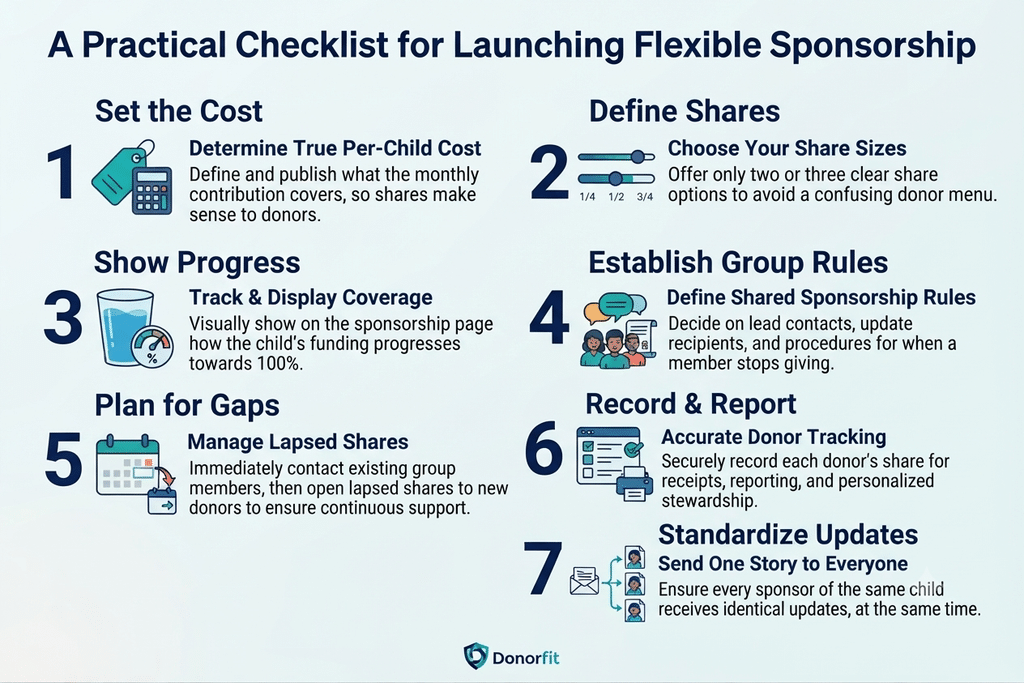
With fractional sponsorship, a donor commits a set share of one child’s monthly cost, and the charity tracks how much of that child’s need is covered until it reaches 100%.
Instead of one button that says “Sponsor for €60 a month,” you offer a few doorways:
- Full sponsorship of one child
- A half or a quarter share of one child
- A fixed amount that counts toward a named child’s support
The child’s funding fills up like a glass of water. When it’s full, the child is fully sponsored. Until then, every share counts and every donor knows exactly which child they’re helping.
That last part matters. Your donor isn’t funding “the programme” in the abstract. She’s funding Amina’s schooling, Yusuf’s meals, a specific child with a name and a story. The bond stays intact. Only the price of entry changes.
How shared (group) sponsorship works
Shared sponsorship brings several people together behind one child, with each person’s contribution recorded and each receiving updates on the same child.
This is where sponsorship becomes something a community does together. A family splits it across three generations. A school class collects it as a project. Colleagues pool a little from every payslip. Friends from a mosque or a sports club take it on as a shared promise.
For many donors, giving together feels warmer than giving alone. The grandmother tells the grandchildren how the child they sponsor is doing at school. The class gets a letter and reads it aloud. The sponsorship stops being a line on a bank statement and becomes a story people share around a table.
For organisations working in the Islamic tradition of orphan care (kafala), shared sponsorship often feels natural, because caring for the orphan has always been a community responsibility as much as a personal one.
Full, fractional and shared sponsorship compared
| Full sponsorship | Fractional sponsorship | Shared (group) sponsorship | |
| Who gives | One donor | One donor, part of the cost | Several donors, one child |
| Monthly commitment | Highest | Lower, chosen share | Split between the group |
| Bond with the child | One-to-one | One-to-one, child partly funded by others | Many-to-one, shared updates |
| Best for | Committed major and mid-level donors | Students, pensioners, first-time givers | Families, classes, workplaces, community groups |
| What the charity must track | One payment, one child | Coverage % per child | Each member’s share, one child record |
Will splitting sponsorship dilute the bond?
Not if every donor stays connected to one named child and receives real updates about that child. The bond comes from the connection, not from the size of the cheque.
There’s a common worry about donor trust here, and it’s worth taking seriously. A survey by Grey Matter Research and Opinions 4 Good, reported by Christianity Today, found that 74% of donors believed sponsorship didn’t really help one specific child (Christianity Today, December 2017). That figure is US-based and now several years old, so treat it as a signal rather than a benchmark. But the signal is clear: donors care deeply about whether their gift reaches a real child.
Fractional and shared models only work if you answer that question honestly. Tell each donor what their share covers. Tell them who else is helping. Send the same progress reports to everyone behind the child. Transparency is the thread that holds a shared sponsorship together.
Keeping it dignified and safe
More sponsors behind a child means more people seeing that child’s photos, school reports and updates. That deserves care.
Share only what each sponsor needs. Use consent from the child’s guardian for images and personal details, and keep it on record. Write about children as people with futures, not as objects of pity. A child is never “owned” by a sponsor, however many shares are taken.
This is general information, not tax or legal advice. Children’s personal data needs particular care under GDPR, so involve your data protection officer when you design shared updates. If you issue donation receipts (Zuwendungsbestätigungen) in Germany, each co-sponsor normally receives a receipt for their own share, so your system needs to record who paid what. Confirm the details with your tax advisor.
FAQ
What is fractional sponsorship?
Fractional sponsorship lets a donor fund part of one specific child’s monthly support, such as a half or a quarter share. The charity combines shares until the child’s full cost is covered.
What is shared or group sponsorship?
Shared sponsorship is when several people, such as a family, a school class or a group of colleagues, sponsor one child together. Each contributes part of the cost, and all receive updates on the same child.
Does fractional sponsorship weaken the donor’s connection to the child?
Not when each donor stays linked to one named child and gets regular, honest updates. The connection depends on transparency and communication, not on paying the full amount alone.
What happens if one member of a shared sponsorship stops giving?
Good practice is to tell the remaining sponsors, invite them to cover the gap, and offer the open share to new donors, so the child’s support continues without interruption.
Can a donor move from a fractional share to full sponsorship later?
Yes, and many will. A fractional share is often the first step. Make upgrading easy and invite it gently when a donor has been giving steadily.
Do co-sponsors each get a donation receipt in Germany?
Generally, each donor receives a receipt for the amount they personally gave. Your system needs to track each person’s share. This is general information; confirm with your tax advisor.
Donorfit’s Sponsorship module supports full, fractional and shared sponsorship out of the box. It tracks coverage per child, records each sponsor’s share for receipts, and sends every sponsor the same updates. If you’d like to open your programme to more donors, [see how flexible funding works]