Donor retention is the rate at which a nonprofit keeps its existing donors giving again, and for water and WASH (water, sanitation, and hygiene) charities, that rate breaks down in a very specific, very avoidable place: the silence between the moment someone funds a well and the moment that well goes live.
A donor who funds a well doesn’t see a well. They see a receipt. Then, for weeks or months, they see nothing — no update, no photo, no confirmation that their name is still attached to a project moving forward underground, out of view, in a place they’ll likely never visit. By the time the well is complete, the emotional thread connecting that donor to that outcome has often gone cold. They don’t churn because they stopped caring. They churn because the organisation lost the thread first.
The Structural Problem Unique to WASH Fundraising
Most fundraising verticals have a tighter feedback loop. A child sponsorship donor gets a letter. A membership donor renews on a calendar. A disaster relief donor sees news coverage in real time. Water and WASH fundraising is different: the gap between the gift and the proof of impact is often the longest of any giving category, spanning drilling timelines, community engagement phases, and infrastructure builds that can run three to twelve months.
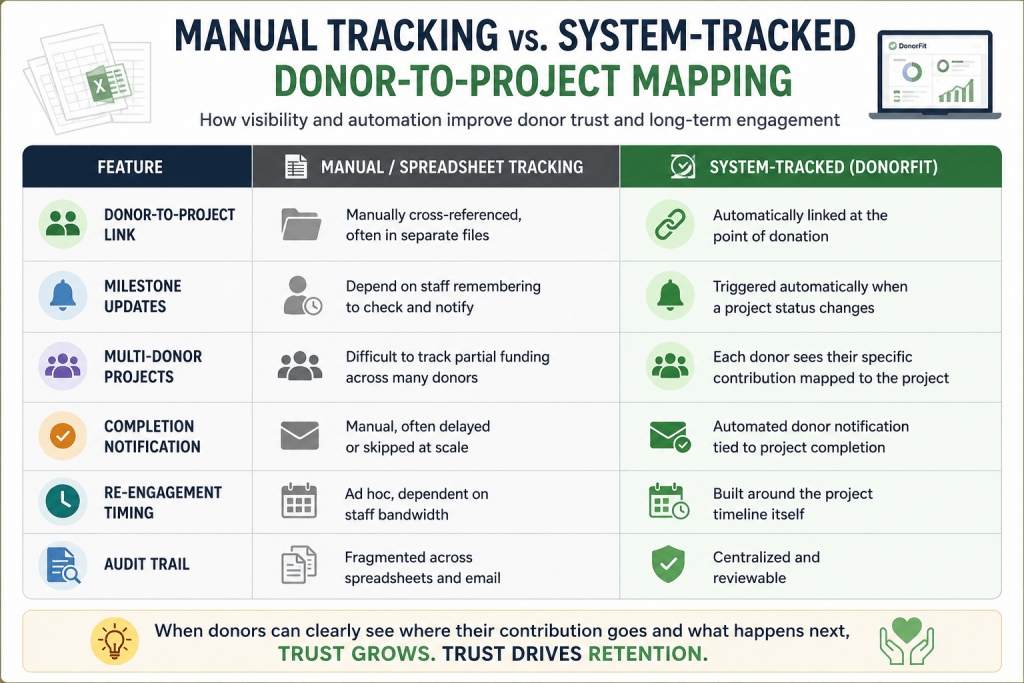
That gap isn’t the problem by itself. Donors understand that clean water infrastructure takes time. The problem is what fills the gap — or doesn’t. In a manual, spreadsheet-based tracking system, there’s no built-in trigger to tell a staff member, “Project #214 just moved to phase two, notify the 40 donors linked to it.” Someone has to remember to check. Someone has to manually cross-reference which donor funded which project. At scale, across dozens or hundreds of concurrent projects, that manual reconciliation quietly stops happening — and the silence a donor experiences isn’t a strategic choice, it’s an operational gap nobody assigned ownership of.
Why This Matters More Than General Retention Stats Suggest
Sector-wide, average donor retention sits at roughly 31.9%, according to a 2026 fundraising analysis from Candid drawing on Giving USA data — meaning charitable giving overall reached $592.5 billion in the U.S. in 2024, but the organisations capturing that growth are the ones investing in relationship depth, not just acquisition. That’s a general nonprofit-sector figure, not a WASH-specific one — a sector-specific benchmark for water charities wasn’t available in the sources reviewed for this piece, so treat it as a directional baseline rather than a category-exact number.
What makes WASH fundraising a heightened case isn’t a worse retention rate than other categories — it’s a longer, more silence-prone gap between gift and proof, which is exactly the condition under which general retention erosion tends to accelerate. The mechanism is the same one driving retention loss sector-wide; WASH campaigns just have more time and more operational hand-offs for that mechanism to act on.
What the Gap Actually Costs
A monthly or repeat WASH donor isn’t just a single gift — they’re a lower cost-per-dollar-raised over time, since acquiring a new donor is consistently more expensive than retaining an existing one. Every donor who churns silently between a well’s funding and completion isn’t just a lost gift; it’s a lost opportunity to convert a one-time gift into a recurring relationship, because the strongest moment to make that ask — the moment the water starts flowing — never reaches them with their name attached to it.
Manual Tracking vs. System-Tracked Donor-to-Project Mapping
Closing the Gap: What System-Level Tracking Changes
The fix isn’t more communication effort from already-stretched staff — it’s removing the dependency on staff memory in the first place. When a donor’s gift is linked to a specific project at the point of donation, every subsequent status change can trigger an update automatically: drilling started, community training complete, well operational. The donor experiences a story unfolding in real time instead of silence, followed by a surprise thank-you email months later.
This is also where transparency and technology reliability — the two pillars WASH donors care about most, given how physically distant the impact usually is from the giver — reinforce each other. A donor who can see their specific project move through defined stages doesn’t need to take the organisation’s word for progress. The system shows it.
FAQ
Why do water charity donors churn more than other categories? It’s not that WASH donors are inherently less loyal — it’s that the funding-to-impact timeline is longer and more operationally complex than most other giving categories, creating more points where manual tracking can lose the thread between a donor and their specific project.
What’s a realistic retention benchmark for a water/WASH nonprofit? There isn’t a widely published WASH-specific retention benchmark. The general nonprofit sector average is around 31.9%, per Candid’s 2026 analysis of Giving USA data. Organisations should treat that as a directional baseline, not a category-exact target, until sector-specific data is available.
Does donor-to-project tracking work for organisations funding many small projects at once? Yes — this is precisely the scenario where automated tracking outperforms spreadsheets most, since the volume of concurrent projects is what makes manual cross-referencing break down at scale.